

Go Back
News
YCYW Educational Insights
The World Is Putting Mother Tongue Back. One Kind of School Never Took It Out.
YCYW Educational Insights
15 Jun, 2026
17 : 20
Core message
A bilingual education does not have to cost a child their first language or their cultural footing. The world's most internationalised systems are now putting mother tongue back at the centre of school, and a school built on Sino-Western Fusion Education holds English and Chinese as a single foundation rather than a trade-off.
- Why "more English means less Chinese" is the wrong way to think about a bilingual education
- The global policy wave putting mother tongue and cultural identity back at the centre of school
- How additive bilingualism (加法式雙語) actually works, and what it asks of a school
- What Co-Teaching (中外籍雙教師合作教學) looks like in a YCYW classroom, and why the model predates the trend
From Bangkok to Delhi to Beijing, governments and parents are deciding that a global education should not cost a child their first language or their cultural footing. For families weighing an international or bilingual route, that shift answers a worry many have carried quietly for years.
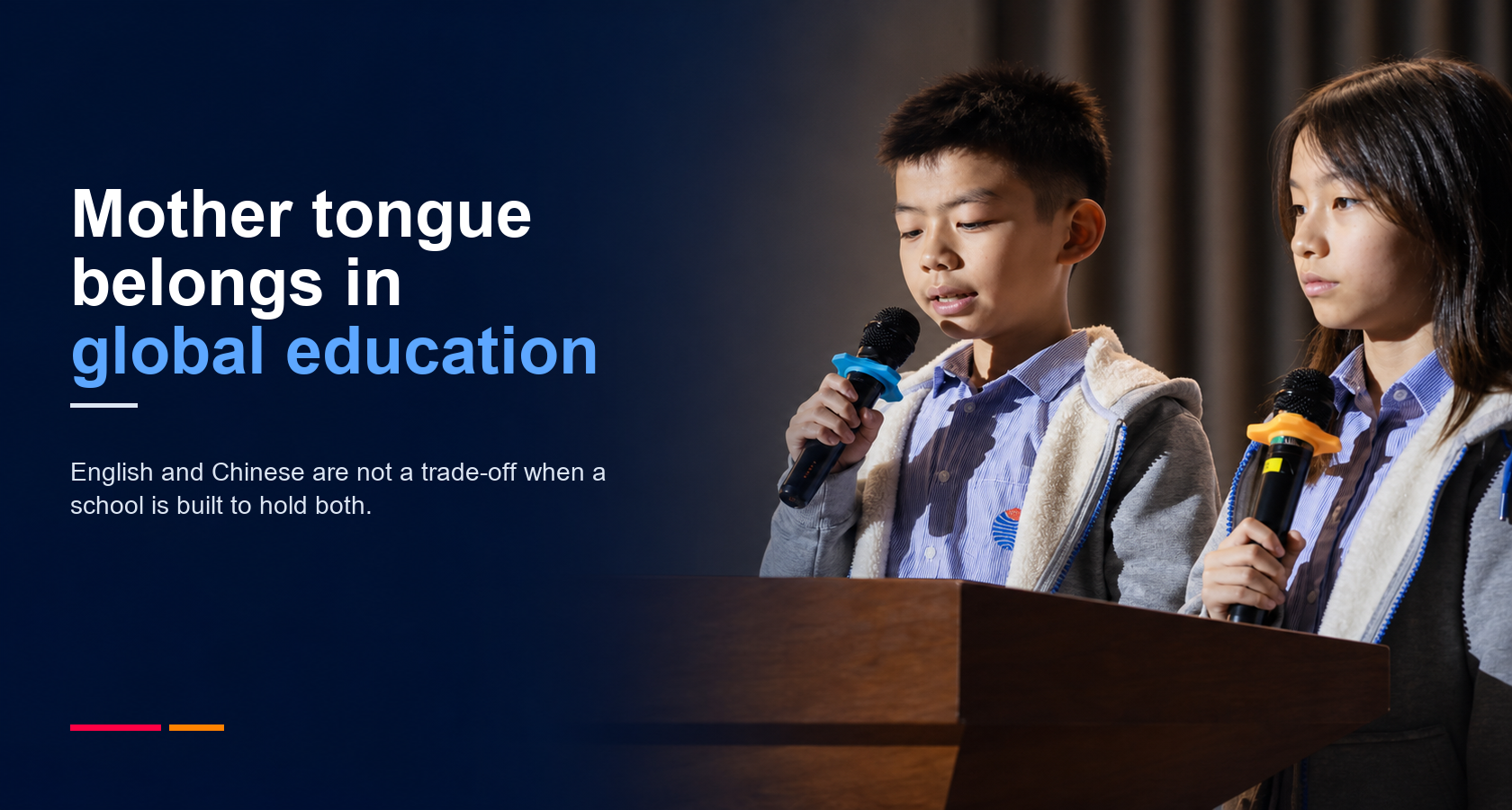
On a Friday evening last November, the auditorium at YCIS Chongqing filled with children reciting poetry. Some pieces were classics, some were their own. The students moved between English and Chinese without anyone treating the switch as remarkable. A child stood on stage and was fluent in two languages at once, rather than caught between them.
That image is worth holding onto, because it answers a question many parents ask only in private.
The worry most parents don't say out loud
If you have chosen, or are considering, an international or bilingual school, you have probably felt some version of this concern. My child will gain English and a path to universities abroad. Will they lose their Chinese along the way? Will their sense of cultural identity blur until they belong everywhere and nowhere?
It is a fair worry, and it rests on an assumption that feels like common sense: that a child has a fixed budget of attention, and every hour spent on English is an hour taken from Chinese. On that logic, internationalisation is a trade. You buy global mobility by spending down cultural roots.
That assumption is now being questioned in the most internationalised education systems in the world. The question is not coming from people who are sceptical of global education. It is coming from the governments and schools building it.
The worry is not yours alone
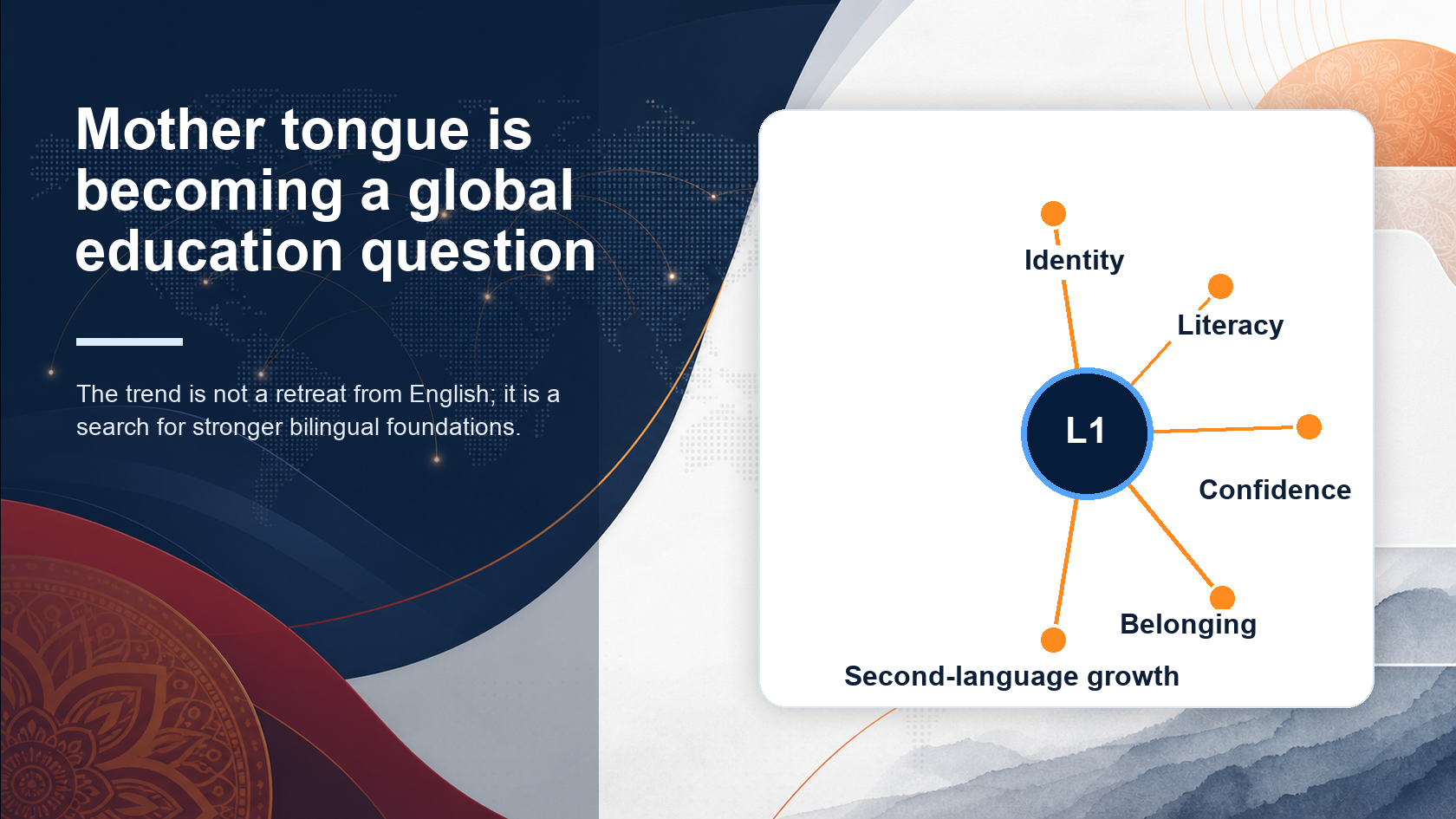
Over the past year, a clear pattern has formed across very different countries.
In June 2026, Thailand announced a curriculum reform that puts Thai language, history, and civic education back at the centre of schooling, and explicitly asks international schools to strengthen mother-tongue and cultural support for Thai students. Officials were direct about the reasoning: international curricula can stay, but Thai children should not lose their first language on the way to an English-medium education.
India is moving the same direction at scale. Its CBSE board is rolling out a three-language requirement, and the National Curriculum Framework now calls for the child's home language to be the primary medium of instruction in the early years. UNESCO devoted its 2025 International Mother Language Day report to the same argument, urging systems worldwide to teach children in a language they actually understand. Vietnam's 2025 decree on foreign-language teaching tries to expand English while protecting the national-language framework. South Korea has begun sending Korean-language teachers and cultural-education staff into foreign schools.
China sits inside this pattern rather than outside it. Bilingual and international schools here already teach the national curriculum alongside Chinese language and cultural identity through the primary and lower-secondary years. The industry even has a name for it, the "Chinese Thread" that runs through a bilingual programme. Read against the headlines from Bangkok and Delhi, what Chinese families have been asking for is not a local quirk. It is the same instinct now reshaping policy in several countries at once.
There is something steadying in that for a parent. The thing you were worried about is something serious systems are now working to protect, which means the instinct behind the worry was sound.
The question was framed the wrong way
Here is where the worry can be put down, because the trade-off it assumes does not actually hold.
Language research has a name for the alternative: additive bilingualism (加法式雙語). A strong first language is not a cost subtracted from the second; it is the foundation the second is built on. Children who keep developing their mother tongue tend to acquire a second language more securely, and they hold a steadier sense of who they are while doing it. A second culture tends to anchor identity rather than blur it, as long as the first culture is given real weight.
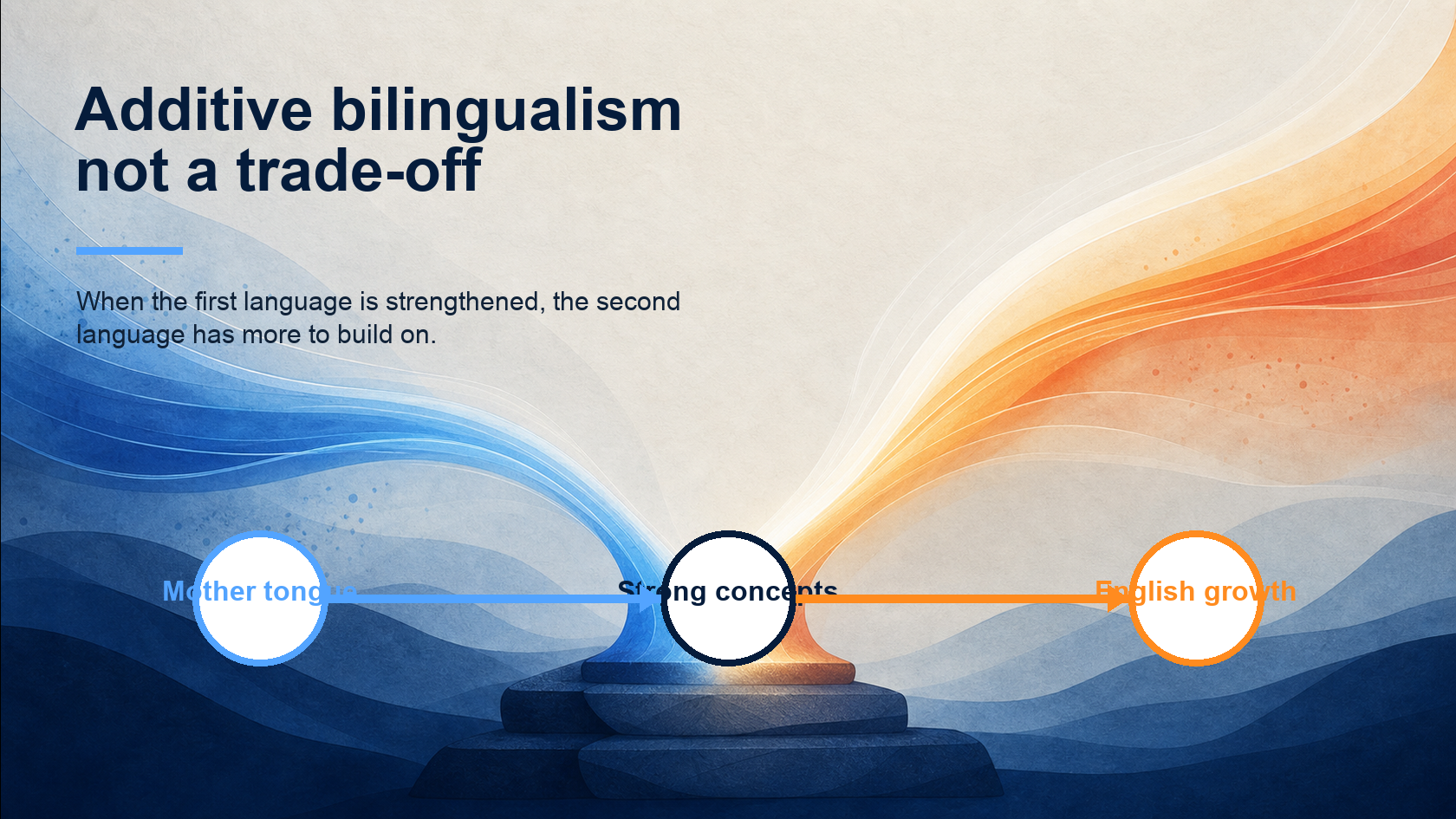
So the real question is not whether to choose English or Chinese. It is whether a school is designed so the two reinforce each other, or designed so one quietly crowds out the other. Many schools that call themselves bilingual are really English-medium schools with a Chinese class added on. The mother tongue is treated as a subject rather than built into the structure of the day, and that design produces exactly the erosion parents fear.
A school built the other way looks different from the inside.
What a Sino-Western Fusion school actually looks like

At YCYW (Yew Chung Yew Wah), founded in Hong Kong in 1932, the Sino-Western Fusion Education model is not a recent response to a trend. It is the founding logic of the network. That history matters here because it shows in how classrooms are actually run.
The clearest example is Co-Teaching (中外籍雙教師合作教學). In the early-years and primary classrooms, a Chinese co-teacher and a Western co-teacher share the same room and the same authority. A child does not visit two cultures on a timetable; they learn in both at once, every day. Andy Clapperton, Western Co-Principal at YCIS Shanghai Pudong, puts the principle plainly: to be truly international, you cannot rely solely on one system. On those campuses, students from nearly fifty nationalities study a bilingual and bicultural curriculum that sets Chinese classical poetry beside Shakespeare's sonnets, and Chinese historical narratives beside the European Renaissance. Both traditions are treated as core, rather than one hosting the other.
The sequence matters as much as the structure. Children build language and cultural grounding in the early years, then carry that foundation into international qualifications and global university pathways. The results are not abstract. In the 2025 IGCSE cohort at YCIS Hong Kong, six students earned ten A* or A grades each. Several had been at the school since early childhood. One who joined at age two described how the multicultural environment let him explore language and ideas with confidence from the start, and how project-based and inquiry learning in the primary years prepared him for subjects like Global Perspectives later on. The strong outcome came after the grounding, not in place of it.
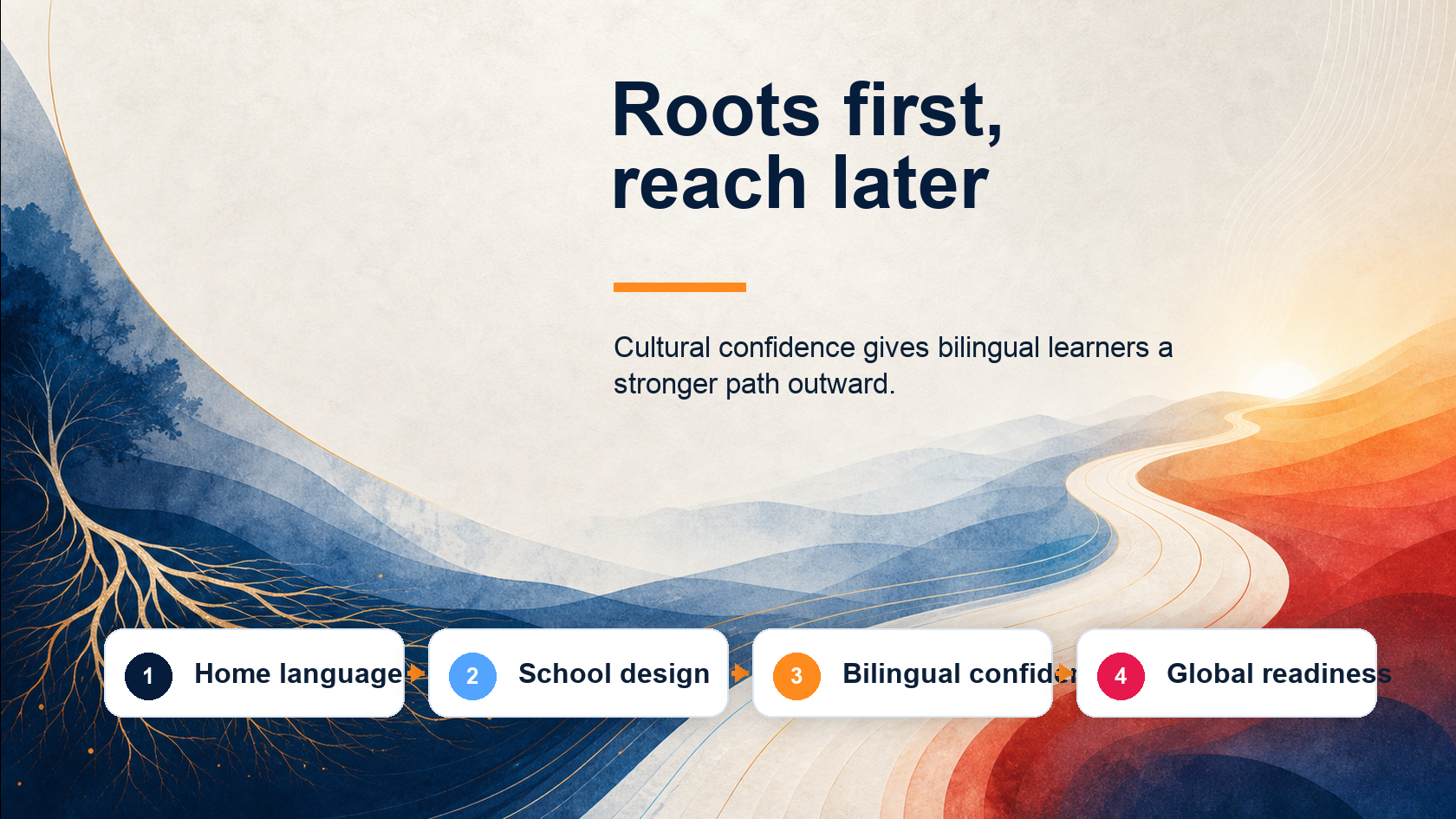
Roots are not only linguistic. They are cultural and moral as well. At a 2025 YCYW parent lecture, Dr Lixin Ren of Xi'an Jiaotong-Liverpool University's Academy of Future Education argued that effective parenting is evidence-based and culturally situated rather than a fixed formula, pointing to approaches like the Chinese "strict yet benevolent" tradition. A school that takes culture seriously treats character and family context as part of the curriculum rather than decoration around it.
What this means for your decision
The worry that started this piece was reasonable. The problem was in the framing, not the feeling. A child does not have to trade Chinese for English, or cultural identity for global opportunity, when the school is genuinely built to hold both.
What the world is now rediscovering through policy, YCYW has been practising for decades. For a family choosing a school, that gap matters, because it is the difference between what a school promises and what it has already done. The clearest evidence is ordinary: a child on the Chongqing stage, at ease in two languages at once.
Sources: This article draws on the Bangkok Post on Thailand's curriculum reform (2026-06-02), CBSE mother-tongue and multilingual guidelines (2025), the UNESCO International Mother Language Day report (2025), Vietnam's Decree on foreign-language teaching (2025), and South Korea's education policies for international and multicultural students (2026). Classroom and outcome details draw on YCYW school publications, including YCIS Hong Kong's 2025 IGCSE results, YCIS Shanghai on its Co-Teaching model, YCIS Chongqing's bilingual poetry contest, and the YCYW Education Lecture Series on scientific parenting.
Frequently asked questions
It depends on the school's design. Where the mother tongue is treated as a foundation rather than a single class, children can develop both languages together. Research on additive bilingualism (加法式雙語) finds that a strong first language supports, rather than competes with, a second. At YCYW, Chinese language and culture run through the curriculum and the classroom, not just one timetabled lesson.
Through Co-Teaching (中外籍雙教師合作教學). In early-years and primary classrooms, a Chinese co-teacher and a Western co-teacher share the room, so children experience two languages and two cultural frames as part of daily learning rather than as separate tracks.
In an English-medium school, the mother tongue is usually one subject among many. In Co-Teaching, two teachers from different linguistic and cultural backgrounds lead together, with equal standing. The difference is structural: the child is in a bilingual, bicultural environment all day, instead of switching into it for one period.
No. Early grounding in language and culture is followed by international qualifications and global university pathways. The 2025 IGCSE results at YCIS Hong Kong, where six students earned ten A* or A grades each, came from students who had that early foundation, which suggests the grounding strengthens later outcomes rather than slowing them.