


Go Back
News
YCYW Educational Insights
When Children Start Filling in University Choices, Is It Too Late to Build AI Competitiveness?
YCYW Educational Insights
10 Jun, 2026
17 : 24
Core message
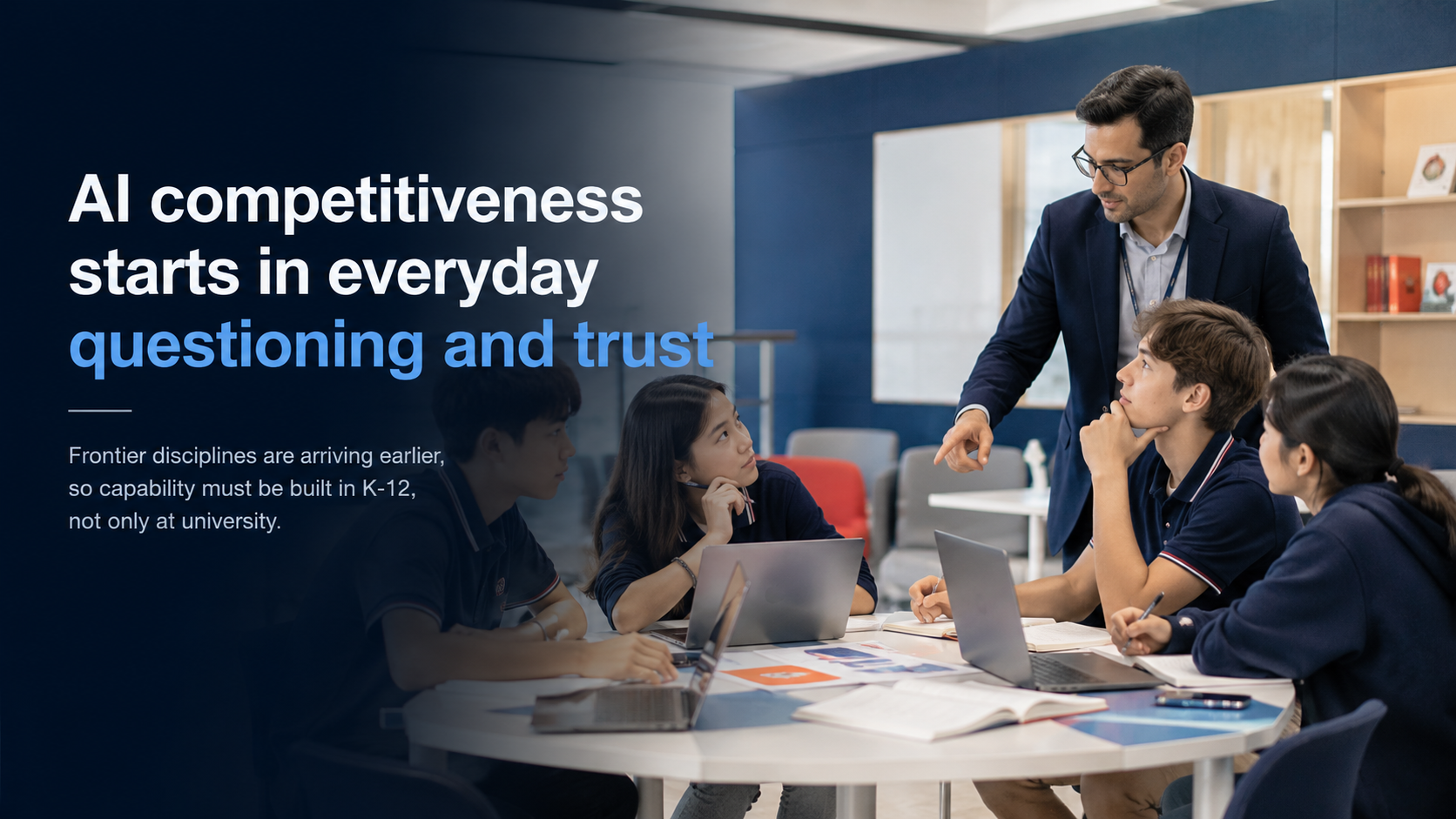
AI competitiveness does not begin when students fill university choices. It grows through K-12 practice: asking clearer questions, improving judgment, connecting disciplines, and acting with responsibility.
- Frontier subjects and policy changes signal earlier capability demands
- AI readiness is not only tool use
- Strong grades matter, but they are not the full preparation
- Schools should build these capabilities in daily learning, not only near admissions
In 2026, frontier fields are no longer confined to university laboratories. China added embodied intelligence, brain-computer science, semiconductors and more to undergraduate catalogues; Cambridge International expanded digital maturity in learning for ages 5-14; the International Baccalaureate discussed how AI changes learning; and major universities in the UK and US are embedding AI skills and ethics into undergraduate education. This is not a signal to force an earlier major choice. It is a signal to prepare children earlier in depth.
What this article covers
- Why China, Cambridge International, the IB, and UK/US universities are sending one common signal
- Why AI competitiveness is not the same as knowing how to use tools
- What core abilities Dr. Huang Zitao raised in the YCYW Educational Lecture Series
- How parents can think about grades, subject pathways and future capabilities together
- How YCYW links future education, interdisciplinary learning and Holistic Education
During China’s 2026 gaokao cycle, around 12.9 million candidates opened university-choice catalogues and saw new names: embodied intelligence, low-altitude economy, brain-computer science and semiconductor science and engineering.
At the same time, families following international pathways saw similar movement. In February 2026, Cambridge International updated its digital literacy curriculum for ages 5-14, saying digital maturity is not only device operation; it also includes judgment, critical thinking and confidence. The IB discussion in 2026 placed AI in learning, thinking and demonstration methods.
The University of Southampton and Northwestern University also moved AI, ethics and human-computer interaction into undergraduate learning. Different systems, same implication: AI-era learning shifts earlier, and capability is cumulative.
Signals move toward earlier capability building

New university subject structures are not isolated policy changes. When frontier subjects enter the entrance layer, schools and families are facing a structural shift, not a cosmetic one.
Parents often react by asking whether children should study coding, robotics or AI tools earlier.
Those skills are useful. But they are not AI competitiveness itself. Embodied intelligence is not only AI. It includes mechanics, perception and body-environment thinking. Brain-computer science is not only biomedical knowledge. It requires engineering, ethics and human boundaries. Low-altitude economy is not only engineering of flight; it includes urban systems, rules, safety and market feasibility.
This points back to capability: connecting knowledge in complex contexts.
The YCYW Educational Lecture Series on June 5, 2026, with Dr. Huang Zitao, emphasised this explicitly. He framed AI-age preparation as long-term practice in human capability.
Dr. Huang Zitao is an Assistant Professor in the Department of Philosophy at the University of Hong Kong, working in political and moral philosophy, AI ethics and technology governance.
In the AI age, the most important thing is not just using tools

Dr. Huang outlined four capability areas: diversity and flexibility, critical questioning, ethical judgment, and relationships and trust.
Diversity and flexibility mean children should not depend on one narrow skill. If they can only complete repetitive tasks, AI becomes a faster substitute. If they can connect mathematics, science, language, social understanding and art expression, they can respond to new contexts with recombined knowledge.
Critical questioning means a child asks whether the question is properly formed, not only whether the answer exists. A strong question separates shallow response from deep learning.
Ethical judgment means separating output from decision. A tool can generate a suggestion; it cannot carry personal consequence. Students need to ask what is assumed, who is ignored and who may be harmed.
Relationships and trust are still hard to replace by tools. AI provides function, but it cannot replace interpersonal trust, communication and responsibility.
Questioning is the first muscle of AI competitiveness
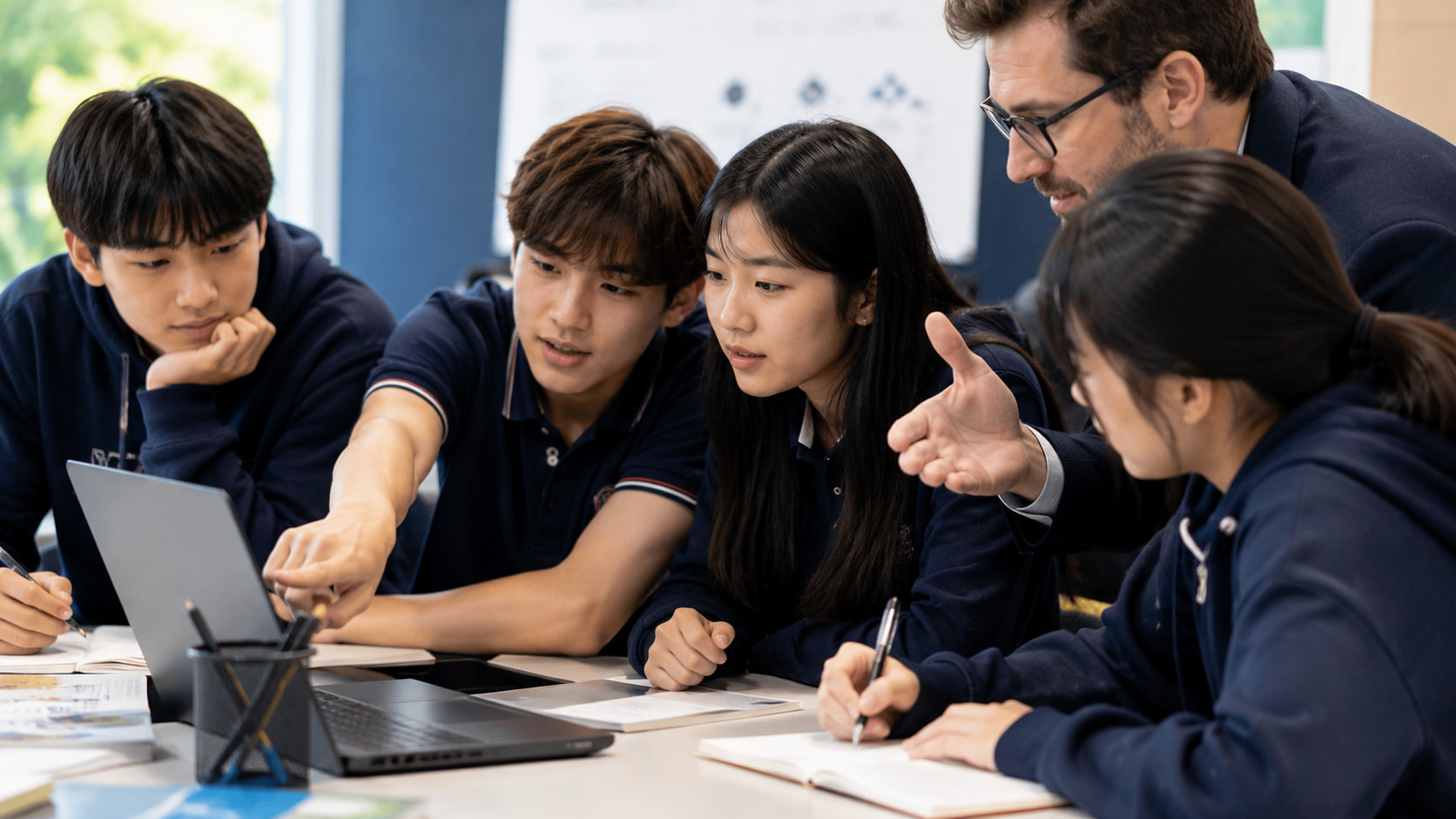
AI can answer quickly, so differences between students increasingly appear in question quality.
One child may ask: “Help me write an essay on brain-computer science.” Another may ask: “Why should brain-computer science involve ethics? How does it connect to medicine, engineering and psychology? Where is the privacy boundary if technology reads neural signals?”
Both children are using AI, but they are building different capacities. The second is building a learning structure where tools are consulted, not obeyed.
Critical thinking in this sense is not just criticism. It is judgment plus timely questioning. It develops through classroom discussion, projects, failed experiments, reading, peer debate and teacher guidance.
“Who is the host and who is the guest when using AI?” is a useful reminder. Tools can help children. Children must not hand over judgment.
Interdisciplinary learning is not adding more subjects
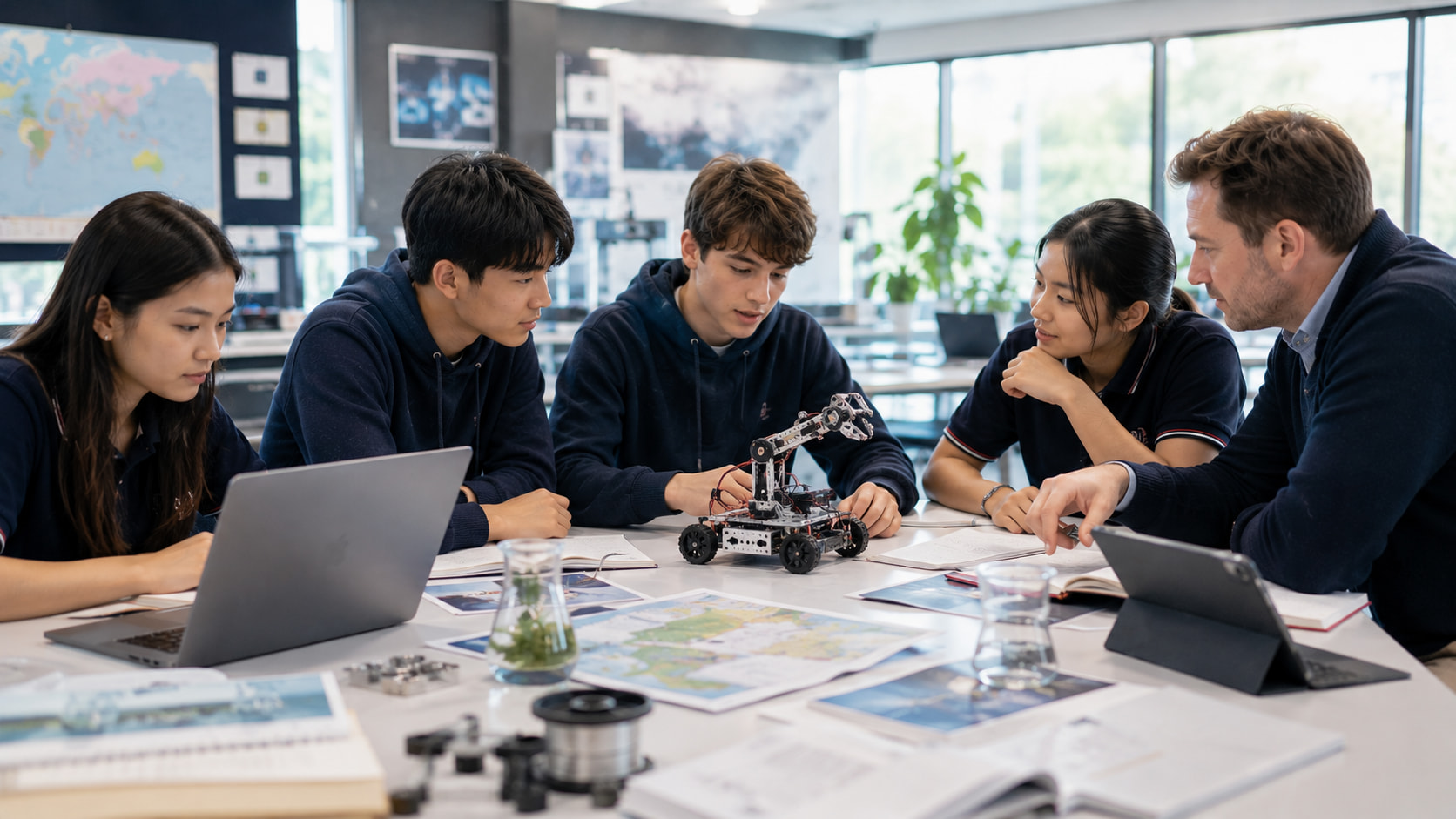
Many schools claim interdisciplinary learning; many add subjects. Real interdisciplinary learning is not quantity but method.
Mathematics can prove that 1 + 1 = 2. Weather forecasting requires observation and probabilistic reasoning. They are different epistemic structures, so students must learn to classify and compare knowledge forms.
That is why students do not need to become “early university learners.” They need repeated real-problem practice: what disciplines are involved, what evidence is reliable, what variables interact, and what consequences follow one decision.
This is more directly aligned with future competence than adding one more AI class.
Grades matter, but they are not full preparation

Grades remain important in admissions. This is not a false reassurance.
Dr. Huang acknowledged that excellent universities still weigh scores. But he also said preparation cannot be reduced to one indicator. Families need to balance thresholds, interest, social complexity and critical-logical training.
Grades open the door. They do not guarantee long-term agency. A child can enter a competitive pathway with high marks, but without judgment, collaboration and ethical clarity, they can still become passive operators.
For parents choosing across gaokao, IB, A Level, HKDSE or overseas routes, the structure is the same: keep score and build capability together.
Moving future capability into everyday K-12 learning
YCYW Education Network, founded in Hong Kong in 1932 and serving over 12,000 students and staff across Hong Kong, mainland China, Silicon Valley and Somerset, takes an education view that aligns with this shift.
In this context, Holistic Education is not separate categories. It links academics, character, arts, service, technology and global perspective. AI-age readiness belongs in all of these dimensions.
Sino-Western Fusion Education grounds this by combining Chinese cultural foundations with Western inquiry and critical learning. Bilingual Learning Communities give students daily opportunities to express, collaborate and reflect in both language environments.
YCYW EdFutures helps schools use AI, coding and immersive technologies responsibly through real tasks, not as a substitute for learning. The key is understanding tool limits, values and responsibility.
The shift is from “learning more information” to “seeking better truth.” When information is abundant, schools must teach students to evaluate what is true, what is useful, and what is worth owning.
What parents should really ask
When frontier disciplines enter university pathways, the better question is not “Should my child choose AI now?” but “Has my child been practising the core capabilities needed for those pathways?”
AI competitiveness is not a course list. It is a long arc built from primary through high school: questioning, judgment, integration, responsibility, and collaborative execution.
Sources: This article draws on China Daily on new undergraduate catalogues (2026-06-06), Xinhua on same report, Cambridge International digital literacy updates (2026-02-24), IB AI discussions (2026-05-22), Southampton announcement on undergraduate AI skills (2026-02-24), and Northwestern Engineering’s AI major announcement (2026-03-09). Lecture insights come from the YCYW Educational Lecture Series on June 5, 2026.
Frequently asked questions
Coding is useful, but coding is not AI competitiveness. The deeper layer is asking questions, judging reliability, connecting disciplines, and understanding ethical consequences of technical choices.
They should build foundational knowledge, interdisciplinary habits, problem-solving depth, communication, critical thinking, and ethical awareness. These capabilities should start early and be rehearsed consistently.
YCYW Holistic Education treats character and academics as equally important and uses bilingual, cross-cultural, and service-based learning pathways so students can make judgments, not only technical choices.
Through Sino-Western Fusion Education, Bilingual Learning Communities, Project-Based Learning, World Classroom, China Classroom and the EdFutures framework, students work through shared problems with multiple lenses.
Because tools can produce polished outputs, including wrong or incomplete ones. Foundational knowledge helps students verify and correct, rather than simply accept answers.
Grades remain a threshold. Long-term readiness needs a wider frame: scores, curiosity, questioning habits, logical training, and family conversation on difficult choices.