


Go Back
News
YCYW Educational Insights
Phone Bans Are Not Enough
YCYW Educational Insights
03 Jun, 2026
16 : 18
Schools are tightening rules on phones and screens. Parents should ask what happens after the device is put away.
In this article:
- Why phone bans are becoming a common school response
- What a new Grade 6 device policy in the UAE can and cannot tell parents
- Why digital wellness is more than device control
- Why self-discipline is the harder educational question
- How YCYW connects digital life with wellbeing, character, and teacher practice
- What parents should ask schools now
In Hong Kong, a secondary school tightened its mobile phone rules and student pushback quickly drew the Education Bureau into the conversation. In the United States, the Office of the Surgeon General, part of the Department of Health and Human Services, advised schools to limit screen time, support bell-to-bell phone restrictions, and return more learning to physical books and paper. In California, legislation on digital wellness was signed into law on 10 September 2026. In the United Arab Emirates, a new Grade 6 public-school policy has brought books, notebooks, and direct classroom interaction back to the centre of selected core lessons.
The settings are different. The question is the same.
Schools know distraction is real. Parents know it too. A phone in a child's pocket is not a neutral object during a lesson, a lunch break, or a fragile social moment. But taking the phone away only answers the easiest part of the problem.
A phone ban can reduce distraction. It cannot, by itself, teach a child what to do when no adult is watching.
Restriction is a reasonable first response
Schools are reaching for phone restrictions because the pressure has become visible.
The Hong Kong case, reported by South China Morning Post, shows the tension clearly. A school may want order, concentration, and fewer social-media disruptions. Students may experience the rule as surveillance, punishment, or loss of voice. Both responses are understandable. A school day cannot function if attention is constantly pulled out of the room. But a rule that students only experience as control will always need more control to sustain it.
The US signal points in the same direction. Education Week reported on May 20, 2026 that the Office of the Surgeon General recommended schools limit screen time to support focus, learning, physical health, and mental health. The guidance backed bell-to-bell phone restrictions and encouraged schools to use physical textbooks, paper assignments, extracurricular activities, and cyberbullying plans.
This is not anti-technology panic. It is a sign that schools have often allowed screens into childhood faster than they have built the habits children need around them.
Restriction helps when the problem is immediate access. It can protect lesson time. It can reduce constant checking. It can give children a few hours when they are not performing for a feed. But the child eventually gets the device back.
The real test begins there.
The UAE's Grade 6 policy is about choosing the medium, not rejecting technology
In August 2026, the UAE Ministry of Education announced that its project for regulating the use of digital tools in education would expand to all Grade 6 students in public schools for the 2026–2027 academic year. A Gulf News report updated on 13 September said that these students would not take laptops to school, while classroom learning would rely more on textbooks, notebooks, activities, and direct interaction.
This is not a complete technology ban. According to the Gulf News report, the guidance allows targeted home use when a subject requires a particular platform, resource, or assignment. The policy is also narrow: it concerns Grade 6 in UAE public schools. It does not, by itself, show that every year group or every school system should adopt the same arrangement.
The useful idea is the decision behind the rule. A device should be present because it improves the learning task, not because digital delivery has become the default. Sometimes the right medium is a laptop. Sometimes it is a printed text, a handwritten explanation, a laboratory activity, or a discussion in which no notification can interrupt the thought.
For parents, that creates a better question than “Does this school use technology?” Ask instead: when does the school deliberately use a device, when does it deliberately put the device away, and what evidence or educational reasoning guides that choice?
Students are asking for education, not only control
California's AB 2071 is useful because it changes the subject.
The law for AB 2071: Pupil instruction, digital wellness, approved on 10 September 2026, frames excessive or inappropriate use of digital media, social platforms, and AI-powered technologies as a mental-health concern. It requires California's Department of Education to develop a plan by 1 January 2028 to expand digital wellness instruction in public schools. Its stated intent covers pupils in elementary, middle, and high school, with attention to media literacy and the responsible use of emerging technologies, including AI.
That matters. It treats digital life as something students have to learn how to inhabit, not only something adults have to police.
EdSource's reporting on the legislation placed student voice at the centre of the story. Students were not simply asking adults to protect them from phones. They were asking schools to teach what healthier use looks like once the phone returns. That is a more mature conversation. It assumes young people can participate in judgment, not only submit to rules.
A phone policy asks where the device is during the school day. Digital wellness asks what the child understands about attention, comparison, sleep, AI output, social pressure, privacy, and the feeling of needing to respond immediately. Digital self-discipline asks an even harder question: what does the child do when the school rule is no longer present?
Parents should notice the difference. A school can have a strict phone policy and still do little to develop judgment. A school can have a serious technology programme and still protect long stretches of screen-free attention. The dividing line is not whether a school is "for" or "against" devices. It is whether the school treats digital life as part of human development.
The deeper shift is from external discipline to self-discipline
The next school debate will not be only about screen time. It will be about self-discipline.
External discipline is necessary in childhood. Children need routines, boundaries, and adults willing to say no. But if external discipline never becomes internal discipline, the school has only managed the environment. It has not finished the educational work.
Digital life makes this visible because the device is portable, private, persuasive, and always waiting. A student can obey a school rule from 8:00 to 3:00 and still be governed by the phone from 3:30 to midnight. A child can avoid AI during one assignment and still learn the habit of outsourcing thought whenever an answer feels difficult.
That is why "digital wellness" should not become another soft school phrase. It has to mean practical habits. Can a child notice when attention has been broken? Can a child question what an AI tool produces? Can a child sit with an unfinished idea before asking a machine to complete it? Can a child step away from social comparison without needing an adult to confiscate the device?
Those are not technology skills. They are self-discipline, discernment, resilience, and identity.
YCYW's earlier article, AI Won't Replace Your Child's Thinking: Teach Them to Use It With a Question, puts this in practical family language. Before a child uses AI, ask what specific problem they are trying to solve. After AI gives an answer, ask the child to challenge, add to, or push back on at least one point. Keep a daily window of AI-free thinking time so the mind keeps the habit of running on its own.
That is digital self-discipline in miniature. It is not a ban. It is a way of using a tool without letting the tool become the child's first reflex.
What YCYW sees in this trend
In YCYW's experience, digital self-discipline cannot be added only through a policy memo. It has to be built into the school day.
This is where YCYW's holistic education becomes relevant to the phone-ban debate. The point is not that every value has to be explained in an article about phones. The point is simpler: digital self-discipline sits between technology, wellbeing, and character. A school has to teach students how tools work, but also when not to use them.
That takes adult preparation. The 2025 STEM'ed Conference, hosted within the YCYW network, is a useful example because it shows AI, curriculum design, data, robotics, and inquiry-based learning being treated as teacher practice, not only student exposure. A school cannot guide children's digital habits if its adults are improvising separately.

It also takes non-screen depth. YCYW's article When Holistic Education Becomes Inspection-Grade makes this point from the wellbeing side: wellbeing has to show up in daily lessons, weekly assemblies, and beyond-the-classroom activities, not only in campaign language. A child learns self-command through repeated practice: sustained attention, arts, physical activity, conversation, service, and reflection.
The YCYW 12 Virtues and the YCYW Learner Portrait are useful here because they give students language for self-reflection. A child who can notice distraction, name a habit, and choose a better response is doing more than obeying a rule. That is the educational layer phone bans cannot provide by themselves.
That is the standard parents should use for digital wellness too. A campaign week is not enough. A poster is not enough. A ban is not enough. The question is whether the school day gives children repeated practice in attention, judgment, relationship, and self-command.
What parents should ask now
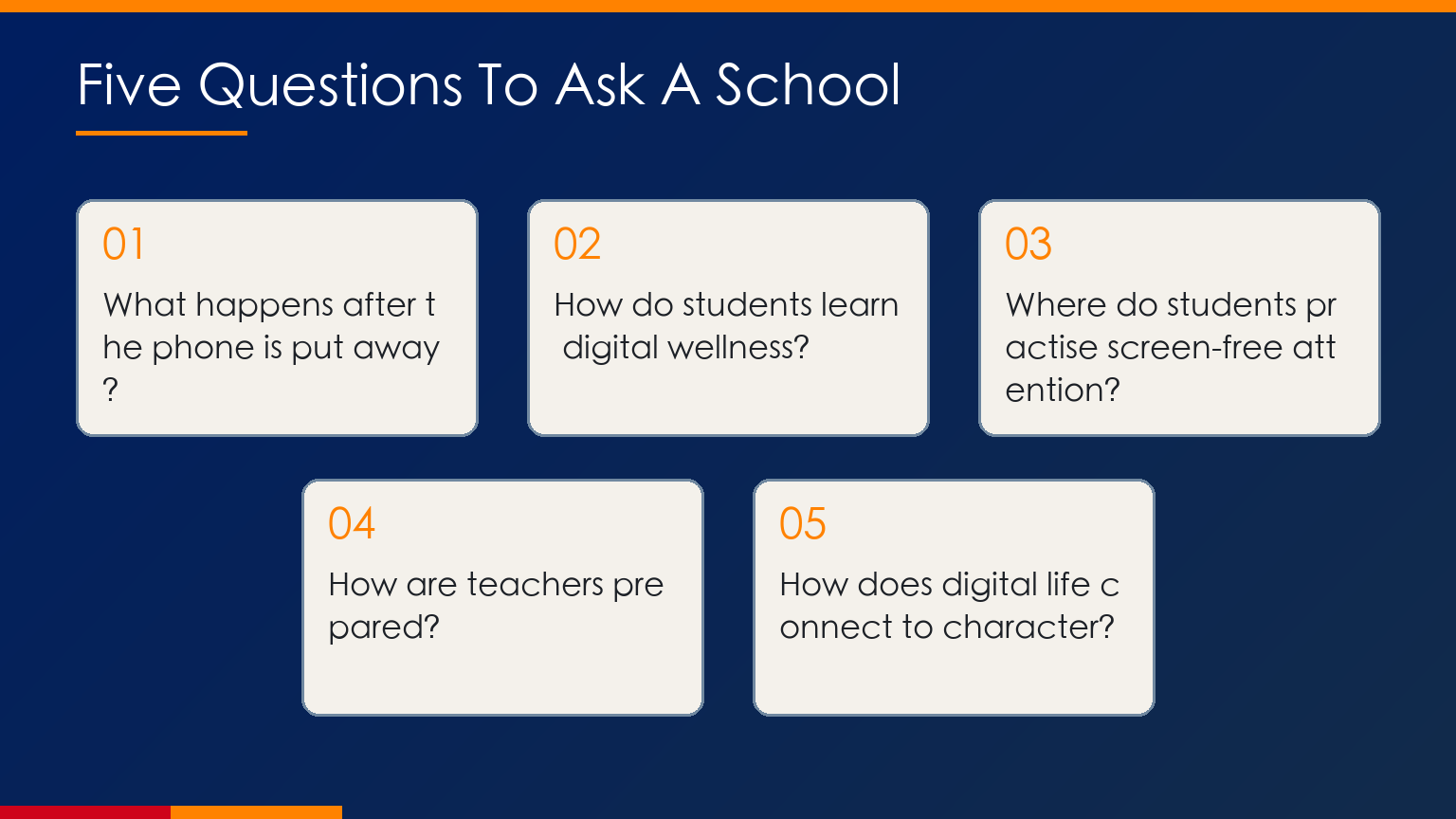
Parents do not need to start by asking whether a school bans phones. That answer is easy to prepare.
They should ask what sits behind the rule.
First, what happens after the phone is put away? A serious school should be able to describe what fills the space: reading, discussion, arts, movement, service, outdoor learning, deep work, or teacher-guided inquiry.
Second, how do students learn digital wellness? Listen for concrete language. The answer should include attention, sleep, social media, AI, privacy, source judgment, cyberbullying, and student voice. If the answer is only "we collect phones," the policy is doing more work than the education.
Third, where do students practise self-reflection? Digital self-discipline requires children to observe their own habits. Schools that have a learner portrait, reflection rubric, advisory system, or student-led norm-setting process are working at a deeper layer than schools that only announce rules.
Fourth, how are teachers prepared? A school's adults need a shared language for AI, screen use, wellbeing, and character. Without that, every classroom becomes a separate experiment.
Fifth, how does the school connect digital life to character? The best answer will not sound like a technology plan. It will sound like a human development plan.
Phone bans may become normal in many school systems over the next few years. Some will be necessary. Some will be clumsy. Some will work better than others. But the schools worth a second look will not stop at the ban.
They will be able to explain how children learn to govern themselves when the phone is back in their hands.
Frequently asked questions
Digital self-discipline is a student's ability to make responsible choices around phones, social media, AI, and digital media when an adult is not actively controlling the device. It includes attention, self-regulation, source judgment, empathy, privacy awareness, and the ability to step away from a screen when needed.
A phone ban controls device access during a defined period. Digital wellness teaches students how digital media, social platforms, AI tools, sleep, attention, mental health, and relationships affect one another. The two can work together, but they are not the same. A ban reduces immediate distraction. Digital wellness builds longer-term judgment.
YCYW's holistic education treats character development as part of a child's education, not an add-on to academic results. In this article, the relevant point is that digital life has to be connected with wellbeing, judgment, relationships, and the habits students practise every day.
The YCYW 12 Virtues are the network's character framework. For digital wellness, the most relevant connection is not the full list of virtues, but the habits behind them: self-discipline, mindfulness, resilience, empathy, and the ability to step back before reacting.
The YCYW Learner Portrait is a student-centred model for character and competence development. Its relevance to digital self-discipline is the self-reflection habit: students need language to notice how they learn, how they respond, and how they manage themselves when adults are not directing every choice.
The YCYW EdFutures team is the network's strategic education innovation and research function. Its role is to drive how AI, programming, immersive technologies, and other emerging tools are adopted across YCIS and YWIES campuses, and to guide students in using these tools well. EdFutures does not act as the sole rule-setter for AI use in any single subject. Subject teachers, curriculum leaders, and campus heads share that responsibility.