

Go Back
News
YCYW Educational Insights
The Future Degree Has Three Variables
YCYW Educational Insights
29 May, 2026
10 : 55
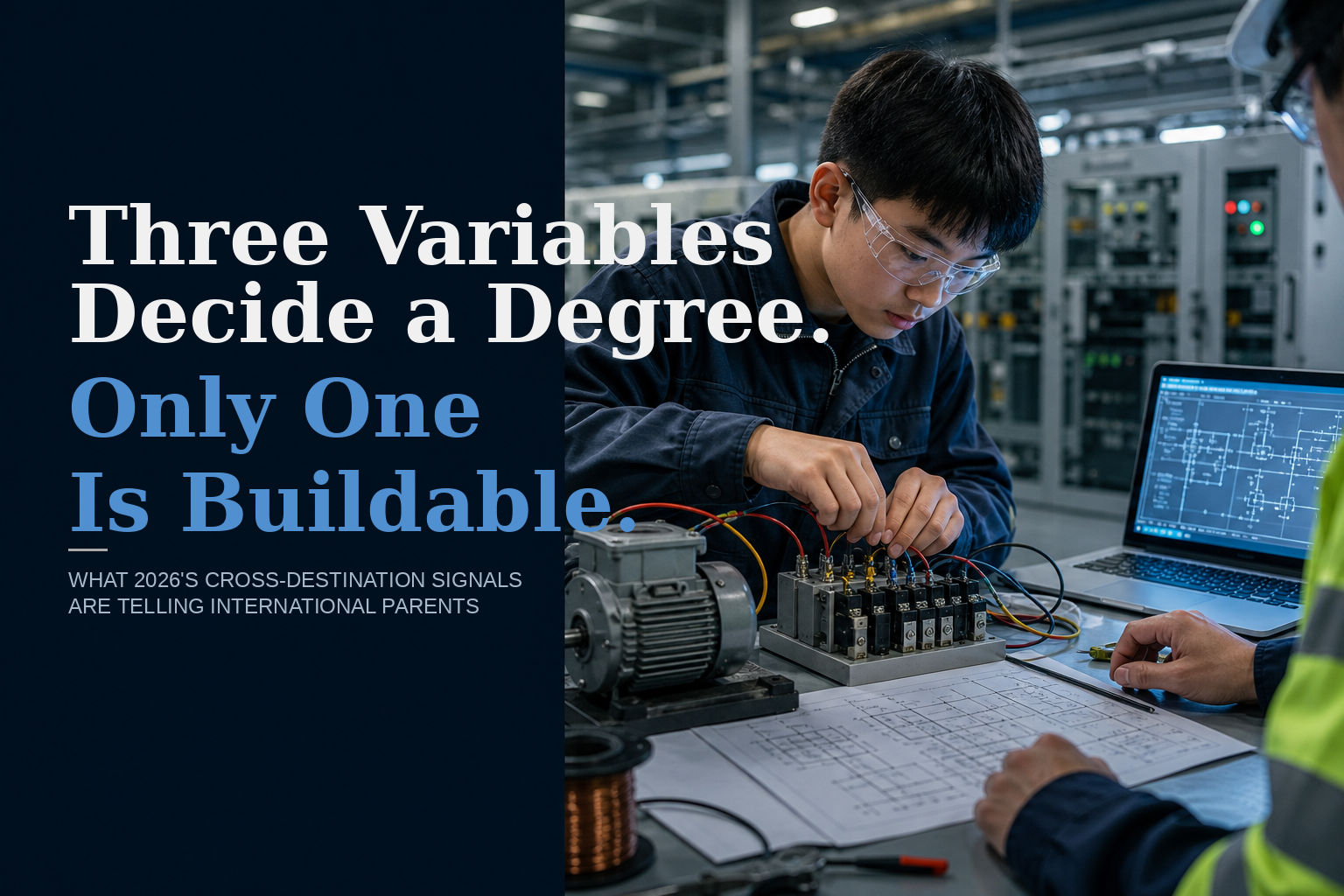
In spring 2026, the value of a foreign university degree began to be set differently across every major destination. The clearest signals are out of US graduate schools, with parallel movements in the UK, Canada, and Australia. The value of a degree is no longer set by one variable. It is set by three.
In this article:
- Why US graduate schools, and their UK, Canadian, and Australian peers, are making moves they have avoided for a decade
- The single-variable model that ran international education for 30 years has broken, and what replaces it
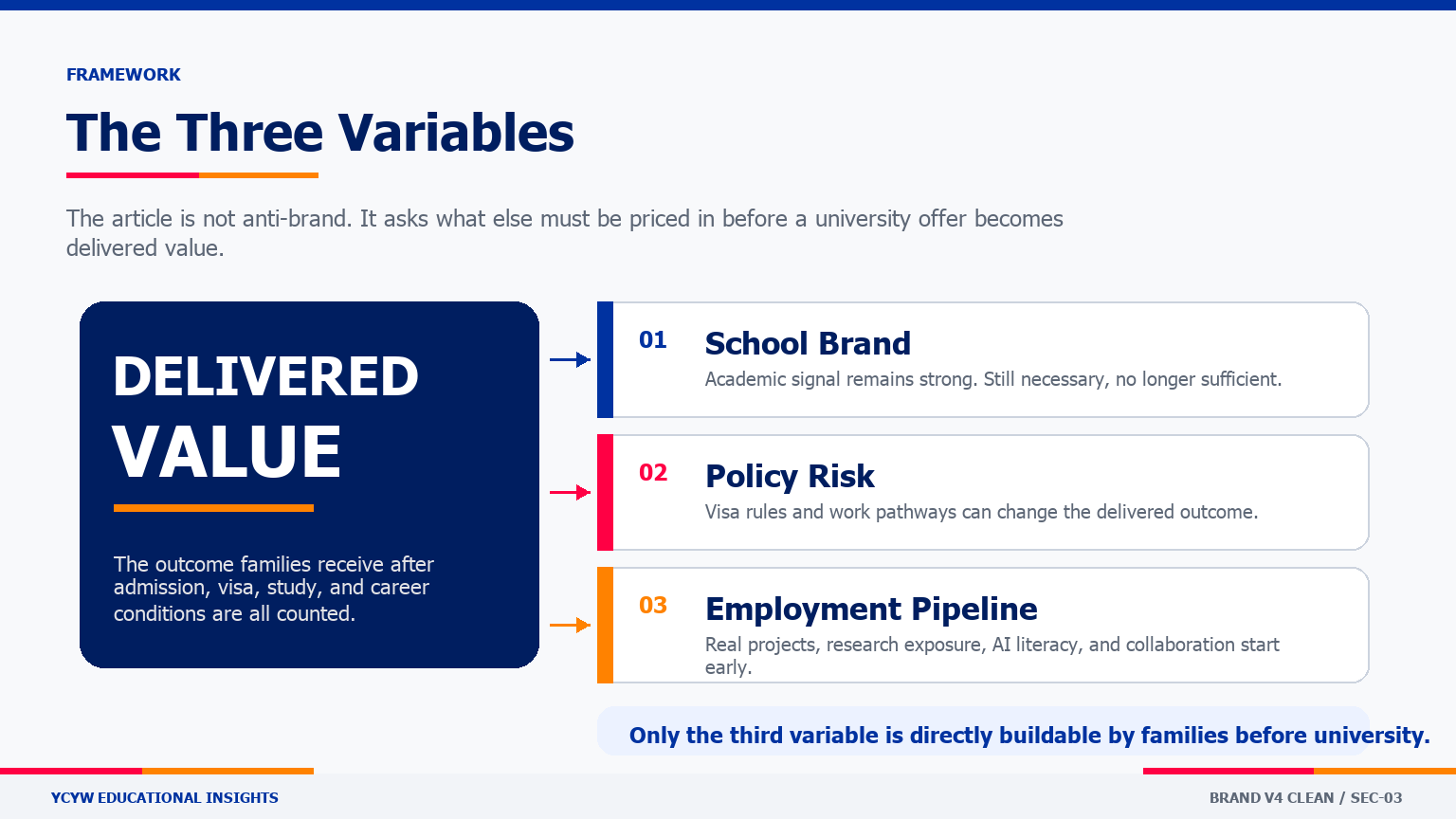
- The three variables that now decide a degree's value: brand, policy risk, and the employment pipeline
- Why only the third variable is buildable from age 11, and what that build actually looks like inside YCYW
The spring 2026 signal
In spring 2026, the value of a foreign university degree began to be repriced across every major destination at roughly the same time. The most legible signal came from US graduate schools.
In the first week of March, admissions directors at US research universities began making three kinds of calls they had not made in over a decade. They called in-state high schools whose students they had previously assumed would default to prestige peers. They called education agents in Bangladesh, Nigeria, and India, markets US schools had largely avoided because of high visa refusal rates. And they called corporate talent partnership offices, asking whether STEM and business graduates could be guaranteed a place in the employer's pipeline before they had even enrolled.

Each call, on its own, looks like a one-off. Schools have always looked for new pipelines when old ones tighten. The pattern that matters is the three happening together, in the same recruitment cycle, across multiple research universities. The Christian Science Monitor documented the convergence on 19 May 2026. NAFSA's May 2026 survey of 149 US institutions confirmed the pressure underneath it: international graduate enrolment fell 24 percent year-on-year. Undergraduate enrolment fell 20 percent.
The same signal was running through the other Big Four destinations in parallel. UK Home Office data for January to April 2026 showed main-applicant sponsored study visa applications down 33 percent year-on-year, with the April 2026 figure the lowest in five years. The UK Office for Students warned on 14 May that cumulative institutional deficits could reach £4.2 billion by 2028–29 in the most severe scenario. The Q1 2026 Global Enrolment Benchmark, jointly produced by NAFSA, Oxford Test of English, and Studyportals across 254 institutions in 36 countries, recorded Canadian graduate intake down 80 percent, with US, UK, and Australian institutions all reporting graduate-level declines of around 67 percent.
Whatever destination an international family is currently evaluating, the same shift applies. The cost of evaluating a foreign degree by school brand alone has gone up.
What these signals tell us
For the last 30 years, parents evaluating a foreign university degree relied on a simple formula. Look at the brand of the school. An offer letter from Harvard, Oxford, or Tsinghua effectively closed the decision. The single variable did most of the work.
That formula no longer holds. What replaces it is a three-variable model: school brand × policy risk × employment pipeline. The three variables multiply rather than add. If any one of them collapses, the realised value of the degree collapses with it.
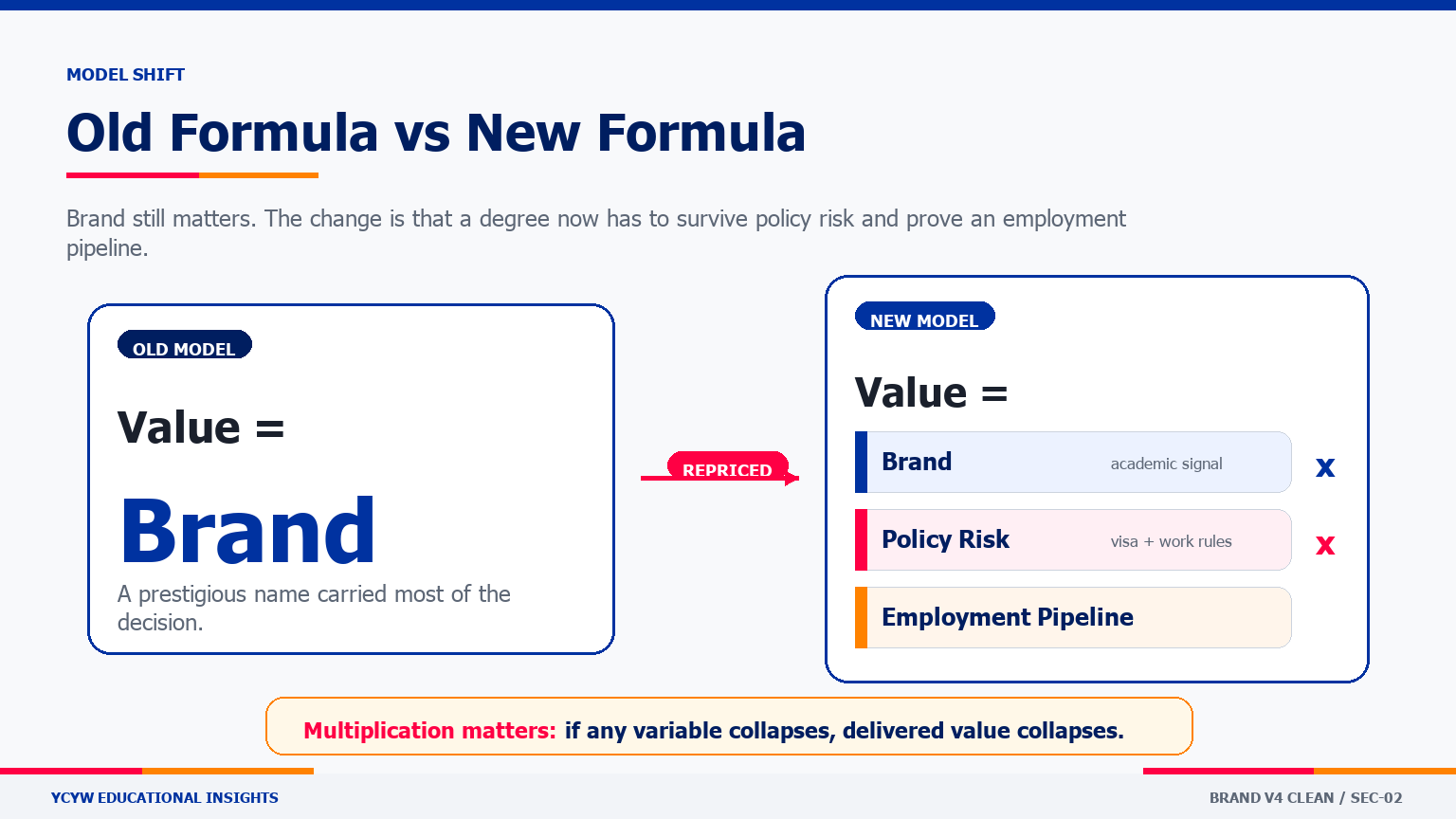
The independent data confirms this is not a one-cycle blip. NAFSA's May 2026 survey found that 62 percent of US institutions reported lower international enrolment year-on-year, and 85 percent named restrictive government policies as their top obstacle, up sharply from 58 percent in 2024. In the UK, the Office for Students' 14 May 2026 financial sustainability report showed 36 percent of providers operated at a deficit in 2024–25. The Q1 2026 Global Enrolment Benchmark showed Canadian graduate-level intake down 80 percent, with US, UK, and Australian institutions reporting graduate-level declines of around 67 percent. Asian institutions, by contrast, recorded undergraduate growth at 82 percent of surveyed schools.
These are not separate stories. They are the same signal told several ways. The school-brand variable is still intact. The conditions for that brand to translate into delivered value have changed.
The three variables, one by one
Variable 1: School Brand
Harvard is still Harvard. The academic signal carried by an elite brand has not weakened. What has changed is how much of the final value calculation that signal can carry on its own.
The clearest evidence is the disconnect between applications and enrolment. NAFSA's data shows that brand-name US universities continue to attract strong international application volumes. The institutions where enrolment is falling are not, for the most part, the institutions that have stopped being prestigious. Students are applying. They are not enrolling at the rates they used to. Something is happening between the offer letter and the airport.
That something is the other two variables coming through. A family can accept an offer from a top-100 university and still find themselves making a different decision six months later because a visa interview went poorly, because a post-study work pathway was quietly narrowed, or because the household's three-year horizon now looks different than it did when the application was first submitted.
The practical implication is that brand still matters, and it matters a great deal, but it no longer matters in isolation. Treating brand as if it carries the full weight of value, as families could reasonably do a decade ago, leaves the other two variables unpriced. Unpriced variables do not stay quiet for long.
Variable 2: Policy Risk
The policy variable is the one families can neither control nor reliably predict. It can still be priced in, and it must be.
The last 24 months have produced a denser sequence of cross-border education policy changes than any comparable period in recent memory. From September 2026, the US Department of Homeland Security will cap F-class student visa stays at four years, a rule that directly affects students enrolled in five-year undergraduate programmes or any dual-degree pathway extending past the cap. UK Home Office data for January to April 2026 shows main-applicant sponsored study visa applications down 33 percent year-on-year, with the April 2026 reading the lowest April figure in five years. ICEF Monitor reported on 20 May 2026 that the UK's new compliance threshold, requiring a visa refusal rate below 5 percent, has already pushed institutions to withdraw recruitment from Bangladesh and Pakistan, with effect from 1 June 2026. US social-media vetting requirements have expanded over the same period, and post-graduation work pathways have narrowed.
None of these changes is a political statement about any single country. They are inputs to a valuation. A degree that depends on the smooth functioning of a specific visa regime is worth less than the same degree under a stable regime, even when the name on the diploma is identical.
Variable 3: The Employment Pipeline
The third variable is the one families can actually build. It is also the one most parents have never been asked to think about deliberately.
The employment pipeline is not what a student does in the year before graduation. It is the running accumulation, from age 11 onwards, of the experiences that future employers and graduate programmes will treat as evidence. Real contact with real employers, not careers talks. Real exposure to research environments, not classroom simulations. AI literacy as a workplace capability, not just permission to use ChatGPT. Cross-cultural collaboration as a daily practice, not a study-abroad week. And decision-making under real constraints, which is what well-designed Project-Based Learning (项目式学习) is for.
The reason US graduate schools have begun signing employment contracts with companies in 2026 is that they have figured out, late, that brand alone is no longer a complete offer. International families have an option US graduate programmes do not. They can start building this variable seven to eleven years earlier than the graduate level. The families paying close attention to this article are, in principle, looking at a head start their target institutions are still scrambling to assemble.
Inside the variable you can actually build: what an employment pipeline looks like from age 11
Age 11 to 15: lower secondary as the first encounter with real constraints
In the 2023–24 school year, Yew Chung International School of Hong Kong (YCIS) ran a cross-year Project-Based Learning module spanning Years 6 and 7. The teaching team, drawn from the Curriculum and Professional Development team, proposed five UN Sustainable Development Goals to the students and asked them to choose where to put their effort. The students then worked in cross-year groups on a problem they had selected, with ownership for the project resting with them, not with the teacher. South China Morning Post documented the work at the school's Open Day in January 2024.
What this design does, for an eleven- or twelve-year-old, is structurally different from learning the vocabulary of sustainability. It hands the student a real-world constraint, in this case one selected from a globally recognised list of constraints, and then asks the student to decide what to do about it. The constraint pushes back. The student finds out, at twelve, that complex problems do not divide cleanly into right and wrong answers, and that defending a chosen path requires evidence, data, and the ability to persuade.
This is what Project-Based Learning is for at the lower-secondary level. Not a curriculum unit on sustainability. A first encounter with the way real-world problems behave when something is being asked of you.
Age 15 to 18: stepping into real research, real employers, and real impact
On 28 February 2024, 22 students from YWIES Tongxiang and YWIES Gubei stood on the factory floor of Siemens Energy's high-voltage switchgear plant in Shanghai. They had not come to tour. They were there to design an electrical-grid supply model, build and wire a three-phase 12-volt generator into a distribution circuit, and learn the practical difference between live, neutral, and earth connections under industrial supervision.
The same logic, scaled up, operates inside the YCYW Advanced Research Programme at the Oxford Suzhou Centre for Advanced Research (OSCAR). Secondary students take residential research stints alongside Oxford scientists in optoelectronics, machine learning, and regenerative medicine. YCYW's own description of these placements is unusually direct. They are, in the network's words, “opportunities normally reserved for postgraduates.”
And at the upper end of secondary school, student-led projects begin to reach into real environmental and community impact. The Corallium Project at YCIS Hong Kong is run by Year 13 students cultivating corals in on-campus tanks, with the goal of replanting them on reef systems around Hong Kong. The project partners with NGO Aquanauts to transfer the tank-reared corals to a protected site off Big Wave Bay. The students monitor temperature, water quality, light, nitrites, and algae every day, and they teach younger year groups about coral conservation through in-school presentations.
This is precisely what US graduate schools are now scrambling to assemble for their adult enrollees. The YCYW EdFutures team has been delivering equivalent experiences to fifteen- to eighteen-year-olds since the 2023–24 academic year.
The three cases above sit on different sides of the same triangle:
| Programme | Where it happens | What students actually do | What it builds |
|---|---|---|---|
| Siemens Energy PowerPioneers | Siemens high-voltage switchgear plant, Shanghai | Design grid models, build and wire a three-phase 12V generator under industrial supervision | Real employer environment, engineering literacy |
| YCYW Advanced Research at OSCAR | Oxford Suzhou Centre for Advanced Research | Residential research with Oxford scientists in optoelectronics, machine learning, regenerative medicine | Real research-lab access, postgraduate-grade exposure |
| Corallium Project | YCIS Hong Kong campus and Big Wave Bay reefs | Cultivate corals, partner with NGO Aquanauts to replant, monitor water chemistry daily, teach younger students | Student-led real-world impact, project ownership |
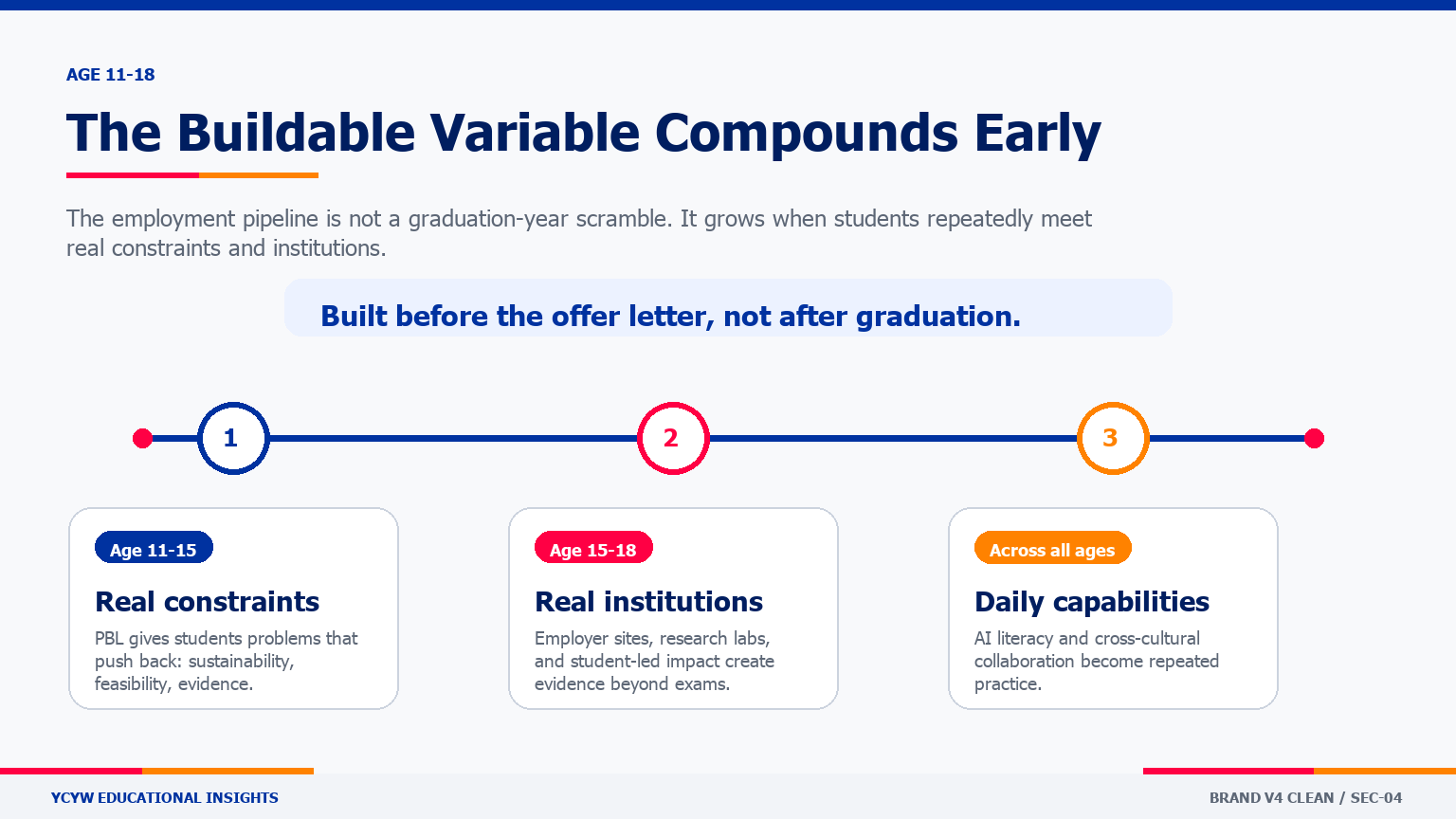
Across all ages: AI literacy and cross-cultural collaboration
Two further capabilities do not belong to any single classroom. They run through the daily texture of school life.
On 7 and 8 March 2025, YCYW ran its annual network-wide Professional Development Days under the theme “Innovate, Educate, Empower: The AI Era of Learning.” The teaching position made explicit at those sessions was that students should learn not only to use AI, but to approach it with critical thinking and empathy, with active awareness of algorithmic bias, privacy implications, and the impact AI has on the texture of their own learning. That position now sits inside the curriculum, not next to it. For the detail on how that position works at the classroom level, see AI policy is the floor, not the ceiling, and on the deeper values question, 70% of students fear AI; the problem isn't the fear.
Cross-cultural collaboration is built more quietly, through Co-Teaching (协同教学), the bilingual two-teacher model that pairs Chinese and Western co-teachers inside the same classroom from the earliest years onwards. Students are not handed cross-cultural competence as a single lesson. They live inside it every day, with two adults in the room negotiating across two languages and two pedagogical traditions in front of them.
What the result looks like
The point of this assembly is not to replace school brand. It is to hold both variables at the same time. As of May 2026, the YCYW Class of 2026 has received over 1,400 university offers, including from Harvard, Stanford, the University of Oxford, the University of Cambridge, Imperial College London, Tsinghua University, and Peking University. The data answers the question parents most often ask about programmes like these. Students are still getting into brand-name universities. The point is that they are getting in with the third variable already partly built.
Three questions to ask at any school open day in 2026
Whatever school a family is currently evaluating, three questions can directly test the third variable. They are designed to surface real evidence of the employment pipeline, not slogans about it.
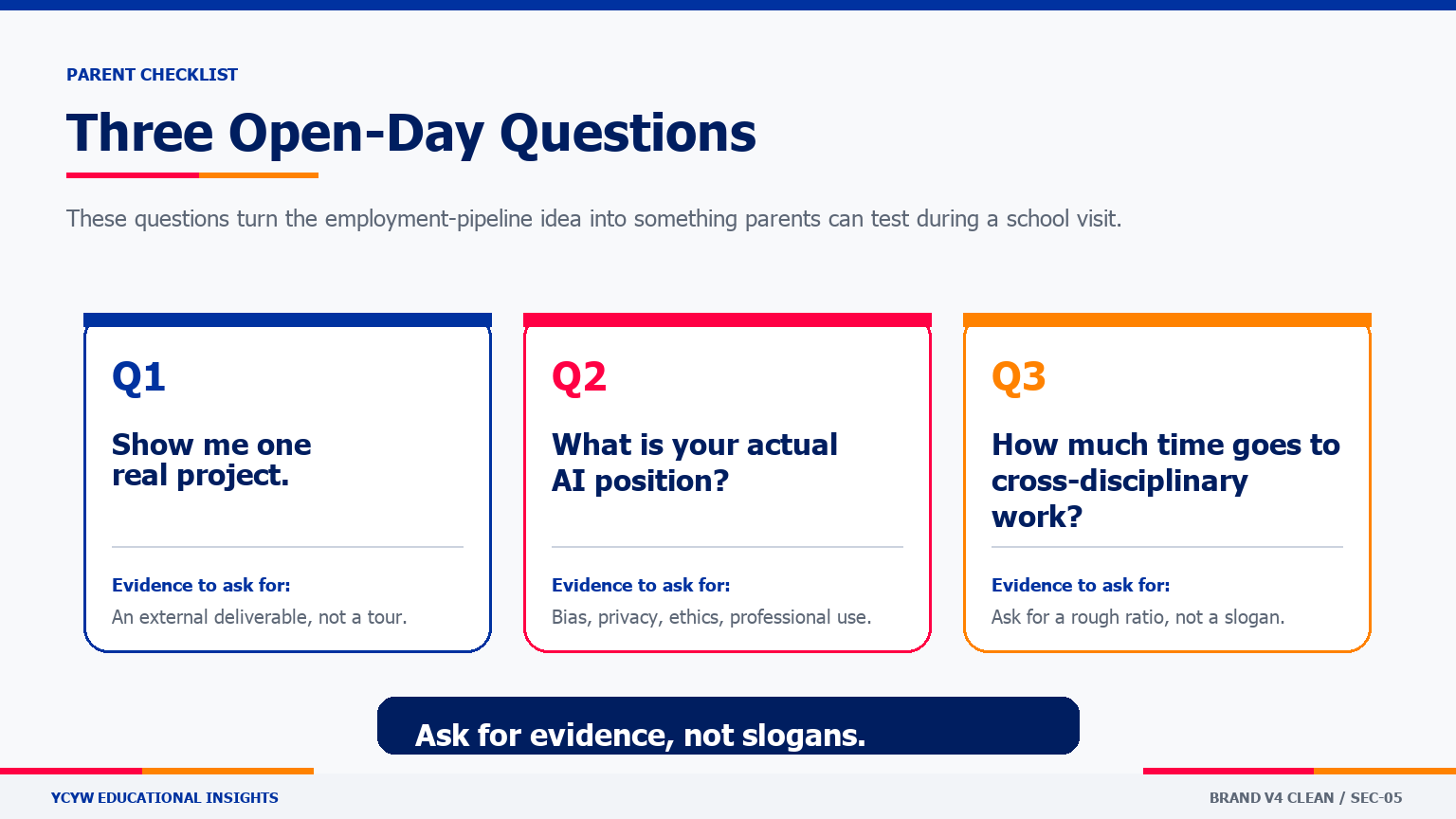
The first question. Show me an example, in the last twelve months, of students doing real work with a real institution or a real company. Not a site visit. Not a careers talk. Real work, with a deliverable, signed off by someone outside the school. Schools that take this variable seriously can answer in 30 seconds. Schools that do not will reach for marketing materials.
The second question. What is the school's actual position on AI? “We have banned ChatGPT in essays” is not a position. It is a punishment. A real position describes how the school is teaching students to recognise algorithmic bias, to use AI ethically, and to treat it as a professional capability with rules attached.
The third question. In the final two years before university, what is the rough ratio of student time spent on cross-disciplinary projects versus pure examination preparation? This is the most quantitative way to ask the same question. Schools that have built the third variable into the curriculum can describe the ratio. Schools that have not will frame the question as unfair.
In 2026, the most useful question international families can ask is not whether a particular degree is still worth pursuing. The useful question is whether their child is accumulating the one variable they have any real ability to build. The third variable does not begin to accumulate on graduation day. It compounds from age 11 onwards. The families who treat it as a long-running project rather than a final-year push are the ones whose children walk into university interviews with something concrete to describe.
Frequently asked questions
A US degree's brand value remains strong, but its delivered value now depends on two additional variables: visa and policy stability, and whether the student can show real employer-grade experience by graduation. The same logic applies to UK, Canadian, and Australian degrees, with each destination carrying its own policy profile. Families should price all three variables in, not assume school brand alone carries the same weight it did a decade ago.
A three-variable model: school brand × policy risk × employment pipeline. The three multiply together. If any one collapses, the realised value of the degree collapses. Parents can only directly build the third variable, and it is buildable starting in middle school.
Age 11 is not too early. Schools that take the variable seriously begin in lower secondary with real-world Project-Based Learning constraints, expand into employer partnerships in middle school, and place students inside actual research labs by upper secondary.
The YCYW EdFutures team is the network's strategic education innovation and research function. It designs programmes that connect students to top universities such as Oxford via OSCAR, Fortune 500 companies such as Siemens Energy, and Chinese research institutions including the Chinese Academy of Sciences. EdFutures runs cross-campus programmes including the Meta Programme and the Super-Curricular Programme.
PBL is a curriculum design where students solve real-world problems under real-world constraints. It matters because the third variable in the 2026 degree-value model, the employment pipeline, is built precisely through this kind of constrained decision-making, not through examination preparation alone.
Because their international students are turning away from a US-only pipeline, and graduate schools have realised that a brand-only degree no longer guarantees a job pipeline. They are now bundling brand and employment pipeline to stay competitive. The same logic applies to families choosing schools.