


Go Back
News
YCYW Educational Insights
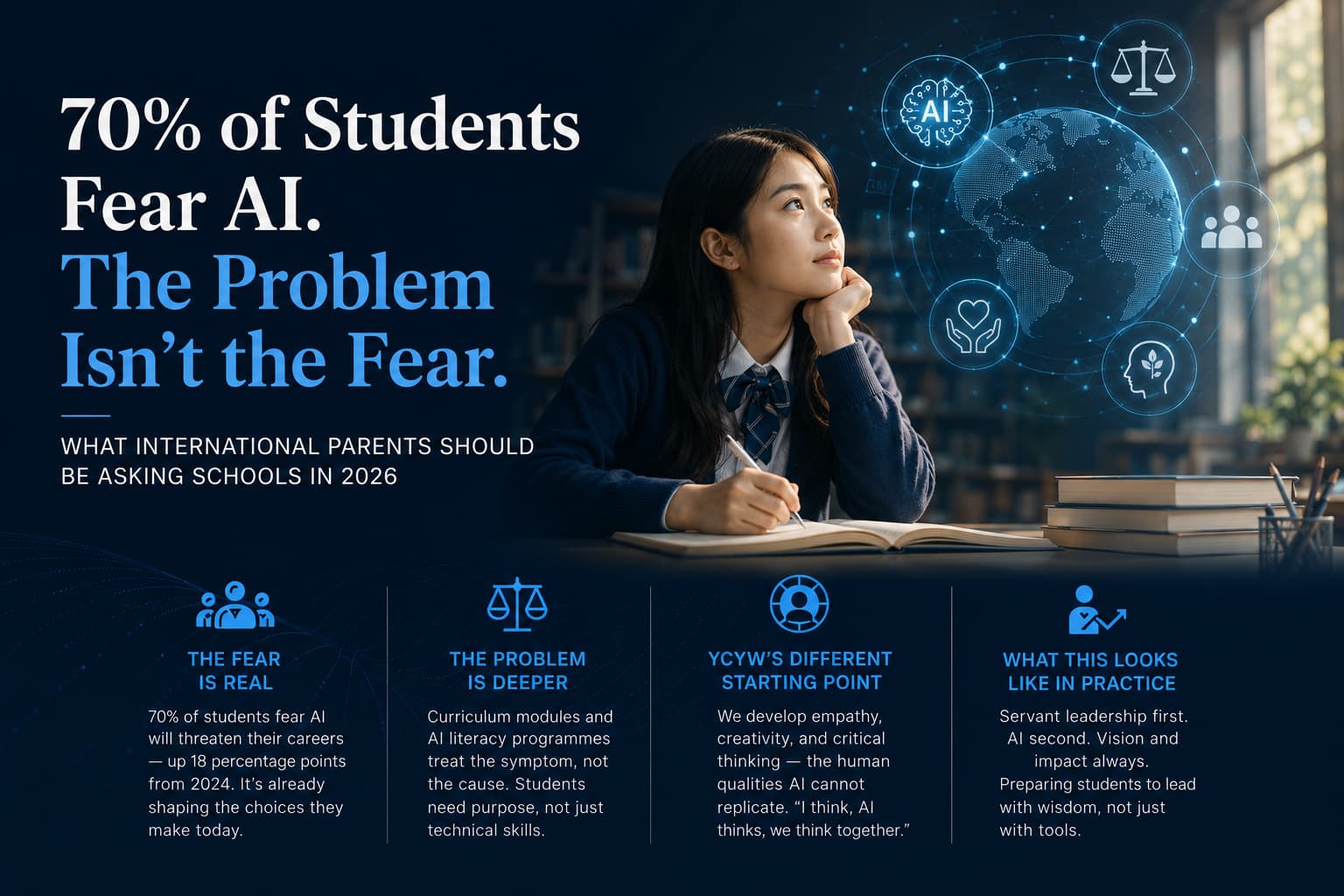
70% of Students Fear AI. The Problem Isn't the Fear
YCYW Educational Insights
18 May, 2026
17 : 10
Published 18 May 2026 · YCYW Education Network
A survey of 70,000 students says the fear of AI is accelerating. Most school responses are treating the symptom. This piece looks at what the underlying problem actually is — and what an educational model built around the right question looks like.
In this article:
- Why 70% of students fearing AI is a signal about values, not technology
- Why curriculum modules and AI literacy programmes address the symptom, not the cause
- How YCYW frames the question differently — and what that looks like in practice
- What parents should ask schools instead of "what is your AI policy?"
Singapore's Ministry of Education made a quiet but precise decision earlier this year. From the 2026/27 academic year, every state primary and secondary school will be required to teach AI — not as a technical subject, but as an ethical one. The curriculum units cover bias recognition, AI ethics, and prompt design. Technical operation is explicitly secondary. A government with 600,000 school students looked at the AI moment and decided the most important thing to teach was judgment, not capability.
That framing is worth noting. Because the more common response — the one playing out across most school systems right now — is the opposite. Add an AI literacy module. Update the acceptable use policy. Run a workshop. Tick the box.
Both responses acknowledge that something significant is happening. Only one of them starts from the student.
The fear is real, and it's already changing what students choose
A recent ICEF Monitor analysis, drawing on independent surveys by Gallup-Walton and Strada, found that 70% of US high school and college students explicitly report fearing that AI will threaten their career prospects. That figure is up 18 percentage points from 2024 — a single year. The anxiety is not abstract; it is driving decisions. Enrolment has grown in creative writing, interdisciplinary design, social-emotional learning, and human-relational skills courses as students look for ground they believe AI cannot reach.
This is a reasonable response to a real pressure. The problem is that rerouting your course choices is a workaround, not an answer. It treats the symptom — the fear of being replaced — without addressing the underlying question: what is education actually for in a world where AI exists?
Most schools have answered the easier version of that question: what should we do about AI in the classroom? Policies, safeguards, and literacy modules are the result. Useful, necessary, and not the whole answer.
What the fear is actually about
Singapore's curriculum decision points at something more fundamental. When a government frames AI education around ethics and judgment rather than technical skill, it is acknowledging that the anxiety students feel is not a knowledge gap. It is a values gap. Students are not afraid because they do not know how to use AI. They are afraid because they do not have a clear sense of what they are for — what they contribute that the algorithm does not.
That is not a problem a module solves. It is a problem a school's entire educational model either addresses or does not.
The question parents are starting to ask, and will ask more over the next decade, is not "does this school have an AI policy?" Almost every school worth the fees will have one within twelve months. The question is: what kind of person does this school produce, and does that answer hold up in a world where AI can do a growing share of the cognitive work?
YCYW's starting point
In March 2025, YCYW held its annual Professional Development Days for more than 2,000 faculty and staff. The theme was "Innovate, Educate, Empower: The AI Era of Learning." The event included over 70 workshops, expert speakers from the University of Illinois, and sessions from every discipline and campus in the network.
What Dr Betty Chan Po-king, YCYW's CEO and School Supervisor, said in her opening address is worth quoting directly: "While AI can process vast amounts of data and offer new efficiencies, the human qualities we bring — our empathy, creativity, and critical thinking — remain irreplaceable."
That is not a reassuring platitude. It is a description of what the school is responsible for. If those qualities are what AI cannot replicate, then developing them is not a supplement to the core academic programme. It is the core academic programme.
Dr Christopher Hurley, who leads the YCYW EdFutures team, frames the pedagogical stance this way: "I think, AI thinks, we think together." The EdFutures team is not an AI governance office. It is built around the question of how human learning and AI capability interact — what each is responsible for, and where the relationship between them sits. AI enters as a participant in learning, not a replacement for the human relationship at its centre.
Dr Troy Lui Tsz-tak, YCYW's Chief Education Officer, put the obligation plainly: "We need to ensure that we're teaching students not only how to use AI, but also how to approach it with critical thinking and empathy. We have to be conscious of the potential biases in AI algorithms, privacy concerns, and the impact AI might have on our students' learning experiences."
What this looks like in practice
In October 2025, YCYW brought together nearly 60 student leaders from six campuses for a cross-network Leadership Retreat in Zhejiang Tongxiang. The retreat's central theme was not an AI skills workshop. It was a question: "How can we become servant-oriented leaders in the world of AI?"
The three modules ran in a deliberate sequence: servant leadership and compassionate systems first; AI leadership, ethics, and practical use second; shared vision and strategic goal-setting third. The human frame came before the technical one.
Mr John Yi Liu, Director of Careers and University Guidance & YCIS Admissions Ambassador, put the rationale directly: "We firmly believe future leaders must be servant-oriented — empowering others with care, diligence, and empathy; addressing practical issues; and proactively utilizing AI with a service mindset, not fear."
The opposite of fear is not confidence in your AI skills. It is clarity about what you are doing with them, and for whom.
YCYW's Seeds of Hope programme — currently active, with students performing in the 2026 concert series — works on the same principle from a different angle. Service learning does not teach students about values. It puts students in situations where values are tested in practice, with real people, under real conditions. That is harder to replicate in a curriculum unit.
What parents should actually ask
The conversation about AI in education has mostly happened at the policy level: what schools permit, which vendors are approved, what the acceptable use guidelines say. That conversation matters. It does not determine whether a school is genuinely preparing children for the next thirty years.
The more useful question is whether a school's model was built around information transfer — teacher delivers, student absorbs — or around developing judgment, agency, and the ability to lead and serve others. AI disrupts the first model significantly. It does not disrupt the second in the same way, because the second was never primarily about information.
For how YCYW structures AI integration at the classroom level, the detail is here. That piece covers what happens inside a lesson. This one covers the question that sits above it.
The point about fear
Fear of AI makes sense. It reflects a real shift in what the labour market will reward, and students are not wrong to sense that. The question is what a school does with it — whether the fear becomes a reason to add another module, or a reason to ask harder questions about what the school is actually building.
Most schools have answered the first. A few have answered the second. Those are the ones worth a longer look.
Frequently asked questions
YCYW's approach starts from the question of what kind of person a student should become, rather than what tools they should know how to use. The EdFutures Division, led by Dr Christopher Hurley, works across the network with the pedagogical stance that "I think, AI thinks, we think together" — positioning AI as a participant in learning alongside human judgment. Cross-network programmes, including annual Leadership Retreats focused on servant leadership in the AI age, develop the relational and ethical capacities that AI does not replicate. YCYW's Careers and University Guidance Office (CUGO), with more than 29 full-time university counsellors, provides individual pathway guidance for students navigating a fast-changing set of university and career options.
The EdFutures team is YCYW's network-wide body responsible for how technology — including AI — is integrated into teaching and learning across all campuses. It was set up to drive thoughtful adoption of new tools, not simply to write policy. Dr Christopher Hurley leads the division from Shanghai. Its work spans cross-campus professional development, curriculum integration support, and the framing of AI as a collaborative participant in learning rather than a subject to be managed.
Servant leadership is a model of leadership oriented around serving others — empowering people, addressing real problems, and building systems that benefit the community. YCYW connects it to AI education because the alternative — a model based on individual advantage and competition — produces exactly the anxiety that 70% of students are already reporting. If students understand their role as serving others effectively, AI becomes a tool for that purpose rather than a threat to their position. The annual YCYW Senior Student Leadership Retreat explores this directly.
Yes. For the detail on how YCYW governs AI in the classroom — what is permitted, how it is monitored, and what the teaching model looks like when AI is present — see AI policy is the floor, not the ceiling. That piece covers the practical governance question. This article covers the question that sits above it.