

Go Back
News
YCYW Educational Insights
AI Won't Replace Your Child's Thinking: Teach Them to Use It With a Question
YCYW Educational Insights
15 May, 2026
16 : 57
Key Takeaways
AI will not replace your child's thinking, as long as your child learns to use it with a question in mind, and to keep questioning after the answer comes back. In an era when AI can produce a finished-looking answer in one second, correct answers are no longer scarce. The ability to ask a good question is becoming the real competitive skill children need.
- Every generation has its tool. The 1980s tool was the reference book. The 1990s tool was the search engine. The current tool is AI. Tool change does not replace thinking, as long as the child uses the tool well.
- Whether AI helps or harms a child depends less on whether you allow it and more on the quality of questioning before and after each use.
- Build in a daily window of "AI-free thinking time" so the child's brain keeps the muscle memory of running on its own.
- Inside YCYW, the EdFutures team drives how AI enters the curriculum at network level, and the Co-Teaching Model puts two qualified human teachers in every classroom to check on what the AI is doing in real time.
During the live audience-question segment of the 7 May lecture "The Battle for the Brain in the Digital Era," a parent of a middle-school student raised her hand and asked something most parents are quietly wrestling with:
"A lot of my child's classmates are already using AI tools to look things up and finish homework. On the one hand, this is the AI era, keeping my child away from it could leave him behind. On the other hand, if he uses AI for everything, will he stop thinking? Will his independent thinking, creativity, and problem-solving abilities take a hit?"
Her question got a strikingly aligned response from the three speakers on stage: Dr Jin Yiwen, paediatrician at Beijing United Family Healthcare; Ms Zhao Zhanshu, Deputy Editor-in-Chief at China Teacher Training Network and a long-time parenting media professional; and Ms Sun Shanshan, Chinese Co-Principal of YCIS Beijing. This article distils their reply into a set of judgements that parents can actually use.
Every generation has its tool. AI is this generation's.
Dr Jin offered a framing parents will want to hold on to. "AI is a tool. Treat it as a tool and use it well, and you're fine. Every era has its tool. In the 1980s, the tool was the reference book and the back-of-the-textbook answer key. In the 1990s and the 2000s, the tool was the search engine. Now the tool is AI. Tools keep changing. The change does not replace thinking."
Each previous tool wave came with the same parental anxiety. The reference book made parents worry kids would never solve a problem unaided. The search engine made parents worry kids would forget how to use a library. In the end, every generation of children learned to balance the new tool with their own thinking. The honest difference with AI is not that it makes children less capable, but that it can make them less capable faster than the previous tools did, if they are using it the wrong way.
Ms Zhao added a perspective parents need to hear. When a child voluntarily embraces AI as a new thing, what a parent should not do is shut down that interest. The right response, she said, is to "stand alongside them as they walk into a new era." Cutting children off from the tool costs more than helping them learn to ride it.
How well AI works for a child depends on the questioning before and after
Dr Jin's practical guidance can be compressed into two sentences: enter AI with a question, and leave AI with one too.
"Are you going into the AI tool with a question? That matters. The wrong way is to just dump every task on AI and ask it to produce everything for you. The right way is to have a question before you start, and a question after you finish. After the answer is back, I can challenge it, I can refine it, I can build on it." (Dr Jin)
Ms Zhao described a scene parents can copy directly. When the child has a project report to write, do not just hand it over and walk away. Sit with the child first and work out the problem. What do you actually need the AI to help you with today? What is the structure of the report? How do you write the prompt? What are you searching for? "If teachers give children these methods early, the children learn how to use the tool well," Ms Zhao said. At home, the parent is the equivalent of the teacher in this exchange.
Questioning literacy is the new core skill of the AI era
Principal Sun closed the speakers' segment with a sentence worth quoting at length. "In an era when AI can produce an answer in a single second, the right answer is no longer scarce. Asking a good question becomes the scarce skill."
The practical implication is the same for family life and for school life. If a child can pull a complete-looking answer from AI in one second, the child's real competitive advantage is no longer "knowing the answer." The advantage is "being able to ask a question worth a serious answer."
Behind questioning literacy is curiosity, critical thinking, and a feel for the edges of what we do not yet know. AI does not replace any of those. AI can hand back an answer, but it cannot generate the meaningful question first. Principal Sun's specific suggestion was to make the following questions normal household conversation: "Is that really true?" "What if we changed this condition, would the answer change?" "Is there a better alternative?"
What this looks like inside YCYW
The lecture's "tool plus questioning literacy plus human check" frame already has concrete homes inside the YCYW network.
The YCYW EdFutures team is the network's strategic education innovation and research function. Its job is to drive how AI, programming, and emerging technologies enter the K-12 curriculum across YCIS and YWIES campuses, and to teach students to use these tools well rather than let the tools think for them. Decisions about whether AI is or is not used in a particular subject are made jointly by subject teachers, curriculum leaders, and campus heads. EdFutures carries the network-level direction, ensuring that whether a child is at our Beijing, Shanghai, Somerset, or Silicon Valley campus, they are being trained to be a creator with these tools, not a passive user of them.
In the actual classroom, the YCIS Co-Teaching Model gives the AI era a structure most schools do not have. One Chinese national teacher and one international teacher are in the room at the same time. When a child is going somewhere with the AI that the child should not be going, either teacher can step in. AI in this kind of room is the third presence, a thing that two adults are watching and questioning at the same time, not a replacement for the second adult.
For university preparation, the YCYW Careers and University Guidance Office (CUGO), with more than 29 full-time advisors, uses AI to help shape personalised university plans. The plan itself is still the result of a real conversation between the advisor and the student. AI is in the workflow to give a human judgement more complete information, not to replace the judgement.
Three habits parents can start tonight
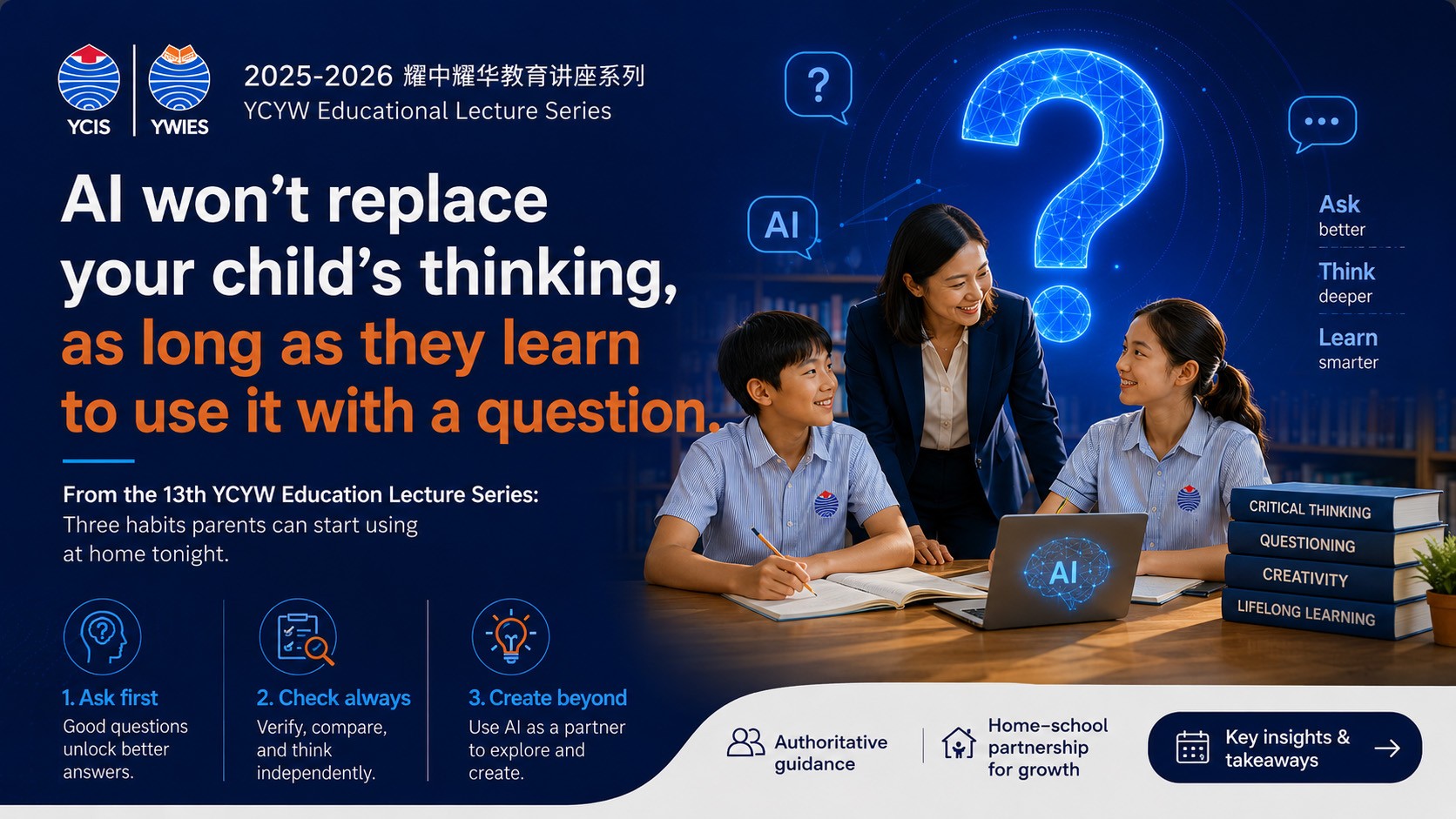
- Before the child uses AI, ask the child: what specific problem are you trying to solve? Turn the task into a question.
- After the child uses AI, ask the child to do one thing: challenge, add to, or push back on at least one point of what the AI produced. Turn use into thinking.
- Keep a daily window of AI-free thinking time: reading, writing, mental arithmetic. Keep the brain's muscle memory of running on its own.
AI is a tool, not a substitute. Hold these three habits steady, and your child grows up knowing how to use the tool and how to keep their own thinking.
Two related YCYW pieces worth reading alongside this one: AI Policy Is the Floor: What Parents Should Ask Schools in 2026 (the regulator's-eye view of AI in classrooms), and When Holistic Education Becomes Inspection-Grade (on wellbeing and whole-person education in 2026).
🎯 About the YCYW Education Lecture Series
Why this lecture series?
With over 90 years of experience in international education, Yew Chung Yew Wah remains committed to driving educational innovation in China with a global perspective. Through the Yew Chung Yew Wah Education Lecture Series, we aim to:
- Break down barriers to information and bring cutting-edge educational ideas to more families
- Build public trust by revealing the true value of quality education
- Unlock children's full potential by co-creating future-ready learning ecosystems
The future of education is not just imagined. It is shaped through dialogue. Join us on this transformative journey and help redefine what is possible.
Full lecture replay · Past episodes of the YCYW Education Lecture Series
Frequently asked questions
The YCYW Education Network is a global education group founded in Hong Kong in 1932. It operates campuses in ten cities across Hong Kong, mainland China (Beijing, Shanghai, Guangzhou, Chongqing, Qingdao, Yantai, and Tongxiang in Zhejiang), and overseas (Silicon Valley in the United States and Somerset in the United Kingdom), serving more than 12,000 students and staff. The network's offering covers early childhood through postgraduate. It includes Yew Chung International School (YCIS) for international and qualifying students, Yew Wah International Education School (YWIES) for Chinese mainland students, and the Yew Chung College of Early Childhood Education (YCCECE).
The YCYW EdFutures team is the network's strategic education innovation and research function. Its role is to drive how AI, programming, immersive technologies, and other emerging tools are adopted across YCIS and YWIES campuses, and to guide students in using these tools well. EdFutures does not act as the sole rule-setter for AI use in any single subject. Subject teachers, curriculum leaders, and campus heads share that responsibility. EdFutures also leads the World Classroom programme, based at the UK Somerset campus, and the Future School pilot at the Tongxiang campus in Zhejiang.
The YCYW Co-Teaching Model places one Chinese national teacher and one international teacher in the same classroom with equal status, co-teaching every lesson. The two share responsibility for the same group of children. Students develop bilingual academic competence in reading, writing, and speaking, and are immersed in real-time fusion of Eastern and Western cultures. At network level, the same logic runs at the top: each YCIS campus is led jointly by a Chinese national and an international principal, ensuring cultural parity in both teaching and decision-making.
CUGO is the YCYW network's university admissions support unit, with more than 29 full-time advisors. The team includes specialists in visual arts and design admissions, Korea pathway, and Japan pathway. CUGO offers the Job Shadowing programme and AI-assisted university planning, and supports admissions to top global institutions including Oxford, Cambridge, Tsinghua, Peking University, and Parsons.
YCYW treats AI as a third presence in the classroom, alongside the existing pair of Co-Teachers, never as a substitute for an adult. The YCYW EdFutures team drives network-level adoption of AI in the curriculum and student-facing AI literacy. Subject teachers, curriculum leaders, and campus heads make the day-to-day decisions about when AI is and is not used in a given lesson. CUGO also uses AI-assisted course planning to support student university preparation.
The core of guiding a child to use AI well is teaching them to use it with a question in mind. Three home habits to start with: 1) before the child uses AI, ask what specific problem they are trying to solve; 2) after the child uses AI, ask them to challenge, add to, or push back on at least one point of the answer; 3) keep a daily window of AI-free thinking time through reading, writing, or mental arithmetic. Rather than arguing about whether to allow AI use, focus on the quality of the questioning before and after each use.