

Go Back
News
YCYW Educational Insights
When holistic education becomes inspection-grade: Ofsted 2026 and what international parents should ask
YCYW Educational Insights
14 May, 2026
12 : 40
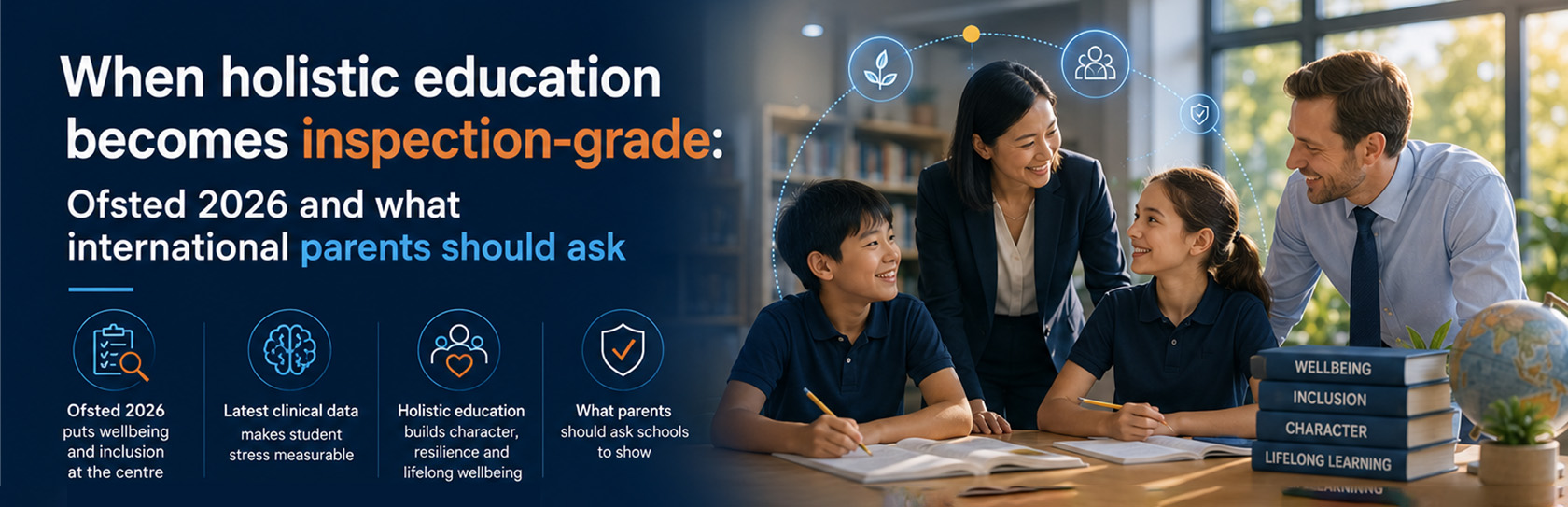
Wellbeing has stopped being a values argument schools make on websites and become an operations one regulators can grade. In 2026, the UK's Office for Standards in Education, the most-watched school inspectorate in the English-speaking world, wrote inclusion and staff wellbeing into its inspection framework. In the same year, clinical research on international student stress in Nanjing reported approximately four in ten students experiencing stress, anxiety or depressive symptoms. These shifts are connected. Together they change what international parents should ask schools to show before choosing one.
The regulator caught up
The Office for Standards in Education has just made the biggest change to school inspection in a decade, and the change is more substantive than the headlines suggest. From 10 November 2025, single overall judgements such as "Outstanding" or "Good" have been replaced by Report Cards that evaluate six separate areas. Inclusion is now its own category. Curriculum "deep dives" have been removed to ease middle-leader workload. Staff wellbeing has, for the first time, been written into the formal inspection requirement. Safeguarding remains a binary "met / not met" judgement. (Ofsted Education Blog 2026)
Ofsted has stopped describing wellbeing in adjectives and started describing it as something a school must produce. The new category names point inspectors toward concrete questions: whether the school includes children who do not fit easily; whether teachers are supported as adults, not just trained as professionals; whether the curriculum is built around how children develop rather than only what they will be tested on.
For a regulator that influences inspection systems across the Commonwealth and beyond, this redefines what good schooling looks like for the next decade.
The data caught up too
Two pieces of recent research explain why the regulator moved.
In 2026, a Brookings consolidation of research on family-school connection argued that family engagement is no longer supplementary. The schools that produce the best outcomes have moved family engagement into the strategic core, with named instruments, written rhythms, and measurable participation. The 2026 review brings together work from Brookings, Action for Healthy Kids, and the Private School Review. The takeaway is consistent: programs that depend on parents and teachers improvising goodwill produce worse outcomes than programs with explicit structure. (Brookings · Moving from family involvement to family engagement)
In the same window, a 2026 Frontiers in Psychology study of international students at a Nanjing-based university reported that approximately 40% of respondents experience frequent stress, anxiety or depressive symptoms. The study focuses on academic-load pressure, but the broader implication is harder to ignore. Cultural transition, language, and academic intensity converge on the same point in a student's nervous system. The cost of treating school culture as a soft factor has become measurable. (Frontiers in Psychology · Academic Load Stress in Nanjing)
Schools that have treated wellbeing as marketing language were operating with worse information than what is now in the public record. Inspectors and lawmakers responded to that.
The infrastructure that already exists
The schools that already built this architecture are reading these 2026 changes as confirmation, not surprise.
The YCYW Education Network is a global education group founded in Hong Kong in 1932. It operates campuses across mainland China (Beijing, Shanghai, Guangzhou, Chongqing, Qingdao, Yantai, and Tongxiang in Zhejiang), Hong Kong, and overseas in Silicon Valley and Somerset. Its century-long core philosophy of holistic education is structured around the Three Alignments: alignment with Science and Technology, alignment with Culture and Arts, and alignment with Love and Charity. The philosophy treats character development as equally important as academic outcomes, and weaves bilingual learning, character formation, and cross-cultural understanding into the daily curriculum. For the 2026 conversation, the philosophy matters less than the operational instruments the network built to deliver it.
Five of those instruments are worth naming, because each one is something a parent can ask a school to produce.
The YCYW 12 Virtues framework. YCYW's character-formation core, defined formally in a 2022 document and rooted in The Virtues Project™ definitions of virtues. Two of the twelve are worth naming as evidence of how the framework maps to modern wellbeing. The virtue of Resilience, under the parent category of Diligence, is defined as "showing the strength of spirit to recover from adversity; overcoming obstacles by tapping into a deep well of faith and endurance." The virtue of Mindfulness, under Wisdom, is defined as "living reflectively and meaningfully, with conscious awareness of our actions, our words, and our thoughts." What educational psychology now calls social-emotional learning, the YCYW document has called character for over ninety years.
The YCYW Learner Portrait. A student self-reflection rubric in two parts: one focused on character, one focused on competency. The character rubric is grounded in the 12 Virtues. The competency rubric is grounded in six attributes: cross-cultural practitioner, knowledge constructor, flexible learner, investigator, thinker, communicator. Students use an "I can…" sentence format to self-assess, with frequency markers from "Never" to "Always." The instrument is for the student, not for the teacher. Self-reflection rather than ranking.
The YCYW Wellness Framework. Cited within the Learner Portrait rubric as one of its formal inputs. Operates at the level of daily lessons, weekly assemblies, and beyond-the-classroom activities. Wellbeing is treated as part of how the school day is built, not as a campaign that runs in October.
The Co-Teaching Model. One Chinese national teacher and one international teacher in every classroom with equal status, co-teaching every lesson. Two adults are present and neither one fills the child's space. In the language of the new Ofsted framework, this is inclusion built into the room rather than added after the fact. Differentiated support is structural, not retrofit.
The YCYW Network Child Protection Policy 2025-26. A unified safeguarding policy across YCIS, YWIES, and YWIEK campuses, refreshed for the 2025-26 academic year. Each campus operates the same baseline policy with jurisdiction-specific compliance addenda. Hong Kong's Mandatory Reporting of Child Abuse Ordinance, which commenced January 2026, is one of the regulatory drivers behind this year's refresh. Mainland China campuses operate the same baseline policy adapted to local requirements. The point is structural: a school network that genuinely operationalises safeguarding maintains one policy across all campuses with explicit compliance mapping per jurisdiction, not a marketing page that reads differently in each region. (YCIS Shanghai · Child Protection, YWIES Tongxiang · Child Protection, YCYW Network Policy PDF)
The point of listing five is not their quantity. The point is that each can be requested by a parent. A school that has genuinely operationalised wellbeing can produce these instruments. A school that has not, cannot.
What this means for international parents
Three questions worth asking a school in 2026.
First, can the school show you a written character framework with named instruments? Not a list of values on a wall. A document with definitions, a rubric students actually use, and a reasonable explanation of how the framework was authored.
Second, can the school show you a child protection policy with an effective date and clear mandatory reporting clauses? Hong Kong's new ordinance is one of several jurisdictions making this a compliance question rather than a values one. A school network that takes safeguarding seriously will operate one policy across all its campuses with jurisdiction-specific addenda. A school that has not updated its policy, or operates different policies in different regions without explicit mapping, will explain why with hedging.
Third, can the school show you what wellbeing looks like in a normal week, not in a special-event week? Daily lessons, weekly assemblies, classroom-level interactions. The 2026 research is unambiguous: programs with structure produce better outcomes than programs with goodwill alone.
The 2026 shift has clarified the choice in front of international parents. Pick the school whose answer to these questions is a document, not an adjective.
A parallel question is shaping the same conversation about AI in schools. For that thread, see our earlier piece, AI Policy is the Floor: What Parents Should Ask Schools in 2026.
Frequently asked questions
YCYW's holistic education is the network's century-long core philosophy, structured around the Three Alignments: alignment with Science and Technology, alignment with Culture and Arts, and alignment with Love and Charity. It treats character development as equally important as academic outcomes, and weaves bilingual learning, the 12 Virtues character framework, service learning, and cross-cultural understanding into the daily curriculum. Day to day, the philosophy shows up through the Yew Chung Approach in early childhood, the Yew Chung Curriculum at primary level, and the Co-Teaching Model across the network.
The YCYW 12 Virtues are the network's character-formation framework, defined formally in a 2022 document and rooted in The Virtues Project™ definitions of virtues. The twelve virtues are Diligence, Frugality, Humility, Faithfulness, Love, Justice, Loyalty, Wisdom, Sincerity, Respect, Harmony, and Courage. The first four were advocated by network founder Madam Tsang Chor-hang. The eight that followed extended the framework for what YCYW describes as the VUCA world. Each of the twelve has associated sub-virtues. Resilience, Mindfulness, Compassion, Empathy, Hope, and Joyfulness are among them.
The YCYW Learner Portrait is a student self-reflection rubric used across YCYW primary and secondary schools. It is built in two parts: a Character Rubric grounded in the 12 Virtues, and a Competency Rubric grounded in six attributes (cross-cultural practitioner, knowledge constructor, flexible learner, investigator, thinker, communicator). The rubric uses an "I can…" sentence format with three frequency levels. It is designed for student self-reflection and teacher-student conversation, not for evaluation by others.
The YCYW Co-Teaching Model places one Chinese national teacher and one international teacher in the same classroom with equal status, co-teaching every lesson. The two share responsibility for the same group of children. Students develop bilingual academic competence in reading, writing, and speaking, and are immersed in real-time fusion of Eastern and Western cultures. At network level, the same logic runs at the top: each YCIS campus is led jointly by a Chinese national and an international principal, ensuring cultural parity in both teaching and decision-making.
YCYW operates a unified Child Protection Policy across YCIS, YWIES, and YWIEK campuses, refreshed for the 2025-26 academic year. The policy is published openly on each campus's child protection page. Each campus operates the same baseline policy with jurisdiction-specific compliance addenda. Hong Kong's Mandatory Reporting of Child Abuse Ordinance, which commenced January 2026, is one of the regulatory drivers behind the 2025-26 refresh. Mainland China campuses operate the same baseline policy adapted to local requirements.
YCYW's Student Wellbeing and Holistic Care system is anchored on the 12 Virtues framework. The Wellness Framework operates at the level of daily lessons, weekly assemblies, and beyond-the-classroom activities. The Seeds of Hope service-learning programme builds emotional resilience through community connection. CUGO (Careers and University Guidance Office) provides specialised career-and-psychological synergy support for upper-grade students, helping them manage admissions pressure.