


Go Back
News
YCYW Educational Insights
Self-Control Is a Muscle: Six Ways to Train It at Home
YCYW Educational Insights
08 May, 2026
17 : 54
Published 7 May 2026 · YCYW Education Network
Key Takeaways
Self-control is not a character trait your child is born with. It is a muscle that lives in the prefrontal cortex. The more it is used, the stronger it gets. The more parents try to manage it from the outside, the weaker it stays. The most effective thing parents can do is turn everyday family life into the place where this muscle gets a small workout each day.
- The brain region responsible for self-control, the prefrontal cortex, does not fully mature until age 25. The younger the child, the weaker the biological baseline. Younger children need more support and structure, not more criticism or pressure.
- Six home practices, recommended jointly by the two experts at the lecture, range from the three-second pause to letting the child be a contributing member of the household. Each one trains the muscle in a different way.
- Two parental habits will quietly undo every one of the six methods: doing too much for the child, and changing the rules from one day to the next.
- In YCYW's nearly century of holistic education practice, character and self-control have always sat alongside academic outcomes, not below them. The starting point is the child, not the parent.
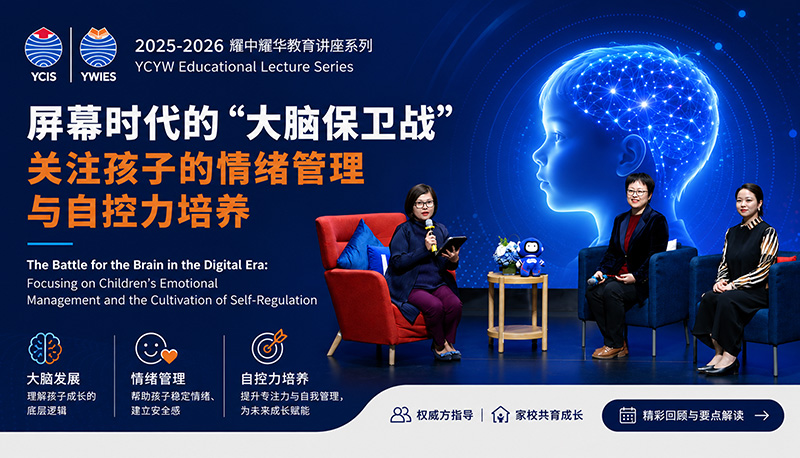
On the evening of 7 May, Yew Chung International School (YCIS) Beijing hosted "The Battle for the Brain in the Digital Era," the thirteenth lecture in the YCYW Education Lecture Series for the 2025–2026 academic year. Dr Jin Yiwen, a paediatrician at Beijing United Family Healthcare, and Ms Zhao Zhanshu, Deputy Editor-in-Chief at China Teacher Training Network and a long-time parenting-media professional, joined Ms Sun Shanshan, the Chinese Co-Principal of YCIS Beijing, for nearly an hour of conversation on how to protect children's emotions and self-regulation in the digital era. This article distils the parts of that conversation that parents are most likely to want to use tonight.
The science of self-control: where it lives, when it grows up
Self-control is not character. It is a muscle that sits in the prefrontal cortex. That was Dr Jin's opening point, and the scientific anchor for everything that came after.
The prefrontal cortex sits behind the forehead. It runs emotion regulation, behaviour control, and impulse management. It also has one fact most parents do not know: it does not finish maturing until around the age of 25. "The younger the child, the weaker the self-control they have," Dr Jin said in the lecture. "Their physiological foundation simply hasn't reached the point where they can control themselves well."
This matters because it changes the question parents are usually asking. The old question is "is something wrong with my child's character." The right question is "is this brain muscle being given a chance to work." When parents try to suppress impulse with willpower alone, or fall into a cycle of criticism, nagging, and doing things for the child, the muscle gets bypassed. It never gets to do its job.
Principal Sun summarised the implication in the lecture: "If we want to respond to the dopamine traps children of different ages face, parents need to first understand the different stages of brain development." Different ages call for different kinds of collaboration with the child, not different intensities of control.
Six home practices parents can start tonight
The two experts each contributed concrete techniques. Combined, they form a list of six. Each one is a specific scenario.
1. The three-second pause. When a child is about to lose their temper, or has a sudden urge to do something (open the phone, demand something now), do not accept or refuse immediately. Coach the child to take a breath, count to three, and decide on the other side. "You'll find the urge drops a little. The child can hold themselves back. They don't feel they have to have it right now," Dr Jin explained. The three-second pause exists to give the prefrontal cortex a moment to step in.
2. Hard things first, then enjoyment. Set a fixed family rhythm: homework first, room tidied first, then the things the child enjoys. Ms Zhao described a scenario most parents will recognise: a parent says, "I'm going to make dinner. Take the iPad and run through this practice paper." The parent has just pushed the child toward the screen and will then scold the child for not putting it down. A "hard things first" rhythm at home is more effective than repeating "stop playing."
3. Two limited choices, not one direct command. "Don't say to your child, 'You have to finish your homework right now.' Give them two options. Option one: play for fifteen minutes, then do homework. Option two: finish homework, then play for half an hour," Dr Jin said. The choice itself trains self-control. While the child compares the two options and decides, the prefrontal cortex is doing its work.
4. Family as mirror, start with yourself. "Parenting is like looking in a mirror. The kind of person a child grows into is often a reflection of the parent," said Ms Zhao. If the parent looks at a screen at the dinner table or scrolls during family time, the child sees the same screen-first behaviour reflected back. Ms Zhao put the point bluntly: "The one telling them to play is you. The one telling them to stop is also you."
5. Redirect attention rather than ban outright. For younger children, Ms Zhao's suggestion is to substitute, not forbid. "Let's build with blocks for a bit, then we can read a picture book." The redirection lets the child wait through the urge. This kind of delayed gratification trains the waiting muscle better than a flat "no."
6. Make the child a member of the household, not the only treasure in it. This was Ms Zhao's deeper point in the lecture: "As a parent, you have to treat them as a member of the household. Maybe the kettle is too hot, and you never let them touch it; they don't know it's hot. But once you give them the chance, they know next time: I can choose not to touch it. I have a better way to deal with it." Letting the child take part in everyday family life, chores, small decisions, small responsibilities, is the actual soil in which self-control grows.
Two parental habits that quietly undo all of the above
The two experts, working from very different professional backgrounds, agreed on two habits parents need to watch.
The first is doing too much for the child. "If we keep doing every step of every task for them, the brain's self-control function gets no exercise. The prefrontal cortex never gets activated," said Dr Jin. Constant nagging, endless help, taking over the parts the child should be doing themselves, all of it amounts to "stepping in for the child." A muscle that never gets used does not grow.
The second is rule inconsistency. "If the rule today is one thing, and tomorrow it is another, the child gets very confused. Today the parent is in a good mood and lets them watch fifteen minutes more. Tomorrow the parent had a bad day at work and won't let them touch the screen at all. The training of self-control becomes unstable," Dr Jin said. Family rules do not need to be strict. They need to be stable. When children know where the boundary is, they can build their own internal sense of judgement.
What this looks like inside YCYW
The reason the lecture resonated so strongly with parents at YCIS Beijing is that "self-control is a muscle, not character" describes something YCYW has been doing for nearly a century.
Holistic education at YCYW does not place character below academics. Character and academics live alongside one another, and they show up in every classroom, every shared meal, every interaction between teacher and child. The Yew Chung Approach and its 12 Values treat children as capable learners. The teacher-child relationship is one of partnership, not management. That is the systemic version of the "do not step in for the child" principle the lecture described.
The Co-Teaching Model that has run inside YCIS classrooms for decades is the same logic from another angle. One Chinese national teacher and one international teacher are present in the same classroom at the same time. Either of them can step in when the child needs help, and neither of them does the child's thinking for them. Two qualified adults are in the room and neither one occupies the child's space. That collaboration shape is what we suggest parents recreate at home.
In daily life with your child, the same logic works. Be present without doing it for them. Offer real options without forcing the choice. Respond to setbacks by helping the child see what to do next, not by withdrawing or criticising.
A closing note
Self-control does not grow from a single act of willpower. It grows from small, repeated practice in the everyday. The prefrontal cortex gets stronger when no one is looking. There is a set of practices in this YCIS Beijing lecture that you can begin using tonight.
🎯 About the YCYW Education Lecture Series
Why this lecture series?
With over 90 years of experience in international education, Yew Chung Yew Wah remains committed to driving educational innovation in China with a global perspective. Through the Yew Chung Yew Wah Education Lecture Series, we aim to:
- Break down barriers to information and bring cutting-edge educational ideas to more families
- Build public trust by revealing the true value of quality education
- Unlock children's full potential by co-creating future-ready learning ecosystems
The future of education is not just imagined. It is shaped through dialogue. Join us on this transformative journey and help redefine what is possible.
Full lecture replay · Past episodes of the YCYW Education Lecture Series
Frequently asked questions
The YCYW Education Network is a global education group founded in Hong Kong in 1932. It operates campuses in ten cities across Hong Kong, mainland China (Beijing, Shanghai, Guangzhou, Chongqing, Qingdao, Yantai, and Tongxiang in Zhejiang), and overseas (Silicon Valley in the United States and Somerset in the United Kingdom), serving more than 12,000 students and staff. The network's offering covers early childhood through postgraduate. It includes Yew Chung International School (YCIS) for international and qualifying students, Yew Wah International Education School (YWIES) for Chinese mainland students, and the Yew Chung College of Early Childhood Education (YCCECE).
YCYW's holistic education is the network's century-long core philosophy, structured around three commitments: alignment with technology, alignment with the arts, and alignment with love and charity. It treats character development as equally important as academic outcomes, and weaves bilingual learning, the 12 Values character framework, service learning, and cross-cultural understanding into the daily curriculum. Day to day, the philosophy shows up through the Yew Chung Approach in early childhood, the Yew Chung Curriculum at primary level, and the Co-Teaching Model across the network.
The YCYW Co-Teaching Model places one Chinese national teacher and one international teacher in the same classroom with equal status, co-teaching every lesson. The two share responsibility for the same group of children. Students develop bilingual academic competence in reading, writing, and speaking, and are immersed in real-time fusion of Eastern and Western cultures. At network level, the same logic runs at the top: each YCIS campus is led jointly by a Chinese national and an international principal, ensuring cultural parity in both teaching and decision-making.
The Yew Chung Approach is YCYW's nine-decade early childhood education methodology. It blends Confucian thought with Western progressive education theory (Dewey, Reggio Emilia) and rests on three pillars: the 12 Values, Emergent Curriculum, and Bilingual Learning Communities built through Co-Teaching. It is the core academic content taught at the Yew Chung College of Early Childhood Education (YCCECE).
Yes. Paediatric neurology and developmental psychology agree that the brain region responsible for self-control, the prefrontal cortex, develops from childhood through approximately age 25. The "self-control muscle" can be strengthened over time through small, intentional everyday practice. Effective methods include delayed reactions (the three-second pause), a fixed "hard things first" routine, offering limited choices instead of commands, modelling the behaviour parents want, avoiding overhelping, and keeping family rules consistent.
The core of helping a child develop self-control is not suppression by willpower. It is turning everyday family life into a place where the muscle gets a small workout. Six habits to start with: 1) when the child is about to act on impulse, coach a three-second pause and breath; 2) build a "hard things first, enjoyment after" routine; 3) offer two limited options instead of a single command; 4) model the behaviour by putting your own phone down during family time; 5) substitute attention rather than ban outright; 6) let the child contribute to everyday household life as a real member of the family. Avoid two pitfalls: doing too much for the child, and changing the rules from one day to the next.