


Go Back
News
YCYW Educational Insights
My Child Wants to Quit. What Do I Do?
YCYW Educational Insights
26 May, 2026
17 : 47
Key takeaways
"Sometimes whether to quit is not up for discussion. How to keep going — that we can work on." — Dr. Chen Yibin
- Three root causes of the plateau phase: practice rhythm too thin, lost sense of purpose, feelings going unseen
- "Should we quit?" and "how do we keep going?" are entirely different questions
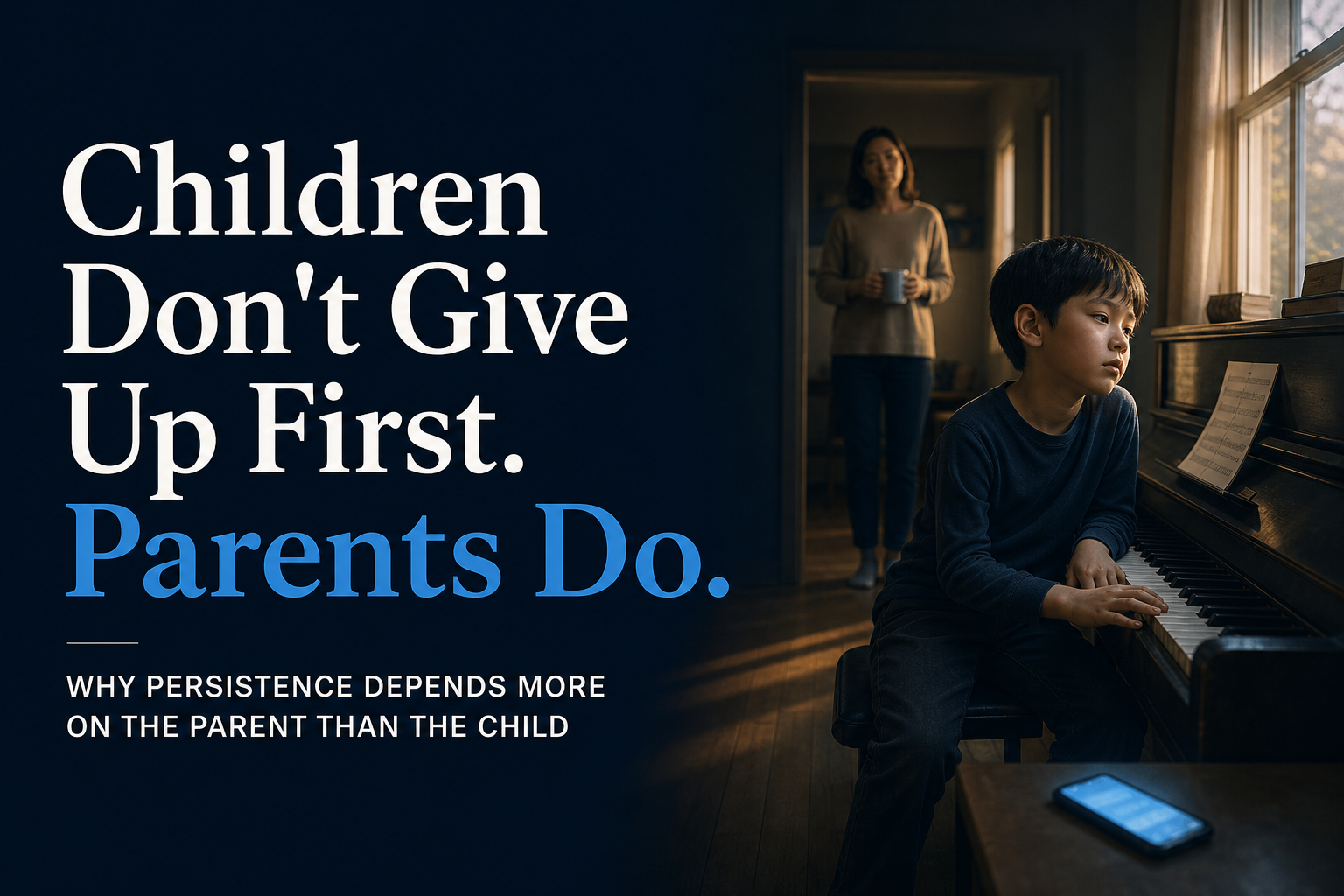
- Most of the time, it's the parent who gives up first — and then the child follows
- Belonging is the foundation for any persistence; encouragement reinforces process, praise reinforces outcome
Ten children start learning piano together. Two stop showing up the first time it rains. One gets sick, and when they recover, nobody says "let's pick up where we left off" — so they never do. The piano teacher makes an offhand comment about one child's hand position, and that child's mother decides that same evening they're done. How many are left by year two?
This is the opening scene Dr. Chen Yibin described at a YCYW parent lecture. His question: are those children actually unsuited for piano — or did something happen along the way that could have been handled differently?
A Plateau Isn't a Character Problem. It Has Causes.
In Session 14 of YCYW's 2025–2026 Lecture Series, Dr. Chen identified three root causes behind the plateau phase that leads children to want to quit (approx. 40:31–44:05).
Cause 1: The practice rhythm is too thin
Once a week is too infrequent for skills to compound. Each session feels like starting over. Each session feels like starting over. Dr. Chen's principle of "energy concentration" holds that a dense period of engagement — enough to build a foundation — is more effective than sparse, widely spaced repetition. Children stay motivated when they can feel themselves actually getting better.
Cause 2: They've forgotten why they're doing it
Loss of purpose is the most common trigger for the plateau phase. When a child can't see the connection between what they're practicing and anything real in the world, the effort starts to feel pointless. Explaining why doesn't fix this — the explanation is abstract. Dr. Chen's approach is to put children in a real context: take them to a live performance, introduce them to someone who actually does this thing, let them see what it looks like up close.
Cause 3: Their experience isn't being seen
A child who feels stuck, frustrated, or quietly convinced they're incapable is developing what psychologists call learned helplessness. If that state goes unnoticed, they stop there. What's required isn't an encouraging phrase — it's actual observation: do you know where your child is stuck, and what it feels like for them to be stuck there?
Each of these has a way through. But before getting to methods, there's a more foundational question to settle first.
"Should We Quit?" and "How Do We Keep Going?" Are Not the Same Question
Many parents conflate these two. When a child says they want to stop, the conversation becomes negotiation — reasoning, bargaining, eventual compromise. The result is that neither question gets answered: the child doesn't learn to persist, and the parent never figures out whether this thing is actually worth continuing.
Dr. Chen put it plainly at the lecture (approx. 47:13):
"Sometimes whether to quit is not up for discussion. How to keep going — that we can work on."
The logic is straightforward: whether something is worth persisting through is a judgment for the parent, not a vote taken during the hardest stretch. But the way of persisting — the frequency, the difficulty level, the type of support, the emotional scaffolding — these can all be redesigned. They're variables parents can actively change.
Treating "should we quit?" as a negotiable question just gives the child a button to press whenever things get hard.
Most of the Time, the Parent Lets Go First
In the plateau phase, children are watching: does this actually matter to you? Will you hold the line when I don't want to, or will you fold with me?
Dr. Chen described several patterns he's observed repeatedly (approx. 47:48):
The patterns Dr. Chen described tend to look like this:
- A child is sick for two weeks. They recover, and nobody says "let's get back to it." It just ends
- One rainy day they don't go. The next dry day they still don't go. Then they never go again
- The piano teacher says "what's the point after Grade 10?" and the parent quietly cancels the next lesson
- One evening the child doesn't want to practice, the parent is tired too — once becomes twice, becomes the new habit
In every case, it's the parent who loosens the grip first.
"Most of the time, it's the parent who gives up first — and then the child follows." (Dr. Chen Yibin, approx. 47:48)
This isn't an accusation. It's an observation about where a child's capacity to persist actually comes from.
Belonging Is the Foundation Everything Else Sits On
The first step of Dr. Chen's seven-step framework is not to make a plan or set a goal. It's to make sure the child knows they are loved — unconditionally, regardless of performance (approx. 01:12:00).
He described a practice he kept up for eleven and a half years: every night before bed, without exception, telling his child "I'm so lucky to have a son like you," or "I'm so happy to have a daughter like you" — no matter how that day had gone.
"Is your child your good child? Does that have anything to do with their grades? No. It has to do with one thing only: you are my child." (Dr. Chen Yibin, approx. 01:12:38)
When a child knows their parent's love isn't conditional on performing well, they have the psychological safety to fail, to get stuck, to be temporarily incapable — without needing to fake persistence out of fear, or abandon the effort entirely because the cost feels too high.
Everything that follows in the framework depends on this being in place first.
Encouragement and Praise: One Fuels, One Backfires
Step five of Dr. Chen's framework (approx. 01:19:52) draws a distinction that sounds subtle but changes outcomes.
Praise is externally directed and result-focused: "You played so well today," "That was better than last time." These are useful when a child is doing well. When a child is struggling, they close a door — the child can't perform well right now, so the praise is unavailable, which only confirms their sense that they're not good enough.
Encouragement is internally directed and process-focused: "You kept going even when you were in tears — that matters." It reinforces the act of persisting, not the quality of the output. A child who played badly today, who hasn't improved in two months, can still receive this and find a reason to continue.
"You're really able to keep going. You kept at it even with tears in your eyes. That's genuinely impressive." (Dr. Chen Yibin, example, approx. 01:19:52)
In the plateau phase, a child can't produce the kind of result that earns praise. Encouragement works precisely because it doesn't require one.
Of those ten piano students, the ones who are still playing years later are rarely the most talented. They tend to be the ones whose parents never quietly let go.
A child doesn't need a parent who is never tired. They need one who holds on a little longer than the child can.
The Seven-Step Accompaniment Framework
The following framework was presented by Dr. Chen Yibin at Session 14 of YCYW's 2025–2026 Education Lecture Series.
| Step | Core Focus |
|---|---|
| Step 1 | Belonging — ensure the child knows they are unconditionally accepted |
| Step 2 | Emotional connection — genuinely understand what the child is feeling right now |
| Step 3 | Boundaries and planning — set expectations together, not unilaterally |
| Step 4 | Warm but firm — don't shift your position based on the child's emotional state |
| Step 5 | Encourage, don't just praise — reinforce the process, not the result |
| Step 6 | Graduated challenge — scaffold the difficulty, start from where the child can actually reach |
| Step 7 | Effective support — identify the specific sticking point and address it directly |
🎯 About the YCYW Education Lecture Series
Why we hold this lecture series
The YCYW Education Lecture Series is a knowledge-sharing platform for parents, bringing in specialists in child development and family education to discuss the issues families care about most.
- Topics: Child development / Parent-child relationships / Learning motivation / Language development / Character education
- Format: On-site lecture + live broadcast on WeChat Video Channel and Boliwei
- Open to: All families interested in supporting their children's growth
📌 2025–2026 Academic Year, Session 14: "Illuminating Potential, Purposeful Accompaniment" — Guest: Dr. Chen Yibin, Host: Ms. Du Lei, 22 May 2026
Full lecture recording · YCYW Education Lecture Series archive
Frequently asked questions
Plateaus and low-motivation periods are a normal part of development, not a sign that something is wrong. YCYW's support works on two levels. Emotionally, the school's dedicated Social-Emotional Learning (SEL, 心理与学生发展支持) system ensures that a child's state is professionally seen and addressed, rather than ignored or criticized. Academically, the Co-Teaching model (协同教学) — Chinese and international teachers working together — combined with scaffolded instructional design helps children find a foothold when they're stuck, rather than being pushed forward at a pace that isn't theirs.
Perseverance (坚毅) is one of YCYW's 12 character virtues. The school's approach is not to teach perseverance as a concept but to create conditions where students experience it firsthand — through service-learning initiatives like Seeds of Hope (希望种子), World Classroom immersions, and other real-world challenges where difficulty is built in. Perseverance practiced in a meaningful context holds differently than perseverance discussed in a classroom.
Intrinsic motivation depends on a sense of purpose, and purpose comes from real experience — not from being told why something matters. YCYW's interdisciplinary projects, community service programs, and overseas learning experiences (World Classroom) create the kind of direct encounters Dr. Chen describes: children seeing, firsthand, why the things they're learning actually connect to the world outside school.