


Go Back
News
YCYW Educational Insights
Is My Child Struggling Because They Lack Talent?
YCYW Educational Insights
23 May, 2026
07 : 23
Key takeaways
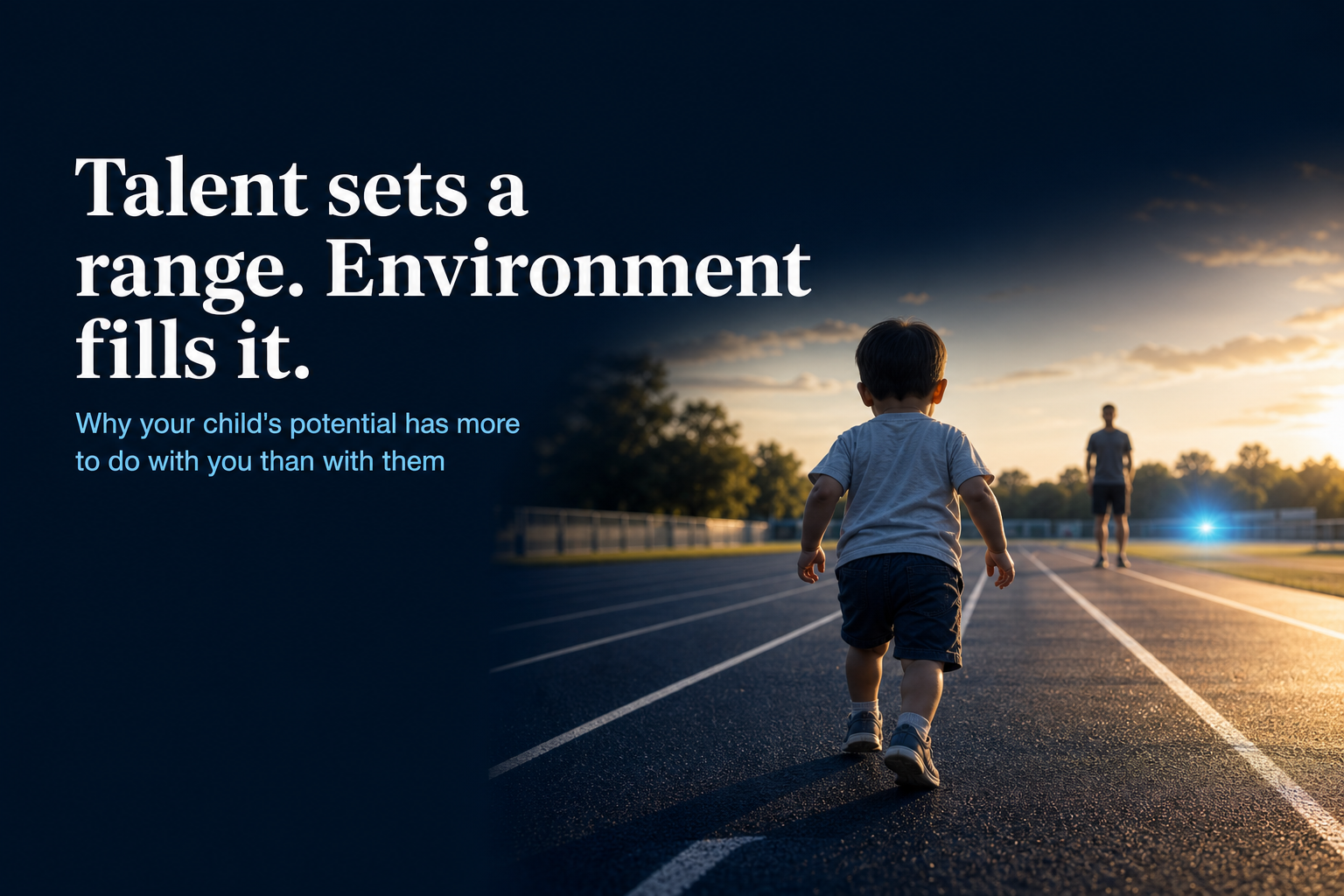
Talent sets a range. Environment decides where within that range a child lands — and environment is something parents can choose.
- Believing interest is "developed" is what allows parents to take responsibility for it
- Talent sets a developmental range, not an outcome — environment places the child within that range
- The people the world calls geniuses are usually the first to reject the label
- Parents see the result. What they don't see is the parenting that made the result possible
Picture a three-year-old: 67 jin (roughly 33 kg), barely any physical activity, happiest when walking slowly hand-in-hand with his grandfather around the neighborhood. If someone asked whether this child had athletic potential, most people would shake their head.
Four years later, that same child had taken up 12 sports. In five or six of them, he was already ahead of his peers. People around him started calling him a "little sports star." And then his parents said: this kid has athletic talent.
Same mouth. Four years earlier: no talent. Four years later: obvious talent. What changed in between was not the child's genes. It was the environment around him.
Discovered or Developed? The Question That Changes Your Behavior
In the 14th session of YCYW's 2025–2026 Lecture Series, child development specialist Dr. Chen Yibin opened with a question for parents in the room: is interest something that gets discovered, or something that gets developed?
This isn't a philosophical debate. It's a practical one — because the answer you hold shapes what you actually do.
If you believe interest is discovered:
Your approach is to wait. You wait for talent to show up before you invest. When a child loses interest, the instinct is attribution — maybe he takes after his dad, maybe she takes after her mum, just not the right genes. Responsibility slides off. Case closed.
If you believe interest is developed:
The same moment sends you inward. You start asking: did I lose my temper during a practice session and leave a crack in their confidence? Did the difficulty level suddenly spike and leave them feeling helpless? Did something a teacher said stick in a way that's been quietly working against them? You don't reach for talent as an explanation, because you know there's something specific to find.
"Why do I want everyone to believe interest is developed? Because only then will you take responsibility for it." — Dr. Chen Yibin
Talent Gives You a Range. It Doesn't Give You an Answer.
Many parents treat talent as a binary: either you have it or you don't. Dr. Chen described something more like a map.
Every child is born with a developmental range — a span that runs from ordinary to elite. That range is what talent determines. But where within that range a child actually ends up has little to do with talent itself. That's determined by environment: what the family provides, what the school provides, what parents choose.
Development doesn't move in one direction. A child who is never challenged, who is consistently mishandled, or who gets compared to others at the wrong moments will slide toward the lower end of their range. A child who looks like they have no particular talent, placed in the right environment with the right support, can reach the top of it.
The people the outside world calls geniuses tend to be the first to reject the label. Olympic skier Su Yiming (苏翊鸣) has said: "Without effort, none of this would have happened." Concert pianist Wang Chun, in a masterclass with one of Dr. Chen's sons, put it plainly:
"Talent is the least reliable thing. Without effort, none of it matters."
They know why they're where they are. It isn't because of what they were born with.
Four Years in the Life of One Small Kid
That 33-kilogram three-year-old was Dr. Chen's elder son.
At three and a half, Dr. Chen decided to introduce him to sport. But he didn't begin with "go for a run." He began with himself. He ran every day — in rain, in wind, on work trips away from home. He came back sweaty and out of breath, filmed himself, sent the videos to his wife, and had his son watch them the next morning. He kept this up for three months.
One day his son said: Dad, I want to run too.
Dr. Chen asked: how far do you think I started at? Five hundred meters? No, he said. Two hundred. We start from where you can actually reach.
One sport at a time, this child eventually built a life around 12 of them. What the outside world saw was a kid winning competitions. What it didn't see was a father running at 1 a.m. before going to bed.
"We parents tend to enjoy the outcome, to see the outcome — while forgetting to notice what the parent was doing before that outcome could exist." — Dr. Chen Yibin
The younger son's story runs alongside this one. He was playing badminton from an early age — able to serve at one year and seven months. That wasn't natural ability: it was hundreds of repetitions with his father's hands guiding his.
One day, at the courts, he was next to a child a year older who still couldn't serve. That child's parents looked over and said — seven or eight times in a row — "Look at little brother, look how well little brother plays." That older child eventually gave up badminton.
A few years later, someone asked about Dr. Chen's younger son: which coach does he train with? Someone nearby said: he was just born like that. Nobody asked the father about the three months of late-night videos.
When a Child Stops Learning, Don't Jump to Conclusions
Two mothers opened the lecture with what sounded like entirely different problems.
One said: my son is eight. He's tried drawing, piano, taekwondo — every time, three or four sessions in, he says he doesn't like it and quits. Is he just born without any drive?
The other said: my child is genuinely bright. Excellent memory, fast learner — everyone told us he was gifted. Then in fifth grade, he suddenly wanted to stop, and his results started slipping. How does a child like that end up here?
Different problems on the surface — but the same question underneath: why did this child lose the ability to stay invested? Dr. Chen's answer: there is always a reason, and that reason is almost never talent.
The reason might be any of these:
- A parent raised their voice during a practice session and left a quiet crack in the child's confidence
- A teacher tapped the child on the head with a pen, and something in that child never fully relaxed again
- The difficulty jumped too fast and no one helped them find a foothold
- "Look at the other kids" was said often enough that they stopped believing they were capable
These are not talent problems. They are problems with causes — and causes can be found.
"The solution to a problem is almost never found in the problem itself. It's found in what formed it." — Dr. Chen Yibin
Environment Is a Variable, Not Just a Backdrop
Dr. Chen put it plainly: as children grow older, the gap between family and school environments has an increasingly decisive effect on developmental outcomes. In infancy, most children are close to the same starting point. The further you go, the more the environment matters.
This is not a pessimistic observation. It's an actionable one. Environment is a real variable — and it's one parents can actively shape and choose.
Yew Chung Yew Wah Education Network's (耀中耀华教育网络) whole-person education (全人教育, Holistic Education) philosophy is built on exactly this premise: every child has potential that can be cultivated, and what matters is creating an environment capable of drawing it out. Three structural commitments reflect this:
- Co-Teaching (协同教学) — Chinese and international teachers working together to deliver differentiated support
- Scaffolded instructional design — ensuring children start from where they can actually succeed, not where adults assume they should be
- Social-Emotional Learning (SEL, 心理与学生发展支持) — a dedicated support system so that a child's emotional state during learning is seen, named, and held
That small boy grew up. He has won his school's badminton championship several years running. People say: born to it — natural talent.
"Heaven gives every child a meal. The question is whether you helped your child learn how to pick up the bowl." — Dr. Chen Yibin
The child who learned to pick up his bowl had a father who ran at midnight for three months to show him how.
🎯 About the YCYW Education Lecture Series
Why we hold this lecture series
The YCYW Education Lecture Series is a knowledge-sharing platform for parents, bringing in specialists in child development and family education to discuss the issues families care about most.
- Topics: Child development / Parent-child relationships / Learning motivation / Language development / Character education
- Format: On-site lecture + live broadcast on WeChat Video Channel and Boliwei
- Open to: All families interested in supporting their children's growth
📌 2025–2026 Academic Year, Session 14: "Illuminating Potential, Purposeful Accompaniment" — Guest: Dr. Chen Yibin, Host: Ms. Du Lei, 22 May 2026
Full lecture recording · YCYW Education Lecture Series archive
Frequently asked questions
Whole-Person Education (Holistic Education) has been at the core of YCYW's philosophy since the school's founding in 1932, built around three missions: Alliance with Technology, Alliance with the Arts, and Alliance with Humanity. It means placing character development on equal footing with academic achievement — through bilingual learning communities, a structured character education program, and service-learning initiatives like Seeds of Hope (希望种子) — to cultivate students with both global perspective and genuine empathy.
YCYW's position is that the difference between children is not in their talent — it's in whether their environment is good enough. The school's Co-Teaching model (协同教学) delivers differentiated support through Chinese and international teachers working together; scaffolded instructional design ensures children start from where they can actually succeed; and a dedicated SEL (Social-Emotional Learning, 心理与学生发展支持) support system means that a child's emotional state during learning is seen, named, and held — not left unaddressed.
Dr. Chen Yibin's position is direct: the older a child gets, the more the gap between family and school environments shapes their developmental path. YCYW provides continuous education from early childhood through high school, with a stable bilingual-bicultural environment and a structured character development framework, ensuring that at every critical stage of growth, a child is in an environment that genuinely supports their potential.