


Go Back
News
YCYW Educational Insights
A New Teacher This Term: How Can Your Child's Learning Carry On?
YCYW Educational Insights
08 Sep, 2026
21 : 14
A new teacher needs to get to know your child and understand where their learning has reached. For a family whose child is already enrolled but has a different class or subject teacher this year, that brings a practical question: have last year's useful strategies, unfinished learning and agreed support reached the person taking over?
On 31 August 2026, GEMS Education reported welcoming 1,550 educators for the 2026–27 academic year. This operator-reported arrival figure cannot establish staff turnover or how many recruits are new to teaching. It does prompt a useful start-of-term question: how does a school help an incoming teacher pick up students' learning?
What does “new teacher” mean here?
A teacher who is unfamiliar to your child may have worked at the school for years. Someone joining the school may already have considerable teaching experience. Entering the profession, moving to a new school and teaching this particular class for the first time involve different support needs.
At an initial meeting, you can ask about the ages and curricula the teacher has taught, and which colleagues will help them get to know this class. The purpose is to understand the transition; meeting a new teacher need not become a job interview.
On 3 September 2026, Northern Ireland's Department of Education announced enhanced support for newly qualified teachers, with online learning resources, face-to-face courses, live webinars and guidance from experienced colleagues during the induction year. This is an announced programme in Northern Ireland, not a requirement for schools in Hong Kong or mainland China or evidence of results. It gives parents a specific question to ask: what learning and colleague support remain available after the teacher starts teaching?
Make the learning handover concrete
Ask the school which information will help the teacher understand your child. A report can provide a starting point, but a score may not reveal where a learner gets stuck. You could bring a recent piece of work and point out what your child can complete independently, where reminders are still needed and which help has been useful before.
For example, instead of saying that a child is “weak in Chinese”, discuss whether they can understand the question, organise their ideas or turn a spoken answer into a paragraph. This is a hypothetical example of making a broad impression specific enough to discuss. The teacher will still need to observe the child in class and may not use every previous approach.
If your child already receives language or learning support, ask the school to confirm what information the incoming teacher has received, which arrangements will continue and which need discussion. Parents can add relevant family updates without taking over responsibility for transferring the whole student file or sharing personal information in a parent group chat.
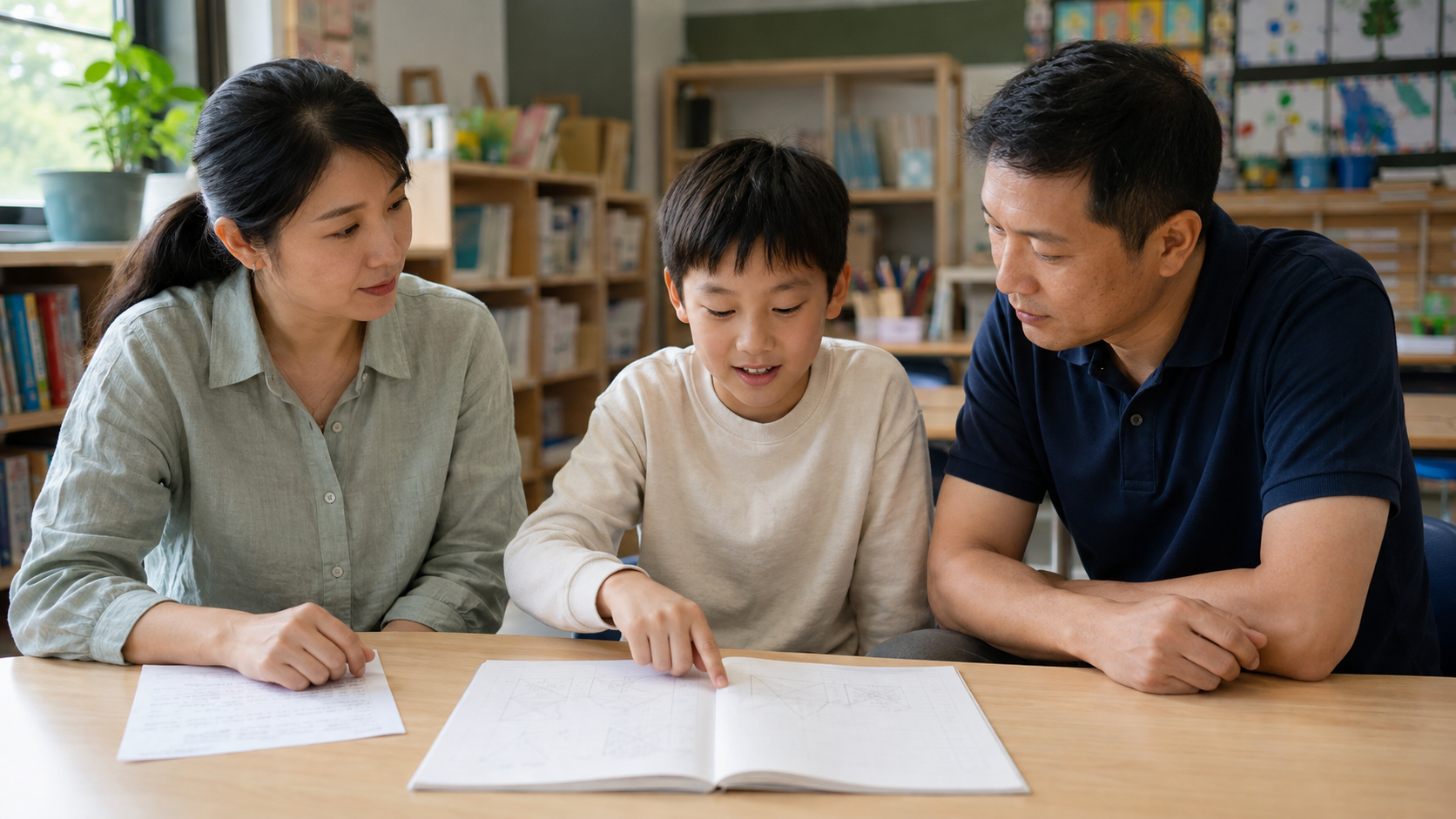
Images are AI-generated illustrations, not records of actual school events.
Who works alongside the teacher?
Handover also involves the teacher's work with colleagues. Families can ask who discusses classroom progress with the incoming teacher, who helps with language or learning needs, and whom to contact first with a question.
Within the YCYW Education Network, Yew Chung International School of Beijing described its preparations for the new school year in an article published on 15 August 2026. It outlined a week of pre-term professional training for all staff, covering teaching practice, child protection and campus safety. This campus report explains the training content. It does not describe how each child's learning information is handed over or establish identical arrangements across campuses.
Introducing families to support teams is another practical part of starting the school year. In its back-to-school report published on 1 September 2026, Yew Wah International Education School of Shanghai Lingang described a management-team welcome session for returning parents. Heads of school sections, the wellbeing team and the residence management team explained teaching arrangements, academic support and boarding services. The session gave parents an opportunity to learn about school support; the report likewise did not describe how individual children's learning information was handed over.
For families, the training content can be a starting point for discussion. Where will information about their child's learning be considered? If the teacher's observations differ from existing records, whom can they consult?
Let the first follow-up lead to a next step
Every change at the start of term need not be treated as a problem. Agree a suitable time to follow up with the teacher, using one current learning task as the basis for exchanging observations. What can the child do in class? Which part does the child find difficult? Does that match what the family sees at home?
If observations differ, use the same piece of work or a similar task to clarify the difference before deciding whether support should change. The useful outcome of a conversation can be modest: one classroom arrangement to confirm, someone responsible for following it up, and an agreement about what to look at next time.
If a problem affecting learning or agreed support remains unanswered, contact the year or section leader through the school's normal channels, with specific examples and a record of earlier communication. There is no need to wait a fixed number of weeks before raising a need.
A one-page note to bring to the meeting
- One thing your child can currently do independently, and one area where help is still needed.
- A recent piece of work and an approach that has helped before.
- Existing support to confirm with the school, plus relevant family updates.
- The next step agreed at the meeting, who will follow it up and how.
This note need not become another scorecard. Its purpose is to start a conversation about the child's actual learning and give the family and teacher something to return to when they next meet.