

Go Back
News
YCYW Educational Insights
New Curriculum, Same Classroom? A Parent Guide | YCYW
YCYW Educational Insights
01 Sep, 2026
14 : 31
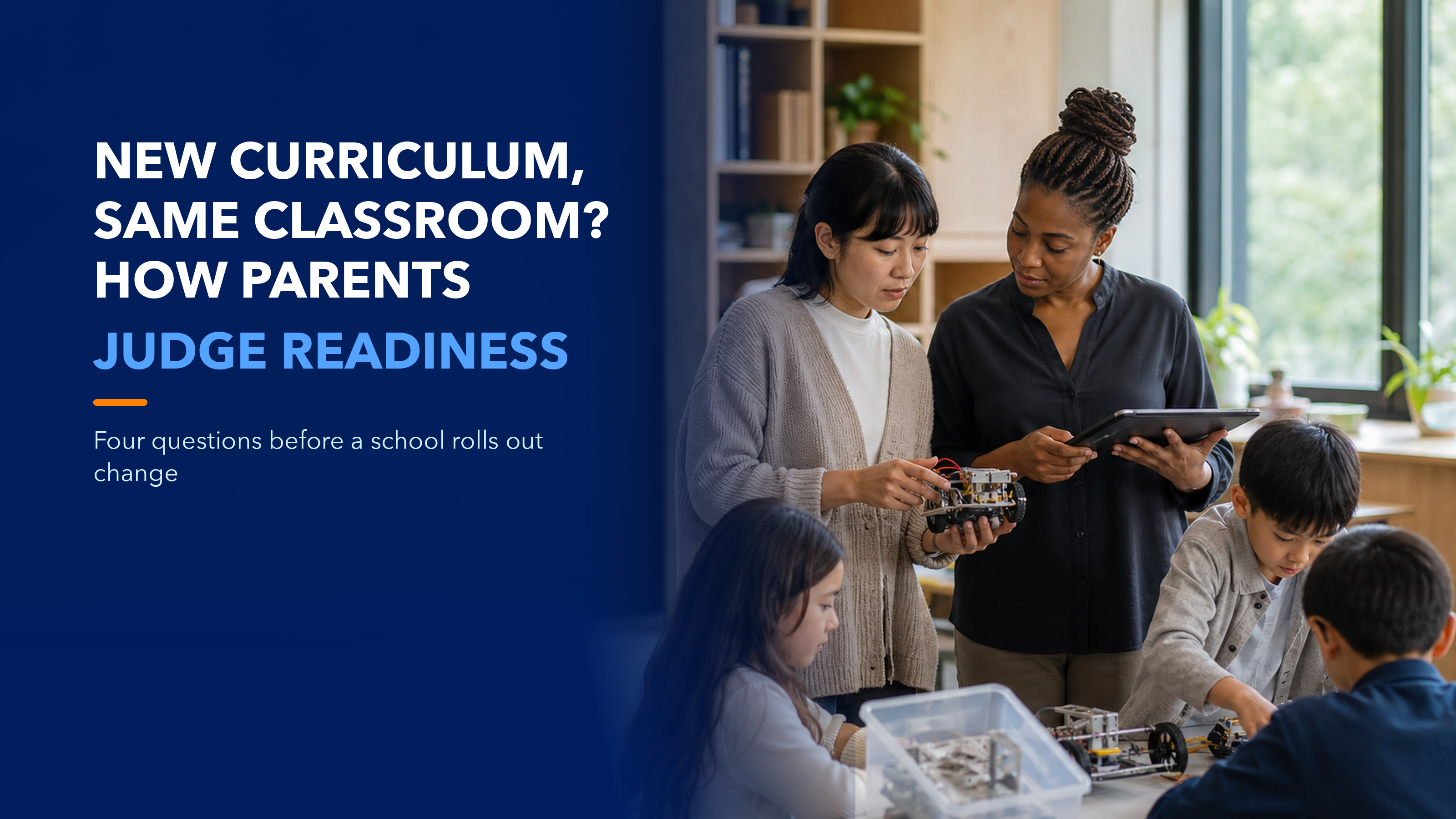
In Alberta's 2026/27 school year, curriculum change will reach classrooms in two different ways. Grades 4 to 6 will implement a new social studies curriculum, while schools may choose to pilot draft curricula for Grades 7 to 9.
The distinction is useful well beyond Alberta. A date tells families when a change begins. It does not show whether teachers have had time to prepare, whether the materials work with real students, or whether classroom evidence can still change the plan.
So when a school announces a new curriculum, the most useful question is not “How new is it?” but “What makes the school ready to teach it?”
What readiness looks like before launch day
No school can know in advance that every part of a curriculum change will work. Readiness means being able to manage that uncertainty. Four things should be visible:
- Teachers can influence or interpret the change before it reaches routine use.
- Staff have time, professional learning, materials, and practical support.
- Classroom testing is designed to produce useful evidence.
- Someone has the authority to revise, delay, or stop what is not working.
These are not universal compliance rules. They are four practical checks drawn from recent curriculum reforms, education-technology guidance, and OECD research on how curriculum intentions become classroom practice.
Teachers need a route back into the design
An OECD paper published in 2026 describes teachers as professional co-designers and interpreters of curriculum. Teachers are also the people who must turn written intentions into choices about explanations, tasks, language, assessment, and support for individual students.
This is why involvement has to mean more than attending a briefing after the important decisions have been made. Classroom knowledge needs a route back into the work.
Korea's Ministry of Education offers one current example. Its programme for 16 AI-related subjects involves classroom teachers directly in curriculum analysis, unit design, and textbook writing. Six subjects are for primary school, two for middle school, and eight for high school. The planned sequence separates development from a first-semester 2027 trial, a recognition review later that year, and classroom use from March 2028.
The example is specific to AI textbooks in Korea, not a template for every school. Its value lies in the staging: teachers contribute before routine use, and the materials pass through trial and review before wider application.
Preparation has to reach the working week
Professional learning is easy to promise and harder to protect. The OECD links implementation to formal learning opportunities, conversations with colleagues, and schedules that give teachers time to collaborate around curriculum goals. A single workshop is unlikely to carry a change that affects pedagogy, assessment, or the language of instruction.
The Alberta Teachers' Association made this concern concrete when the K–6 social studies curriculum was released. It argued that teachers needed time to review the curriculum and resources, work with colleagues, and plan for complex classrooms. It also welcomed field testing and called for teachers to help guide development.
Families do not need access to the staff timetable, but they can ask what preparation has actually happened. Who took part? What did teachers work on together? Are materials and assessment examples ready? What support remains available once students begin using the curriculum?

A pilot needs a decision rule
Pilots sound reassuring, but the label alone says little. A school can run new activities, collect general feedback, and still move ahead without deciding what would count as a serious problem.
Alberta's official account separates field testing from classroom pilots. More than 100 teachers from 43 school boards field-tested selected Grades 7 to 9 outcomes in early 2026, after which the drafts were refined. Optional classroom pilots create another feedback stage before planned mandatory implementation. The important point is not the number of phases. It is that feedback is expected to affect the next version.
The US Department of Education's August 2026 guidance on education technology goes further. It asks schools to identify the learning problem a tool should solve, examine evidence of learning impact, support implementation, and review effectiveness. If the evidence shows that a tool is not helping learning, schools should change course; persistent shortcomings should lead to removal.
This guidance concerns education technology, not a whole curriculum. The transferable question is still useful: before testing begins, has the school decided what it will observe, who will review the findings, and what would trigger revision, delay, or withdrawal?
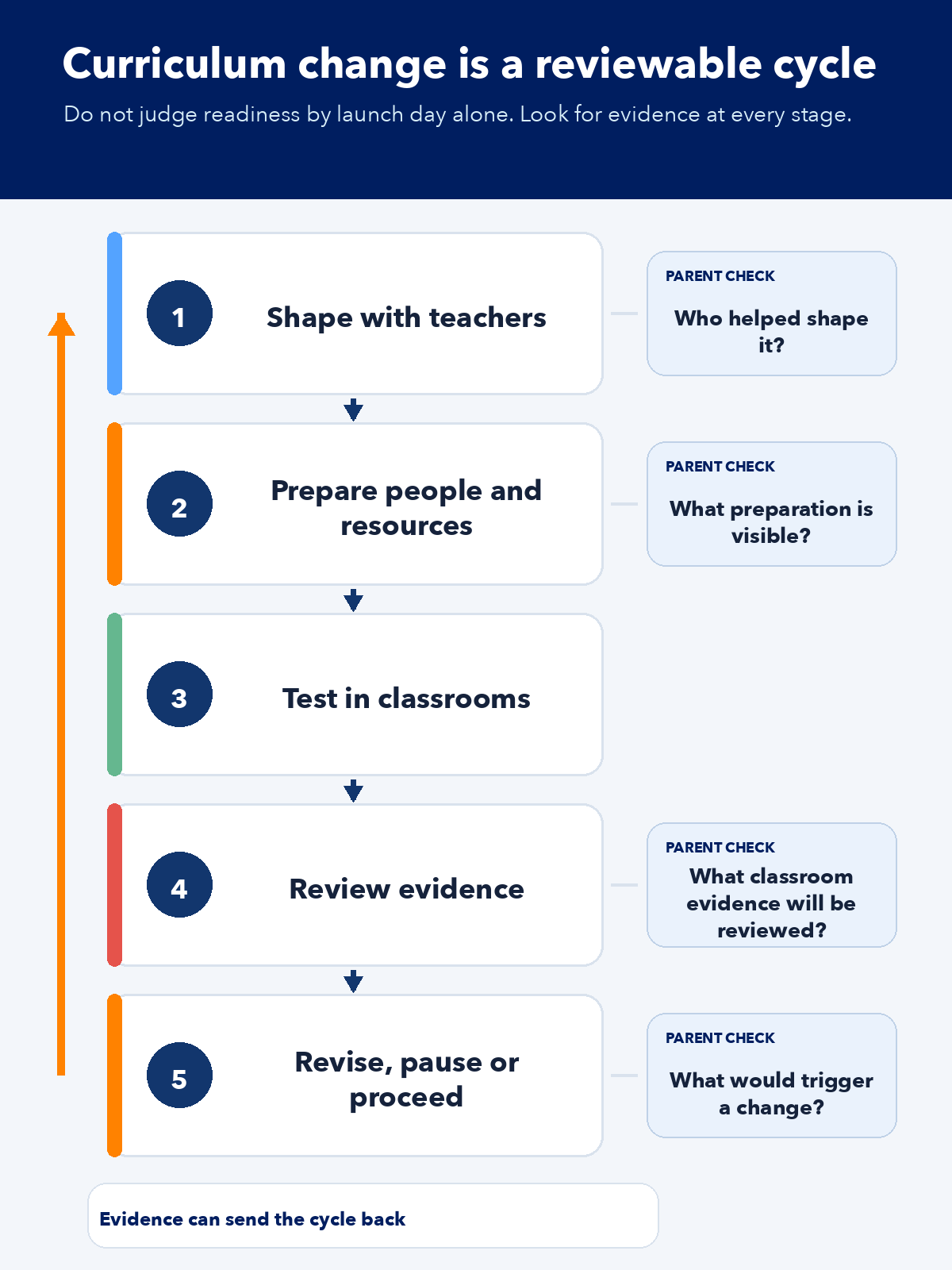
Four questions parents can take to a school
Who helped shape the change?
A useful answer names the classroom teachers, curriculum leaders, specialists, and decision owners involved. Ask whether teacher feedback changed anything and which parts remain open to adaptation.
What preparation is visible?
Look beyond the number of training sessions. Ask about collaborative planning time, teaching resources, assessment examples, coaching, and help after launch. The preparation should match the scale of the change.
What classroom evidence will be reviewed?
Depending on the change, relevant evidence might include student work, teacher observations, assessment patterns, participation, or recurring points of confusion. There is no single metric for every curriculum. The school should nevertheless know what it wants to learn from implementation.
What happens if the evidence challenges the plan?
Ask when reviews happen, who can act, and which options are available. Can the pace change? Can teachers revise materials? Can the school add support, delay a stage, or withdraw an element? Correction is part of responsible implementation, not an admission that the whole idea has failed.
.
How this connects to YCYW
Two established YCYW structures give these questions a more specific place to land.
The Yew Chung Curriculum is YCYW's proprietary primary-school bilingual curriculum, written by the network's internal Curriculum and Professional Development team. It integrates inquiry-based learning, the Co-Teaching Model, and bilingual academic development. This identifies an internal curriculum owner. It does not establish how every later change is tested or revised.
The YCYW Co-Teaching Model puts one Chinese national teacher and one international teacher in the same classroom with equal status, co-teaching every lesson. The two share responsibility for the same group of children. That makes shared classroom responsibility visible, but it does not prove joint curriculum authorship, guaranteed planning time, formal pilots, or better outcomes.
For parents, the next questions are straightforward. How does the internal curriculum team hear from classrooms? How do co-teachers prepare when content or assessment changes? Which examples of student work do they examine? Who can decide that an approach needs more support or a different direction?
The YCYW connection is not that two distinctive structures make every reform succeed. It is that those structures make responsibility visible enough for families to ask better questions.
Listen for what the school is willing to change
A school will never have complete evidence before a new curriculum begins. The more credible sign is a clear account of how it will learn once the curriculum meets real students.
When families hear a confident announcement, they should listen for four details: who shaped the work, how teachers prepared, what evidence the school will review, and what it is willing to change if the evidence points elsewhere.
Main sources
- Government of Alberta: K to 12 curriculum renewal
- Government of Alberta: How we got here
- Alberta Teachers' Association: New K–6 Social Studies curriculum now available
- OECD: Ecosystems approach to curriculum change
- Korea Ministry of Education: Teacher-led AI subject materials and authorised textbooks
- US Department of Education: Responsible use of education technology guidance
- YCYW Brand Profile and approved brand glossary, checked 2026-09-01
Frequently asked questions
Look for named teacher involvement, protected preparation time, usable materials, a defined classroom-testing plan, relevant learning evidence, scheduled reviews, and clear responsibility for changing the rollout.
Teachers see how curriculum intentions interact with real students, subjects, languages, and classroom constraints. Their involvement can expose problems early and help turn a written design into workable teaching.
It should explain what teachers learned, what time and resources they received, what the pilot is testing, what evidence will be collected, who reviews it, and how feedback can affect the next stage.
There is no single threshold for every curriculum. Before implementation, the school should decide which findings would trigger more support, a change in materials or pace, a delayed stage, or withdrawal of an element that is not helping learning.
The Yew Chung Curriculum is YCYW's proprietary primary-school bilingual curriculum, written by the network's internal Curriculum and Professional Development team. It integrates inquiry-based learning, the Co-Teaching Model, and bilingual academic development.
The YCYW Co-Teaching Model puts one Chinese national teacher and one international teacher in the same classroom with equal status, co-teaching every lesson. The two share responsibility for the same group of children. This structure makes shared responsibility visible, but does not verify a particular curriculum-change process or outcome.