


Go Back
News
YCYW Educational Insights
Is HKDSE Right for Non-Local Students? | YCYW
YCYW Educational Insights
24 Aug, 2026
15 : 46

More families may now have an opportunity to consider secondary school in Hong Kong. Yet access to a place and readiness for HKDSE remain two different questions.
Hong Kong government data show that approved study applications for people aged 12 to 17 rose from 386 in 2022 to 1,170 in 2025. The official table, however, notes that the later figure also includes applications for courses other than secondary school. The Education Bureau's trial expansion of the Direct Subsidy Scheme also allows participating schools to increase places on a self-financing basis for non-local students holding student visas. Its latest official list contains 38 secondary-level and 10 primary-level entries. Some through-train schools appear at both levels, so this should not be simplified into 48 distinct schools.
These developments suggest that families may have more options. They do not determine whether a curriculum suits a particular student. In this article, “non-local student” is a general description. Visa status, school admission and examination registration each follow their own official definitions and must be checked separately.
First understand HKDSE as a senior-secondary curriculum and assessment route
The Hong Kong Diploma of Secondary Education Examination, or HKDSE, is administered by the Hong Kong Examinations and Assessment Authority, or HKEAA, at the end of Hong Kong's three-year senior-secondary stage. School candidates generally study four core subjects, Chinese Language, English Language, Mathematics, and Citizenship and Social Development, together with two or three electives. Subjects fall into Categories A, B and C. The subjects actually offered, the timetable and the language of instruction still vary by school.
Category A mainly contains senior-secondary academic subjects, Category B covers Applied Learning, and Category C covers Other Language subjects. Assessment and reporting are not identical across the three categories. Most Category A subjects are reported by level, while Citizenship and Social Development is reported as Attained or Unattained. Specified subjects also include school-based assessment, so preparation is not confined to one set of public examinations.
This structure matters for students arriving from the mainland curriculum, IB, A Level or another examination system. Both systems may offer Biology, History or Economics, but the shared subject name does not prove that topic coverage, sequence, use of evidence or response style will align. The useful comparison is between what the student has already completed and what remains in the proposed entry year.
Three system questions that families often combine by mistake
First, school admission, permission to study in Hong Kong and HKDSE candidate eligibility are separate. A school candidate must be a bona fide Secondary 6 student of an approved school. Direct entry as a private candidate is also subject to conditions such as having sat HKDSE before or meeting the specified age rule. Other applicants with an equivalent education or public-examination background may seek special entry, but HKEAA considers the supporting documents and decides each application. A student visa does not establish the other two conditions.
Second, HKDSE is not one uniform Chinese-medium or English-medium route. Many Category A subjects can be answered in Chinese or English, while Chinese Language, English Language and other language subjects have specified language arrangements. The school's teaching language, its materials and the examination language available to the student are related, but they are not the same question. Current regulations do not record the examination language chosen on the certificate. Even so, a student's ability to learn and express subject knowledge in that language remains central to readiness.
Third, recognition of HKDSE does not guarantee admission to a particular university programme. HKEAA publishes general recognition information, but admission still depends on performance, subject combination and faculty or programme requirements. Families who already have a result can use From HKDSE Results to Asia's University Map for post-results planning. The rest of this article focuses on the decision before enrolment.
Complete five checks before enrolling or transferring
Taken together, these five checks connect the student's status, academic language, previous curriculum, assessment experience and future direction.

1. Status, school and candidate eligibility
Ask the school to confirm four points separately: the status under which the student will study in Hong Kong, whether the school can admit the student, whether the student can enter HKDSE as that school's candidate, and whether a place exists in the intended year group. A positive answer to one point cannot replace the other three.
2. Academic language
Being able to chat in Chinese or English is not the same as reading subject terminology, analysing source material, structuring an argument and writing under time pressure. Families can ask the school to state the teaching and assessment language for every proposed subject, what evidence its entry diagnosis uses, who provides support and when progress will be reviewed again.
3. Curriculum and subject continuity
Map the student's learning from the previous two years against the school's HKDSE subjects, prerequisite knowledge, teaching hours and subject combinations. A similarly named mainland, IB or A Level subject may cover material in a different scope or sequence. Families can bring transcripts, syllabuses and samples of work, then ask the school to identify the actual gaps. The later the transfer, the more specific the bridging plan should be. “The student should adapt” is not a plan.
4. Assessment habits and Hong Kong context
Find out whether the student has experience with data-response items, short and extended answers, evidence-based argument, practical work or portfolio requirements. Check whether the proposed subjects include school-based assessment. Some school-based work develops over time, so the transfer point may affect what can be completed and must be confirmed subject by subject. Parts of the curriculum also draw on Hong Kong's social, geographical and cultural context. This understanding needs to develop through regular learning, not last-minute examination preparation.
5. Guidance and alternative routes
Ask when subject guidance begins, who checks current university requirements, and what alternative the school would discuss if the student's language, subjects or transfer timing do not fit. The purpose of guidance is to identify a route supported by current evidence, not to move every student towards the same examination.
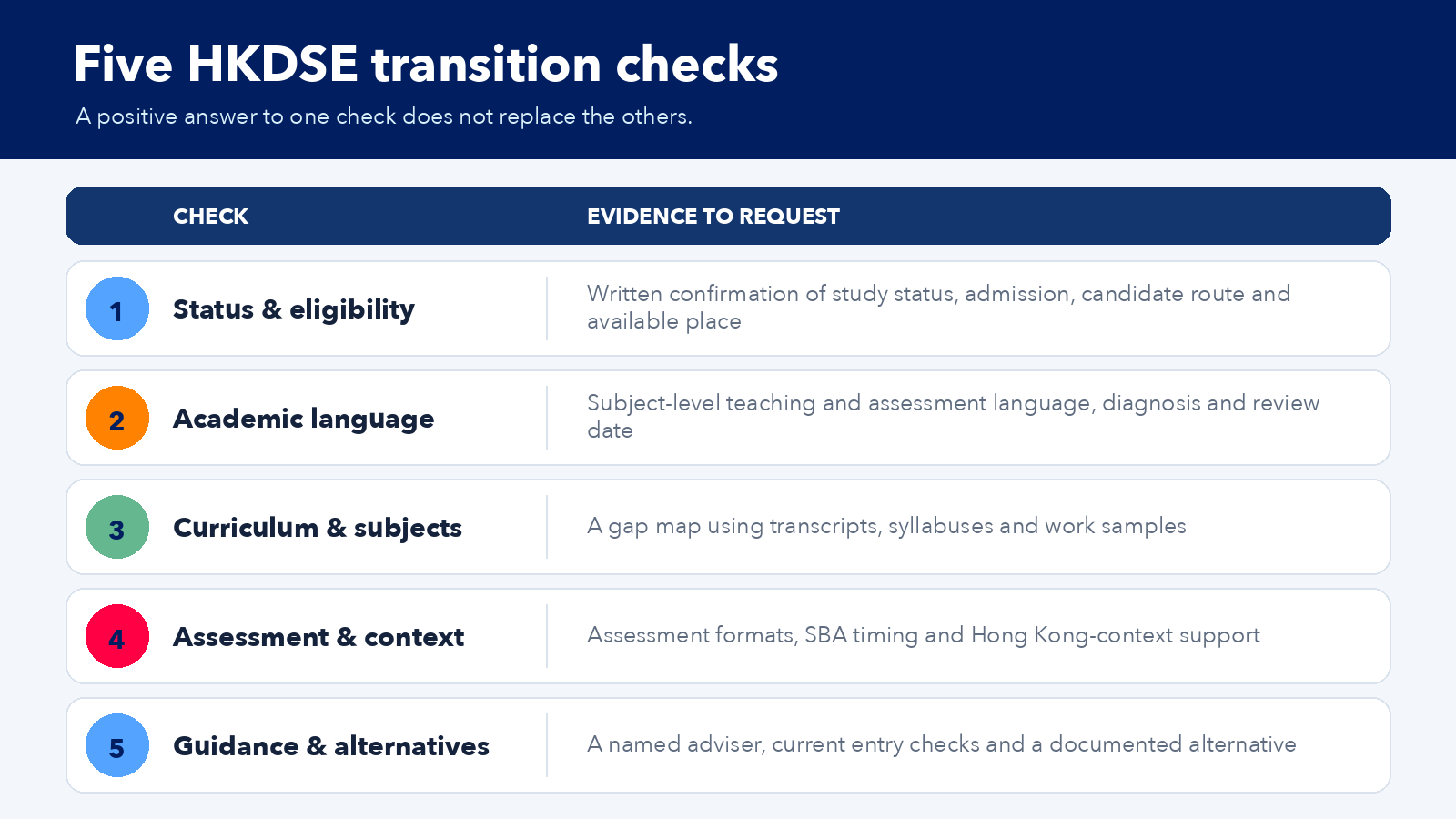
A credible HKDSE offer should make the transition plan visible
Families should be able to see written evidence covering admission and candidate eligibility, teaching and assessment language by subject, academic-language diagnosis, curriculum gaps and bridging support, assessment and feedback, Hong Kong-context learning, the people responsible for subject and university guidance, and an alternative if the route proves unsuitable. A subject list alone cannot show whether a student can make the transition successfully.
A bounded example from YCYW
For the 2025–26 academic year, first-party evidence from YCYW Education Network confirms enrolled HKDSE students at YCIS Shanghai, YCIS Beijing, YWIES Zhejiang Tongxiang and YWIES Guangzhou. An article published in January 2026 records students from the four schools taking part in a week-long HKDSE Hong Kong Classroom. Chinese, English, Citizenship and Social Development learning was connected with field observation, interviews and Hong Kong context. This is one way to strengthen contextual understanding. It does not imply that one visit resolves every transition need.
YCYW's Careers and University Guidance Office, or CUGO, publicly describes support that connects academic counselling and subject choice with career exploration and university applications. For a transferring family, the important test is whether this becomes an individual plan grounded in the student's existing curriculum, language evidence and future requirements. Each school's actual 2026–27 programme, subjects and places still need to be reconfirmed directly.
The family's next step
Put the evidence from all five checks on one page before deciding. If the evidence is complete, the family can continue with an application. If the gaps are defined and supported by a written bridge, the route may proceed with conditions. If language, subjects or timing do not fit, compare another route. If the information is incomplete, do not treat “eligible to apply” as “ready to enrol”.
Frequently asked questions
It is Hong Kong's senior-secondary public examination and qualification, administered by HKEAA. School candidates generally take four core subjects and two or three electives, with the actual combination shaped by the school's programme and the student's needs.
Potentially, but nationality or possession of a student visa is not the complete test. Families must separately verify permission to study, school admission, school-candidate eligibility, or the applicable private-candidate and special-entry rules.
A school candidate must be studying in Secondary 6 at an approved school. Direct private entry is limited by conditions such as previous HKDSE participation or age, while other cases require a special-entry application with evidence. Some assessment arrangements also differ.
Origin is less useful than evidence about academic language, prerequisite knowledge, subject choice, assessment habits, transfer timing and future direction. These need to fit the programme actually offered by the school.
Compare completed content, sequence, teaching and response language, school-based assessment, question formats and the subject requirements of possible future programmes. A shared subject name does not establish continuity.
There is no single threshold that fits every student. Readiness has to be judged against the teaching, reading, writing and assessment language of the proposed subjects, using diagnosis and subsequent progress evidence.