


Go Back
News
YCYW Educational Insights
Your child finished homework with AI. What have they learned?
YCYW Educational Insights
17 Nov, 2026
09 : 39
Getting a question right with artificial intelligence (AI) and tackling a similar question without it are different performances. In one high-school mathematics study, they moved in opposite directions: students using a study interface with general-purpose AI assistance did better during practice, but later scored below the control group on a test without the tool. The study gives parents a reason to look beyond the finished homework when asking what a child has learned.
A more specific conversation can begin with the learning goal. What was this assignment meant to teach? What does the finished work show? What can the child's own explanation and a later attempt at a similar task add? Each needs to be considered in relation to that goal.
Start with what the homework is meant to teach
Begin with the assignment instructions. Two pieces of work containing computer code may serve different purposes. One might ask students to practise writing a particular instruction; another might ask them to design a system and test whether it solves a problem. What students should demonstrate independently may differ accordingly.
Parents can check the instructions and existing teacher feedback, then ask: "Which part should my child be able to explain or apply independently?" There is no need to assume that every tool must be removed before learning can count. If the aim is to understand a calculation, a complete answer does not reveal why the child chose that operation. If it is to design and test a system, its behaviour and the child's adjustments are relevant too.
"Can you redo the whole assignment without AI?" may therefore be the wrong opening question. Identify one piece of knowledge or judgement, then look for evidence that bears on it. The Smart Farm example below illustrates why testing whether code controls a physical device differs from testing whether a student can write every line independently.
A finished task and later performance answer different questions
A randomised study of mathematics at one Turkish high school, published in PNAS in 2025, separated AI-assisted practice from a closed-book test of similar problems immediately afterwards, within the same session. The group using the study interface offering general-purpose AI assistance did better during practice but worse than the control group on the subsequent test. A version with teacher-designed tutoring prompts avoided that significant disadvantage, although its test results were not significantly above the control group's.
This was short-term assessment, not next-day or long-term follow-up. Success on similar problems does not establish that students can apply the learning across subjects. The study supports distinguishing assisted task completion from subsequent independent performance; it does not show that all AI makes learning worse.
Positive findings matter too. In a 2025 physics study at Harvard University, a specially designed AI tutor produced higher immediate post-lesson test results than the in-class active-learning condition. That finding concerns university students, particular content and a particular tutor. It neither establishes long-term retention nor shows that ordinary chatbots generally outperform teachers.
Stanford SCALE's November 2026 review likewise reports mixed learning results and distinguishes doing work for students from supporting their learning. Contexts vary, and many papers reviewed were preprints. Parents can ask how the tool was used and what the researchers measured. Finding work easier and demonstrating understanding remain separate matters.
Use one learning goal to look at explanation and application
Consider a hypothetical example, intended to illustrate evidence rather than prescribe a research-validated home test. The learning goal is to explain why a rectangle's area is found by multiplying length by width. A child uses AI to complete a page of correct calculations and worked steps. The page shows the answers and procedure, but leaves their understanding of the multiplication unclear.
During a calm homework conversation, a parent could choose a familiar step and invite the child to put the tool aside briefly: "How does your drawing show why we multiply?" A drawing of the number of squares in each row and the number of rows adds an explanation to the finished work. If the child only rereads the AI's wording, the parent can note the unclear step without continuing until a correct response appears.
A later ordinary assignment or teacher-planned activity may offer a similar application. A small variation chosen with the child or teacher should preserve the learning goal, perhaps changing only the rectangle's dimensions. How does the child begin without the tool? That attempt offers another observation; one correct answer does not establish mastery of every area problem.
The work shows what was completed. Explanation makes some of the child's thinking visible. A similar task offers an attempt in another context. Discussing the concept at another suitable time can separate that observation from the original output, but the research cited here does not establish a fixed interval, question count or pass score for families. There is no need to add daily tests for this purpose.
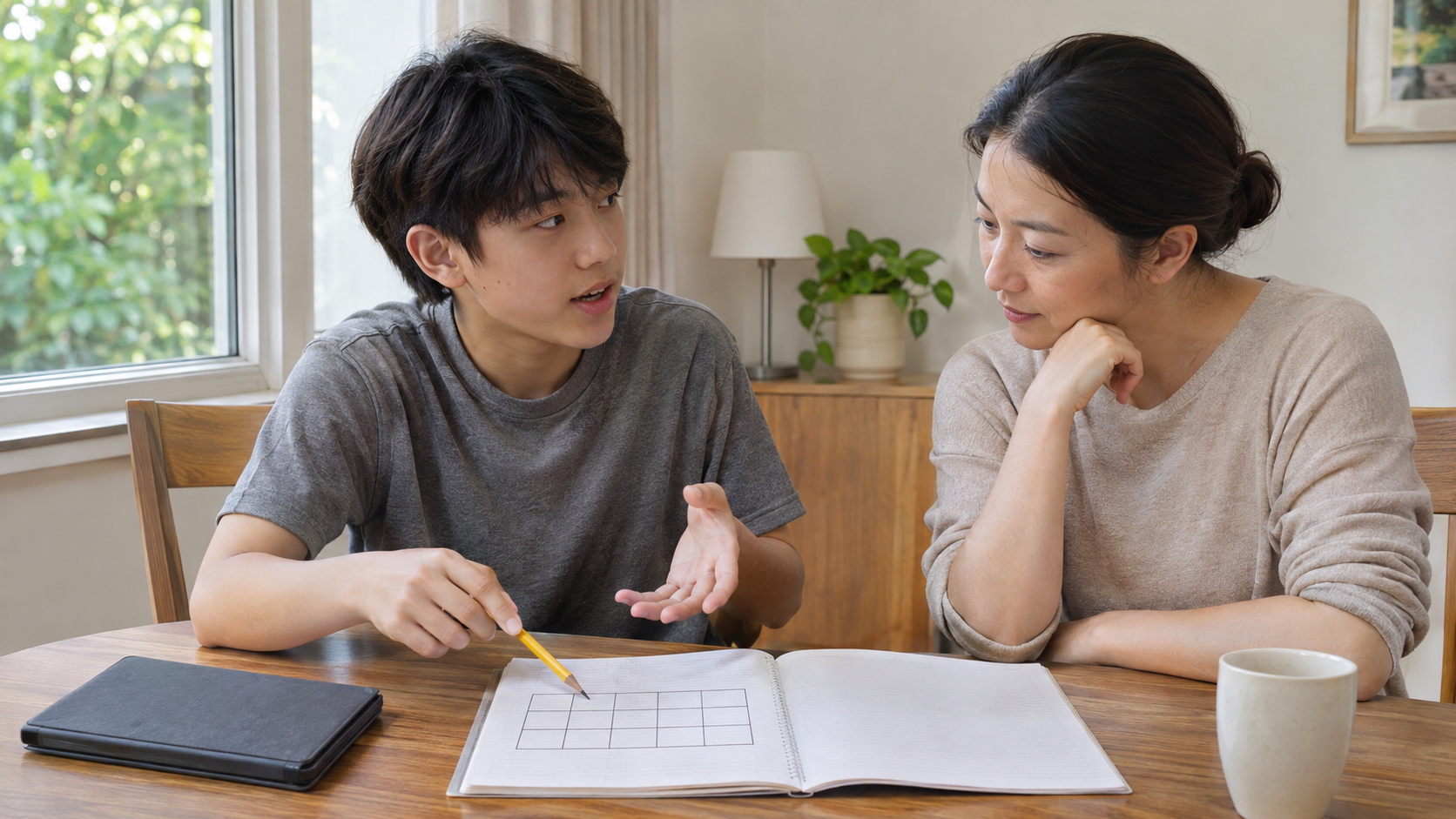
AI-generated illustration of a fictional family conversation.
Smart Farm code had to work on real hardware
Moving code from a screen to a physical device offers another kind of check. In a 2024 report by the YCYW Education Network, IG1 students at Yew Wah International Education School of Guangzhou used ChatGPT to help generate control code for a Smart Farm project. They downloaded it to a chip, tried it out and adjusted their requirements in response.
Trying the code on the hardware tested whether it worked as intended. A mismatch with the requirements gave students something concrete to change. Parents reading the case could ask what students wanted the system to do, how they identified a mismatch and what judgements informed an adjustment. These are suggested discussion questions, not answers the report documents for every student.
Working hardware verifies an output. The report does not establish that each student could subsequently code without AI or explain every line. Nor does one 2024 project in Guangzhou establish assessment practices across campuses. If the goal is system design and testing, the relevant discussion concerns those judgements; it should not become an arbitrary requirement to rewrite the entire program without AI.
When a child gets stuck, check the task and the help available
Start by identifying the difficulty. Is the child unsure of the principle, unable to begin, or facing content that was not in the original task? If task difficulty or available prompts changed, a difference in performance cannot simply be attributed to AI.
Parents could also check the circumstances: was the child tired, unfamiliar with the question format, or in need of another way to show their thinking? These are circumstances to ask about, rather than causes to assume. One difficult conversation does not establish dependence, cheating or a decline in overall ability. Existing teacher-arranged learning support should not be withdrawn on that basis.
Describe the observation when speaking with the teacher. "They can follow the calculation but need a prompt to explain why they multiply" gives more to discuss than "AI has stopped them thinking." A teacher can consider it alongside classroom observations and help decide what needs further teaching, which prompts remain useful and where to look again in ordinary work. This is a suggestion for collaboration, not a home ability rating.
Bring one piece of work and one question to the teacher
Parents need not collect every assignment before getting in touch. Choose one useful example, invite the child to say briefly what they did and where AI helped, and keep one unresolved point. The aim is to provide enough context to discuss the difficulty, without requiring a complete chat history.
For the hypothetical area problem, a message might read: "AI helped with this page. My child can calculate the answers but still needs prompting to explain length times width. What was my child expected to show independently in this task? Is there classroom work we could consider alongside it?" The message separates the work, the observation and the question without deciding the cause in advance.
The next action can be limited: look for the same concept in the next similar assignment, or ask the teacher to explain it again before considering another attempt. For guidance on questions before and after AI use, the lecture article on using AI with questions in mind provides related reading in Traditional Chinese. For this piece of homework, the shared question is narrower: what do we already know about this learning goal, and what further evidence would help us decide how to support the child?
Frequently asked questions
How can I help if I do not know the subject?
You can describe how the work was done without marking it yourself. Ask your child to identify what they completed and where they needed help, note one specific uncertainty, and ask the teacher what evidence would reflect the learning goal. Say when you are unsure whether an answer is correct, leaving subject judgements and the next support decision to the teacher.
What if my child can draw or demonstrate an idea but struggles to explain it aloud?
Keep the drawing or demonstration and ask the teacher whether it addresses the intended skill. Do not use fluent speech as the sole measure of understanding or diagnose the reason for a difficulty. If explaining aloud is itself a learning goal, discuss suitable support so that both subject understanding and the expression requirement are considered.
What if my child feels they are being doubted and refuses to explain the homework?
Pause the questioning. Explain that you want to understand where help is needed, rather than ask the child to prove their innocence. Invite them to choose a part they are willing to discuss, without forcing a complete redo or demanding a full AI chat record. If the conversation remains difficult, ask the teacher to help find a more suitable everyday way to talk about the work.
