

Go Back
News
YCYW 101
Which IB Schools in Hong Kong Should You Consider? Start with Your Child’s Entry Pathway
YCYW 101
08 Oct, 2026
18 : 53
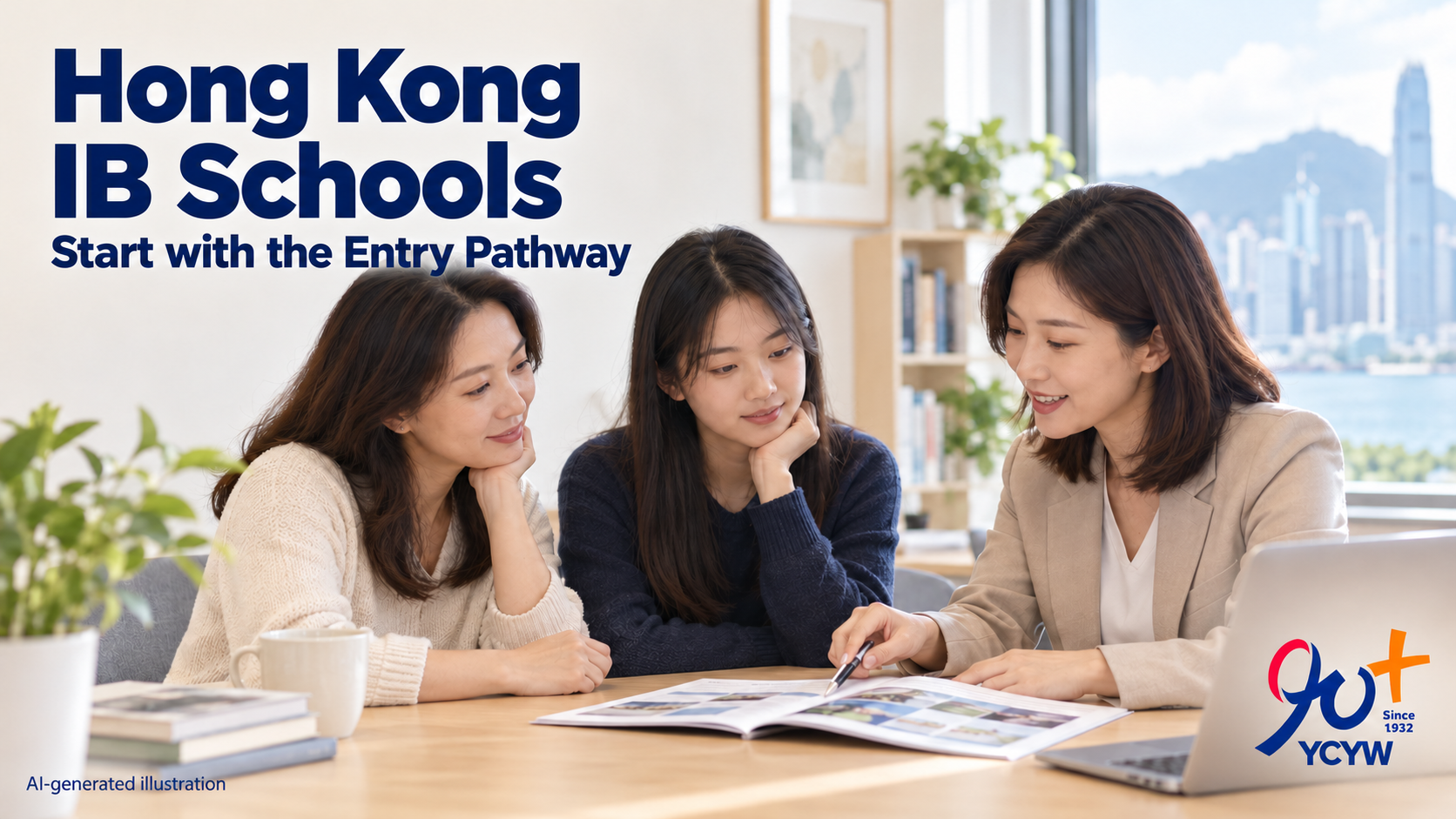
When choosing an IB school in Hong Kong, average IBDP scores are only part of the picture. Your child’s current year group, previous curriculum and intended transfer date often determine which schools are worth exploring first. Diocesan Boys’ School, Renaissance College and Yew Chung International School of Hong Kong (YCIS Hong Kong) illustrate three different routes: transferring at upper secondary level, following an IB framework from primary school, or studying IGCSE before the IBDP. These examples are not a school ranking.
| School | Main route before the IBDP | What a transferring family should ask first |
|---|---|---|
| Diocesan Boys’ School | A Grade 10 bridging year followed by the IBDP in Grades 11–12. The school also lists external applications for direct entry to Grade 11. | Which grade should my child apply for? Are places available in the intended year, and what does the assessment involve? |
| Renaissance College | PYP in Years 1–6 and MYP in Years 7–11, followed by DP or CP in Years 12–13. | Are places available in the target year group? How would my child’s previous curriculum lead into the MYP or DP? |
| YCIS Hong Kong | A school-based curriculum in Years 7–9, IGCSE in Years 10–11 and IBDP in Years 12–13. A one-year IB Pathway is also available for students entering Year 11. | Should my child enter IGCSE, the IB Pathway, or apply directly for the IBDP? |
Year groups in the table follow each school’s own system. Matching numbers do not necessarily mean the same stage of learning.
The routes above are described in the DBS IB curriculum and admissions information, Renaissance College curriculum guide and YCIS Hong Kong secondary curriculum information.
Transferring at upper secondary level: preparation time and entry requirements
For a child who has completed lower secondary education in another curriculum, the Grade 10 bridging year at Diocesan Boys’ School offers a period of preparation before the IBDP. The school also invited external applications for Grade 11 IBDP entry in the 2026/27 academic year. However, direct-entry places are limited, and applicants take assessments that include English, languages and mathematics. DBS is a boys’ school, so families should first check whether their child meets the application requirements.
The two entry points are different. Grade 10 includes a bridging year; direct entry to Grade 11 requires students to adjust more quickly to DP study and subject choices. Check the admissions notice for your intended entry year to confirm places and assessment arrangements.
Starting within an IB framework: distinguish continuity from available places
Renaissance College connects the PYP at primary level with the MYP and, later, the DP or CP. It may suit families who want their child to experience IB learning earlier. However, a complete IB pathway does not mean every child must join in Year 1, or that every year group has vacancies. ESF’s admissions guidance identifies Years 1 and 7 as central application entry points, while other year groups use general applications. Admission still depends on available places and other conditions. At upper secondary level, parents should also establish whether their child is applying for the DP, CP or another course arrangement.
Moving from IGCSE to the IBDP: understand the options in between
YCIS Hong Kong follows a different secondary route from PYP–MYP–DP. Students take IGCSE in Years 10–11, followed by the IBDP in Years 12–13. The IB’s official school directory lists the school’s DP authorisation; this does not establish that it also offers the PYP or MYP.
For students transferring from other schools, YCIS Hong Kong also describes a one-year IB Pathway for Year 11 entrants who plan to continue to the IBDP. This differs from the two-year IGCSE route. Ask the school to recommend a pathway based on your child’s previous courses, language skills and subject knowledge. School curriculum information
A student’s experience can help explain the route, but it does not replace the entry requirements. YCIS Hong Kong reported that Hilary, a member of the Class of 2026, transferred from a local school through an IB preparatory programme, achieved 45 points in the IB and received an offer from the Royal Veterinary College. This is one example of a successful transition; whether the same route suits another child requires an individual assessment. School report
Before comparing schools, ask four specific questions
Take your child’s school reports and intended subject choices into the conversation, rather than asking only whether a school’s IB results are good:
- Which year group can my child apply for, and does it accept external applicants in the intended academic year?
- What will my child study before starting the IBDP, and how much preparation time will there be?
- Do their existing subject knowledge and language skills support their intended DP subjects?
- Beyond tuition, what other costs will we need to cover from entry to graduation?
Then consider the results. Before comparing average IBDP scores, confirm the examination year, number of candidates and scope of the figures. Admissions practices and students’ starting points also affect what those figures mean. For a family considering a transfer, whether their child can enter, how the transition works and whether the route suits them are more useful starting points than an average score alone.
Information checked to September 2026. Places, assessments and course arrangements should be confirmed against the school’s notices for the intended entry year. These three schools illustrate different pathways; they are not a complete list of IB schools in Hong Kong.