

Go Back
News
YCYW 101
How to Choose an International High School in Beijing: Four Questions for Families
YCYW 101
08 Oct, 2026
15 : 16
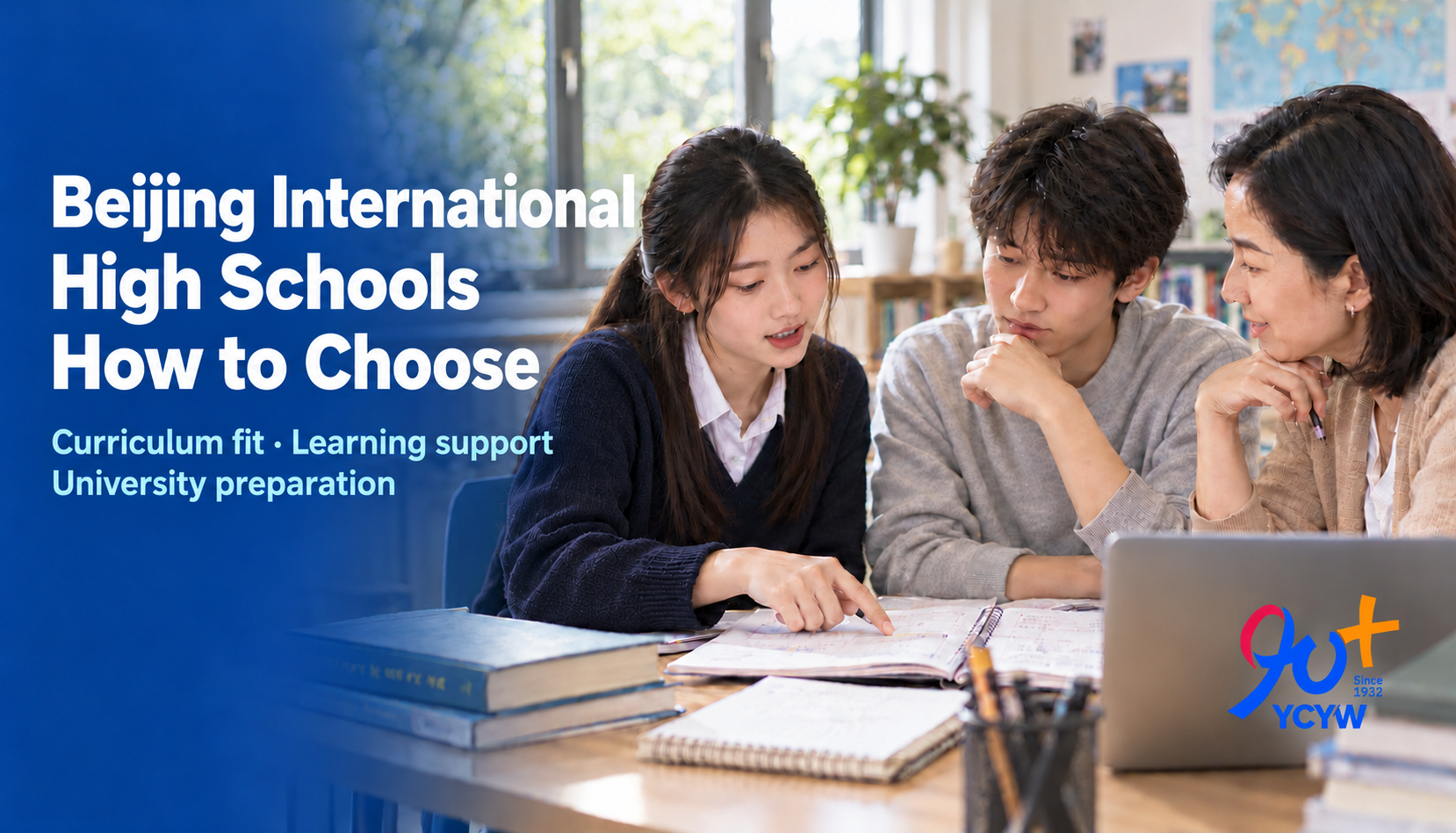
When a child is preparing for international high school, families often face two decisions at once: which curriculum suits them, and which school can help them prepare for university.
To compare international high schools in Beijing, start with four questions: Does the curriculum suit your child's way of learning? Are they ready for its academic demands? How are teaching and university guidance connected? And what can the school's results tell you?
This article looks at Yew Wah International Education School of Beijing, Yizhuang Campus (YWIES Beijing), and Yew Chung International School of Beijing (YCIS Beijing). YWIES Beijing offers an IGCSE-to-A Level pathway. YCIS Beijing offers an IGCSE-to-IB Diploma Programme (IBDP) pathway and a separate Hong Kong Diploma of Secondary Education (HKDSE) option. Their curricula and admission requirements differ, so each deserves a closer look in relation to your child's needs.
Before comparing courses, check eligibility. YCIS Beijing's published requirements include foreign passport holders, Hong Kong, Macao and Taiwan residents, and eligible families returning from overseas; its admissions team assesses individual eligibility. YWIES Beijing serves eligible families, including Chinese nationals, with entry requirements for the intended grade to be confirmed with the school. For HKDSE, check course admission, examination registration and university application requirements separately. YCIS Beijing admission eligibility
1. Does the curriculum suit your child's learning strengths and university plans?
Start by looking back over the past year or two. Which subjects does your child willingly spend time on? Can they sustain reading, writing and research tasks? How do they manage several assignments at once?
These questions help families understand curriculum demands and make subject choices more relevant to the child.
| School and pathway | Main learning features | What families should explore |
|---|---|---|
| YWIES Beijing: IGCSE to A Level | More in-depth study of selected subjects after IGCSE | How the child's strengths could form a suitable subject combination and prepare them for a university course |
| YCIS Beijing: IGCSE to IBDP | Study across different subject areas, alongside research, Theory of Knowledge and practical activities | How the child will balance subject learning with ongoing tasks, and how the school supports this |
| YCIS Beijing: HKDSE | A combination of core and elective subjects | Subject combinations, course arrangements and university application requirements relevant to the student's status |
See the YCYW school network overview and YCIS Beijing secondary curriculum for these pathways.
A Levels focus on deeper study of selected subjects, with choices informed by students' interests and future study plans. Students who already have subjects they want to pursue further, and who hope to develop a clearer sense of their university direction, can explore YWIES Beijing's transition from IGCSE to A Level and its subject-choice support. A Level curriculum framework
The IBDP combines six subject groups with Theory of Knowledge, the Extended Essay, and Creativity, Activity, Service. Families considering this pathway at YCIS Beijing can look beyond subject grades to ask how students develop independent research and reasoned arguments while managing different tasks. IBDP curriculum framework
HKDSE has core and elective subjects. Families considering this option at YCIS Beijing can bring their intended universities or courses into discussions about suitable subject combinations, while checking application requirements separately. HKDSE subject information
If your child has not settled on a pathway, begin with how they are learning now and give them time to understand the commitment each curriculum involves.
2. Is your child ready for high school, and what preparation do they need?
Fluent everyday English does not necessarily mean a student can comfortably read subject materials, explain experimental findings or write a research paper. At high school, language skills and subject understanding need to be considered together.
Likewise, a strong grade in a subject is a starting point. Look at whether your child understands its concepts, can explain their reasoning and knows how to approach unfamiliar problems.
YWIES Beijing's published application procedure includes previous academic records, written assessments in Chinese, Mathematics and English, and interviews in Chinese and English. Families can ask the school to explain any gaps between their child's current preparation and the demands of the intended course stage. YWIES Beijing application procedure
Families considering IGCSE, IBDP or HKDSE at YCIS Beijing should also explore the requirements of the relevant stage. Previous learning experience, subjects studied and academic records can help the school and family discuss a suitable starting point.
For students transferring during high school, go beyond asking whether a place is available:
- How does the learning already completed connect with the intended course stage?
- Which subjects or language skills need further preparation?
- How will teachers observe the student's adjustment and provide feedback?
YWIES Beijing's pathway is worth exploring for families seeking to prepare gradually for A Levels through IGCSE. Families considering IBDP or HKDSE at YCIS Beijing should assess readiness against the structure of the chosen curriculum.
Clear answers make it easier to picture daily school life and plan the time your child may need to prepare.
3. How do subject choices, teaching support and university preparation connect?
During high school, subject choices and university applications become more concrete. What a student enjoys, what they do well and what they may want to study at university need to be discussed alongside their daily learning.
Families can begin with two or three courses of interest, look at the requirements of potential universities, and discuss subject combinations and preparation with the school. Students still exploring their direction can ask a guidance counsellor to help narrow their options through their interests, subject performance and course experiences.
YWIES Beijing's campus introduction from April 2026 describes an on-campus university guidance team that stays in contact with students and families to discuss suitable fields of study, application directions and subject planning. This is an arrangement worth exploring for families who want to understand the connection between A Level subject choices and university plans. YWIES Beijing subject planning and university guidance
How a school responds when learning becomes difficult also matters. YWIES Beijing's 2025 Mathematics examination report describes focused practice, multiple mock examinations and conversations about students' approach to exam preparation. Families can use this example to ask how teachers identify the cause of a difficulty in a subject and decide what help comes next. Mathematics exam preparation report
YCIS Beijing's website describes career-planning talks, university engagement activities and personalised university guidance, with counsellors supporting students through application procedures step by step. Families can explore how their chosen curriculum connects with possible fields of study and how students and parents participate in application planning. YCIS Beijing university guidance overview
One useful question to ask both schools is:
If my child plans to apply for a particular university course, but their performance in a relevant subject changes, how would the school help them reassess their subject choices and application plans?
This discussion can show how guidance responds to the child's learning and help families understand how academic preparation connects with university goals.
4. How should families interpret course results and university destinations?
Course results and university offers are useful, provided families first establish what the figures describe.
Graduation-stage results can help explain the outcomes of a particular curriculum. A university list offers a view of possible destinations. Check the course, graduating cohort, reporting date and student numbers; the number of university offers is not the number of students.
Materials supplied by the school for the Class of 2026 show that YCIS Beijing's IB students achieved an average score of 35.5 and a 100% pass rate. Related university offer materials list institutions including the University of Edinburgh, the University of Hong Kong and Pratt Institute.
These materials provide a reference for the IBDP pathway at YCIS Beijing. Families can then explore subject preparation, application processes and guidance in fields that interest their child. For HKDSE, consult information about that curriculum separately.
For YWIES Beijing's IGCSE and A Level pathway, ask about learning outcomes and university preparation at the relevant stage, alongside subject choices, teacher feedback and students' progress. A Mathematics preparation example from IGCSE can help explain teaching support, but it cannot stand in for A Level results or university offers.
Results from different schools and curricula need to be understood in their own learning context. They should help families ask more specific questions, while leaving the choice grounded in the child.
Bring the comparison back to your child
Families leaning towards A Levels, seeking a gradual introduction to international courses through IGCSE and support with subject choices and application planning, can include YWIES Beijing's Yizhuang Campus on their school-visit list. Focus discussions on the child's subject strengths, suitable combinations and preparation for the next stage.
Families interested in the IBDP and its research and practical requirements, or exploring HKDSE, can take a closer look at YCIS Beijing and check entry requirements and university arrangements for each pathway.
Before visiting, bring recent academic reports and note your child's favourite subjects, current difficulties and the family's initial university plans. Ask the school to explain its course requirements and support in relation to those materials.
When a comparison helps you understand how your child would learn each day, find help when they need it and prepare for university, it becomes easier to judge which high school pathway deserves the next few years of their life.