


Go Back
News
YCYW Educational Insights
How schools teach children to manage their learning
YCYW Educational Insights
26 Oct, 2026
14 : 25
A child sits at a desk with the textbook open, yet the homework has not begun. Before asking them to hurry, find out whether they understand what they need to finish, where they could start and how to ask for help when they get stuck.
Our article on practising self-control at home discusses everyday routines, adults taking over and consistency. It leaves a useful question to bring to school: during lessons, how does a child learn to organise work, check a strategy and gradually take responsibility for parts of the task that an adult previously managed?
Schools can build this teaching into ordinary learning. Parents need to understand how the teacher introduces a skill, how the child practises it and how support changes when difficulties arise.
Make managing learning something that can be taught
In an article published on 19 October 2026, Cambridge International Education reported on Mitch Weathers's contribution to its online schools conference. Clear modelling and predictable classroom routines featured in his account of developing self-management. This is an educator's perspective, offering a starting point for teaching rather than a guarantee about an individual child's progress.
Consider a particular assignment. “Do your reading homework properly” may sound clear to an adult. A child may still be unsure whether to read the question first, which paragraph to revisit or how to judge whether an answer has evidence behind it. A finished page may result either from following an adult's prompts throughout or from deciding what to do next. The page alone does not reveal who managed the work.
The Education Endowment Foundation's second-edition guidance, published in November 2025, recommends explicit teaching of planning, monitoring and evaluating learning within specific subjects and tasks. Parents can make this accessible in conversation: how does the child choose an approach before starting, notice a problem while working and judge the approach afterwards?
These questions give the school a concrete teaching process to explain. They also make it easier to discuss a child who appears willing to work but does not yet know how to get going without repeated directions.
Let pupils hear the thinking behind the answer
The EEF's summary of recommendations describes teachers verbalising their thinking as they approach a task. Watching someone write a correct answer may leave important decisions hidden: how they spotted a difficulty, checked their understanding or changed direction.
Here is a hypothetical teaching example, created to illustrate the process. It is not a report of a YCYW lesson. After reading a short story, pupils need to explain why a character changed their mind. A teacher could say: “The question asks for a reason. I will look at the paragraphs before and after the decision. This sentence might help; I need to check whether the next part supports it.” The teacher could also show an unhelpful choice and explain why they need to look again.
A pupil then tries a similar question. The teacher listens to where the pupil intends to look before deciding whether to offer a cue. If the child is waiting to be told which sentence to copy, it is worth checking their understanding of the question and the strategy. If they can explain their choice, the teacher has more information about their learning, even when the answer needs revision.
The example shows a movement from observing a strategy to trying to use it. The text, language demands and prompts need to suit the pupil; the same script will not serve every learner.
Adjust help to what the child can currently do
Teaching learning management involves deciding when to continue helping and when to let a pupil try. The EEF's seven-step model connects modelling, guided practice, independent practice and reflection in a deliberate shift of responsibility. It can extend across one or several lessons. It is not a fixed lesson plan or a timetable for withdrawing support.
In the reading example, assistance might be a question, a useful clue or another demonstration of how to find evidence. When the pupil can manage a step, the teacher can let them attempt it. A harder text may require more help again. The EEF's scaffolding framework offers a least-help-first approach, with prompts or modelling provided as necessary.
Parents can therefore ask: “Which part can my child manage, and what kind of help do they still need?” They can also ask what the teacher would look for before reducing or restoring assistance. This brings a general promise to develop independence into a discussion about their own child's work and current needs.

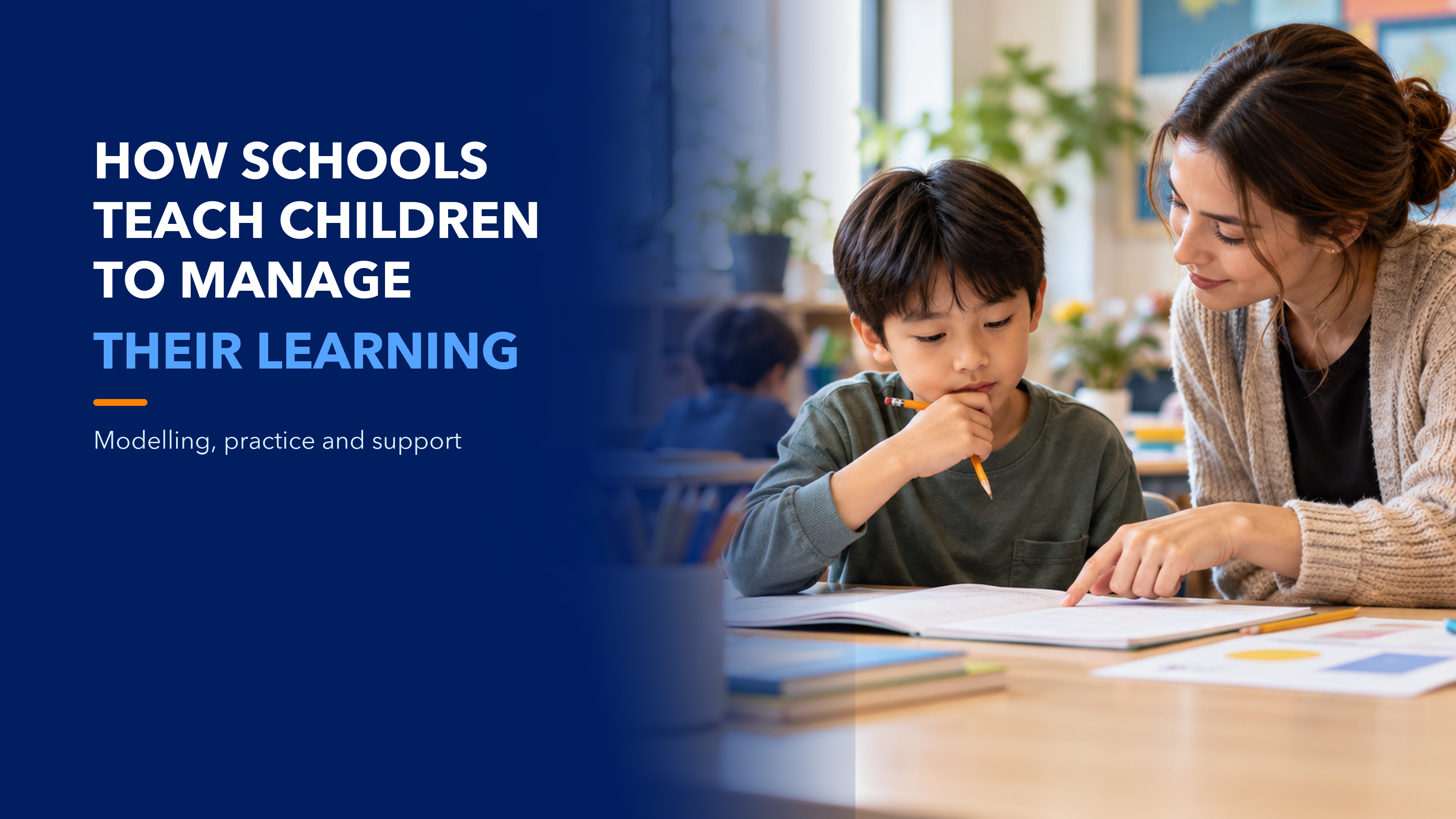
AI-generated illustration of a learning situation, not a record of a real YCYW classroom.
Give pupils practice during the school day
Managing learning also comes into preparing materials, sharing responsibilities and getting ready for the next activity. In a report published on 21 September 2025, Yew Wah International Education School of Shanghai Lingang described its support for the transition to primary school. Teachers taught pupils to organise schoolbags, children took turns with classroom responsibilities such as timekeeping and managing materials, and the school communicated with families about practising everyday habits.
The report provides a concrete example of opportunities within a child's day: knowing where materials belong, preparing for the next task and checking whether a responsibility has been completed. It does not independently evaluate the effectiveness of those arrangements or establish that all YCYW campuses currently use them.
When discussing a similar arrangement with a school, parents can ask how the responsibility is taught. If a child is looking after materials, how do they learn to prepare, notice something missing and put things away? What happens when they forget? A classroom job title leaves those questions open. The process reveals what the child actually has a chance to practise.
Look at the work the child is taking over
For a meeting with the teacher, bring one recent task that became difficult at home. Describe how far the child got and when an adult usually intervened, then ask for the teacher's classroom observations. Checking whether the child understands the content and instructions makes it easier to discuss further teaching, practice or changes to the task.
You might look at a piece of work together and invite the child to explain: “What did I do first? Where did it become difficult? What would I change next time?” A full reflection form is not necessary every time. A short conversation, pictures or objects can give a younger pupil something to discuss. These are suggestions for a family-school conversation, not a description of a school's standard assessment system.
Progress need not be expressed only in terms of speed. A child who previously needed directions for every step may now identify how to begin. Another may be able to explain where they are stuck rather than simply stopping. These are specific observations to discuss with a teacher, taking account of the task's difficulty. They are not universal milestones or a scorecard.
Home and school can agree on one approach to try, such as inviting the child to name the first step, deciding when an adult will offer a prompt and choosing a later piece of work to review together. The EEF guidance also recognises teacher observation and traces of the learning process as ways of understanding strategy use.
Learning management becomes clearer when the conversation returns to the child's work. Knowing what needs to be done, choosing or adjusting an approach and asking for help give parents and teachers a firmer basis for deciding what to practise next.
Frequently asked questions
Does slow homework mean poor self-management?
Speed alone cannot tell you. Discuss whether the child understands the content and instructions, knows the approach and has an appropriate workload. Describing where they get stuck and what prompts they need is more useful than labelling them undisciplined. If difficulties persist, ask the school how it will investigate their needs further. This article cannot replace an individual assessment.
What if mistakes increase when the school reduces prompts?
Share the work and the child’s explanation with the teacher. Consider whether the strategy is still unfamiliar or the task has become harder. Appropriate prompts, further modelling or adjusted practice may be needed before reviewing again. Developing independence allows support to increase when necessary; a child need not remain stuck to preserve an earlier decision to step back.
Should parents reproduce the school’s approach in full at home?
Agree on one approach the child understands and the family can sustain, including when to prompt and when to let them try. Home differs from a classroom. Parents need not recreate a lesson or add conflicting requirements. Record what happens and discuss adjustments with the teacher.
