

Go Back
News
YCYW Educational Insights
From AI Tools to AI Trust: How Schools Make AI Safe, Useful, and Human
YCYW Educational Insights
07 Jul, 2026
15 : 29
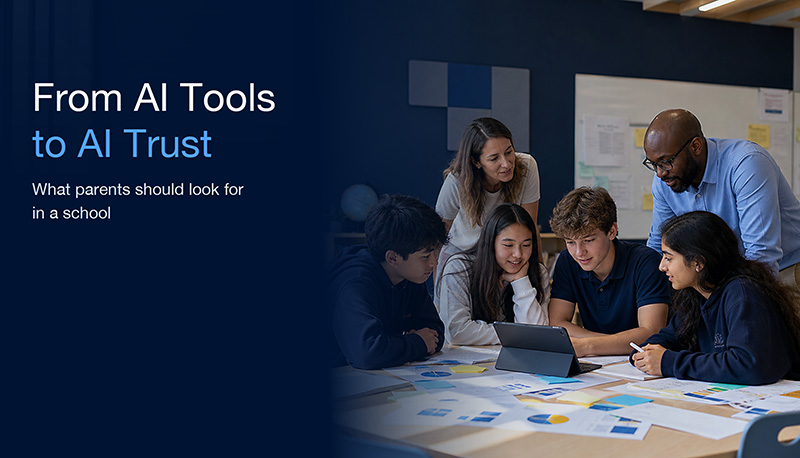
Two schools can both say they use AI. That fact alone tells parents very little.
The more useful question is whether a school can explain how AI is used, when it is not used, who checks its output, how teachers are trained, and how students learn to challenge what a machine gives them.
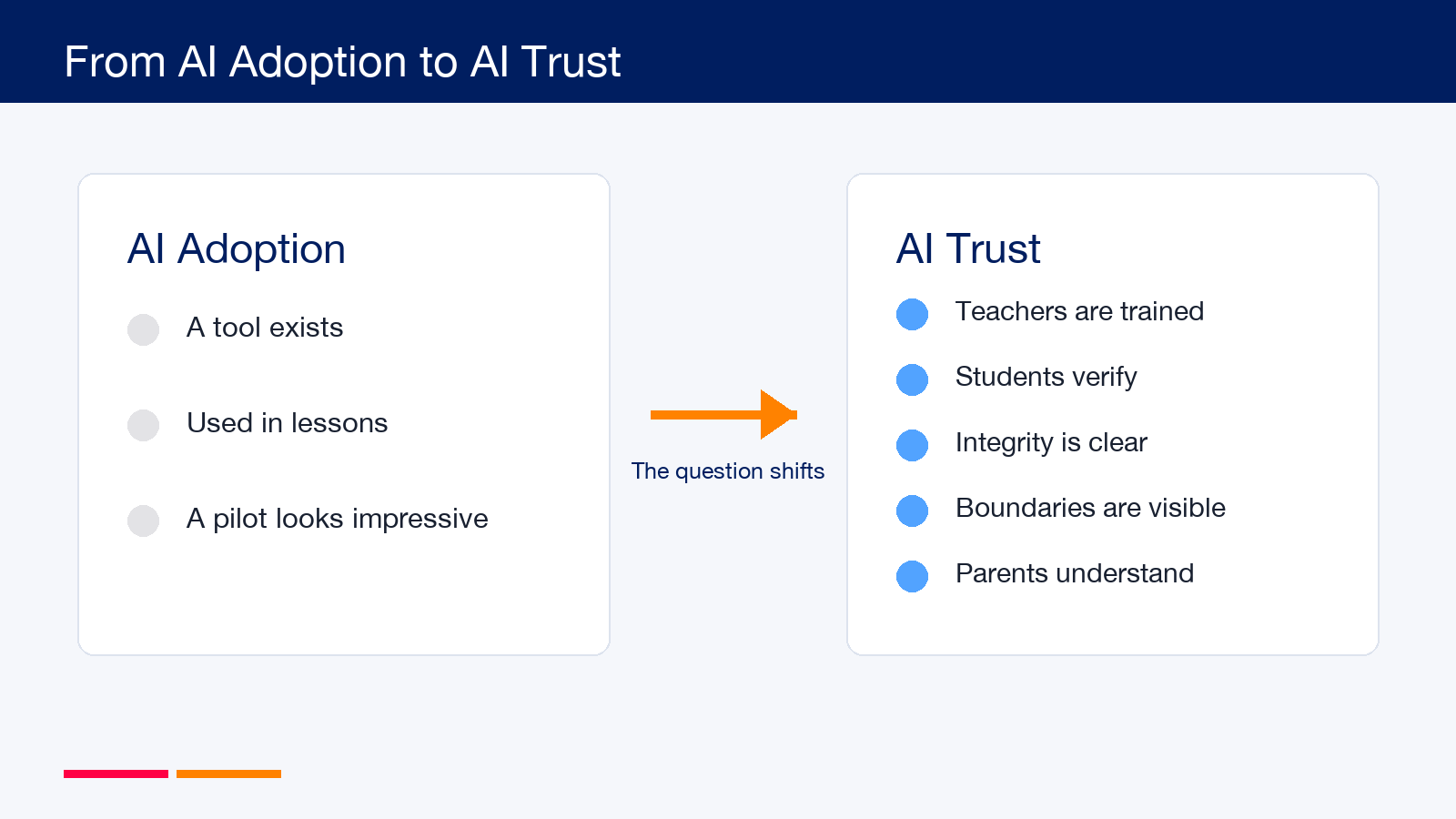
That is the shift now taking shape in education. The first stage was AI adoption. The next stage is AI trust.

By July 2026, several education systems were already pointing in the same direction. Vietnam's new technology-use framework for higher and vocational education placed AI, big data, cloud computing, virtual reality, personal data protection, academic integrity, and teacher responsibility in one governance structure, according to Vietnam.vn. In China, Xinhua reported more classroom AI use, from writing feedback to sport movement analysis, while still stressing that teachers remain responsible for guidance and judgment. Microsoft's 2026 education AI report described a similar gap: AI use is widespread, but formal training and classroom guidance have not caught up.
This matters because AI in schools is no longer a platform question. It is a school-habit question.
AI Trust Begins With Teachers
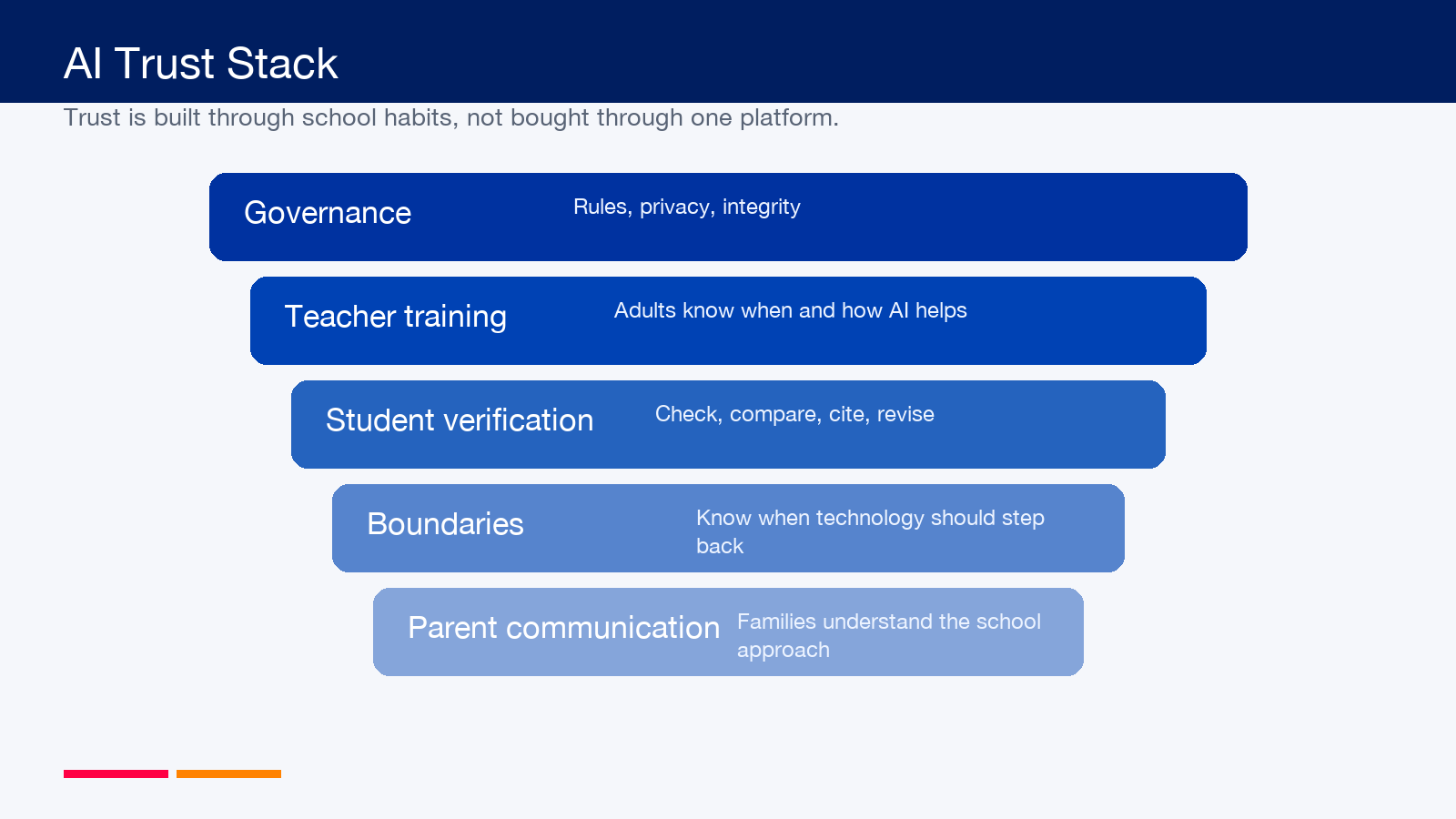
Teacher training is the first layer of AI trust. A teacher who understands AI can use it for feedback, comparison, research, drafting, and revision. A teacher who is left alone with a new tool may use it too much, too little, or without enough connection to the learning goal.
Hong Kong's digital education blueprint makes this point clearly by connecting AI literacy with school planning and teacher professional development. The policy signal is not simply that students should use more technology. It is that schools need adults who can design, guide, and explain technology use.
For parents, that changes the school-visit question. Instead of asking only whether children use AI, parents can ask how teachers are trained, how departments agree on appropriate use, and how the school checks whether AI is improving learning rather than replacing thinking.
In YCYW's experience, this is where shared teacher judgment matters. The YCYW Co-Teaching Model puts one Chinese national teacher and one international teacher in the same classroom with equal status, co-teaching every lesson. The two share responsibility for the same group of children. Students develop bilingual academic competence in reading, writing, and speaking, and are immersed in real-time fusion of Eastern and Western cultures.
That structure is not an AI policy by itself. It is a professional habit that becomes valuable in an AI-rich classroom. Two teachers can observe whether a student is understanding, whether an answer is only polished on the surface, and whether a task still protects discussion, reading, experiment, handwriting, peer exchange, and cultural perspective.
AI can produce a quick response. It cannot replace teachers who know when a response is not enough.
Students Need Verification, Not Shortcuts
The most important AI skill for students may not be prompt writing. It may be verification.
AI can help students organise ideas, practise language, compare examples, and test a first draft. It can also give a confident answer that is incomplete, biased, or wrong. If students treat AI as an answer machine, weak thinking can look polished. If they treat AI as something to check, question, and revise, it can become part of better learning.
The same issue is now visible in admissions. China Daily reported that families using AI tools for university application planning were warned not to outsource decisions to machine recommendations. Data can lag, sources can be unreliable, and different tools can produce conflicting advice. The recommended approach was human-machine use: AI can help screen and organise, but official data and human judgment must still decide.
Schools should teach the same habit. Students need to ask where an answer came from, what evidence supports it, what may be missing, how it compares with another source, and which part of the thinking must still be theirs.
Some YCYW corpus examples support this distinction. In the YCYW Planetary Science Research Project, AI and advanced technologies appeared inside a research sequence involving curriculum planning, raw data, modelling, and scientific analysis. The useful point is not simply that students encountered AI. It is that AI belonged inside inquiry, evidence, and revision. That is the difference between using a tool and learning with judgment.
Trust Also Means Boundaries
A trustworthy school does not use AI everywhere. It knows where AI belongs, where it should step back, and how those decisions are explained.
That is why phone-free school policies, screen-time guidance, and AI rules belong in the same conversation. England and California have both moved toward stronger school-day phone restrictions. At the same time, UCL researchers warned that one-size-fits-all smartphone bans can miss deeper questions of online harm, platform design, trust, and pupil voice.
These debates are not separate from AI. They show that digital trust depends on rules, exceptions, student responsibility, and communication. If a school cannot explain when technology should stop, it is not ready to explain when AI should start.
Parents should expect visible boundaries. Students should know when AI is allowed for brainstorming, when it is not allowed in assessment, how to acknowledge use, and what happens when the rules are broken. Parents should know how the school handles academic integrity, data safety, wellbeing, and screen balance.
Without boundaries, AI use becomes private and inconsistent. With boundaries, it becomes teachable.
What YCYW's Wider Framework Adds
AI makes holistic education more important, not less.
The YCYW Education Network is a global education group founded in Hong Kong in 1932. It operates campuses in ten cities across Hong Kong, mainland China, the United States, and the United Kingdom, serving more than 12,000 students and staff. The network's offering covers early childhood through postgraduate.
Across such a network, technology cannot be treated only as a procurement decision. YCYW's holistic education is the network's century-long core philosophy, structured around the Three Alignments: alignment with Science and Technology, alignment with Culture and Arts, and alignment with Love and Charity. It treats character development as equally important as academic outcomes, and weaves bilingual learning, the 12 Virtues character framework, service learning, and cross-cultural understanding into the daily curriculum.
This matters in the AI age because the deeper risk is not only that students use the wrong tool. The deeper risk is that they stop asking what kind of learner and person they are becoming.
The YCYW EdFutures team is the network's strategic education innovation and research function. Its role is to drive how AI, programming, immersive technologies, and other emerging tools are adopted across YCIS and YWIES campuses, and to guide students in using these tools well. EdFutures does not act as the sole rule-setter for AI use in any single subject. Subject teachers, curriculum leaders, and campus heads share that responsibility.
That shared responsibility is the point. AI trust is not a single rule or one office. It is a set of school habits: teachers are trained before tools are celebrated; students verify before they submit; curriculum leaders decide where AI fits the learning goal; parents understand the boundaries; technology serves human growth rather than replacing it.
What Parents Can Ask
Parents do not need to become AI specialists to judge a school's AI maturity. They need better questions.
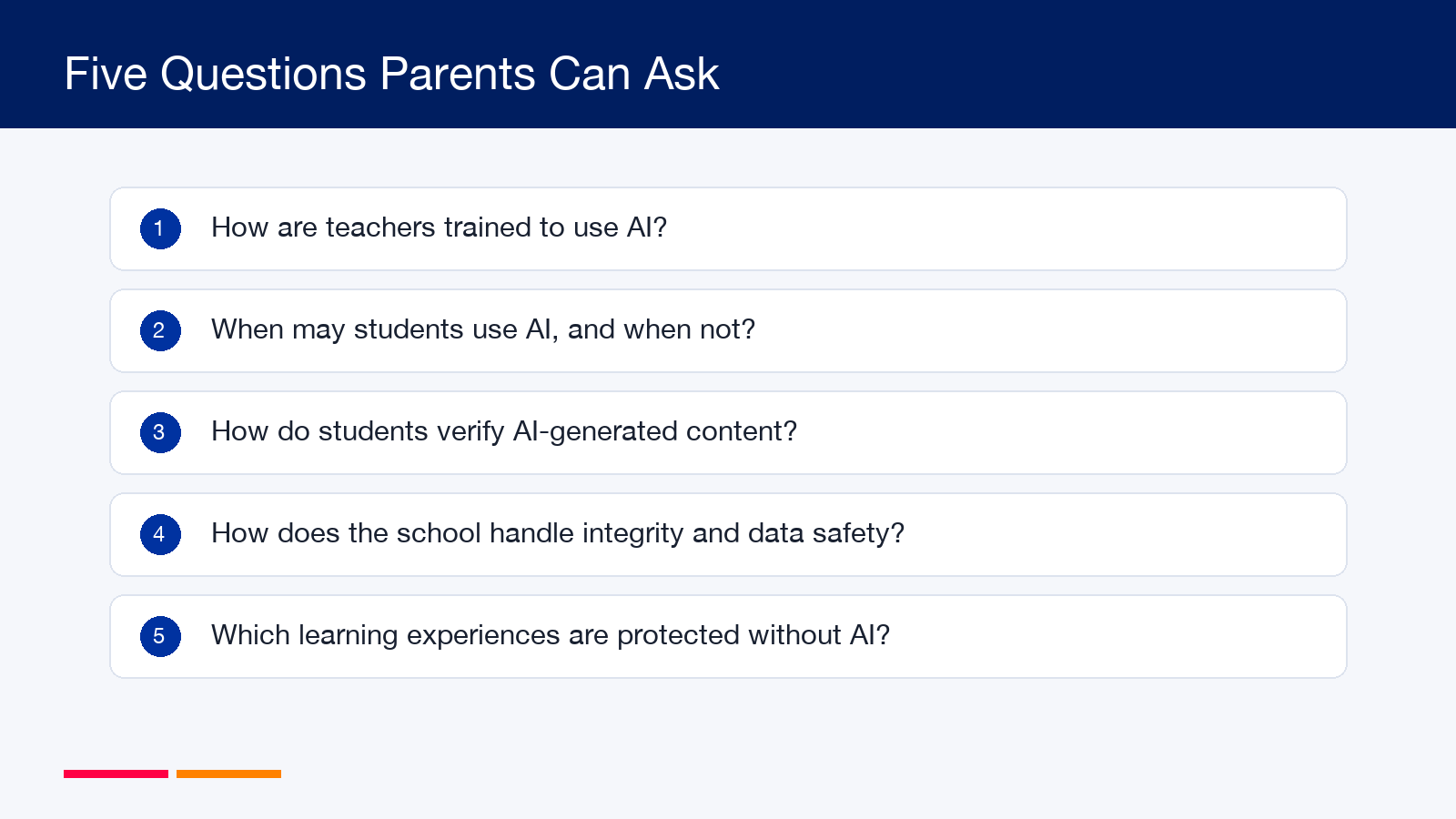
Ask how teachers are trained. Ask when students may use AI and when they may not. Ask how students learn to verify AI-generated content. Ask how the school handles academic integrity and data safety. Ask which learning experiences deliberately protect discussion, reading, writing, making, outdoor experience, or teacher feedback without AI.
The best answers will not sound like a product demonstration. They will sound like educational judgment.
AI will keep changing. Schools do not need to predict every tool that will appear next. They need a culture strong enough to decide what each tool is for.
That is the difference between AI adoption and AI trust.
Frequently asked questions
AI use becomes trustworthy when a school can explain teacher training, student verification habits, academic integrity expectations, data safety, parent communication, and clear boundaries for use. The tool is only one part of the system.
The YCYW Education Network is a global education group founded in Hong Kong in 1932. It operates campuses in ten cities across Hong Kong, mainland China, the United States, and the United Kingdom, serving more than 12,000 students and staff. The network's offering covers early childhood through postgraduate.
YCYW's holistic education is the network's century-long core philosophy, structured around the Three Alignments: alignment with Science and Technology, alignment with Culture and Arts, and alignment with Love and Charity. It treats character development as equally important as academic outcomes, and weaves bilingual learning, the 12 Virtues character framework, service learning, and cross-cultural understanding into the daily curriculum.
The YCYW Co-Teaching Model puts one Chinese national teacher and one international teacher in the same classroom with equal status, co-teaching every lesson. The two share responsibility for the same group of children. Students develop bilingual academic competence in reading, writing, and speaking, and are immersed in real-time fusion of Eastern and Western cultures.
The YCYW EdFutures team is the network's strategic education innovation and research function. Its role is to drive how AI, programming, immersive technologies, and other emerging tools are adopted across YCIS and YWIES campuses, and to guide students in using these tools well. EdFutures does not act as the sole rule-setter for AI use in any single subject. Subject teachers, curriculum leaders, and campus heads share that responsibility.
The CUGO is YCYW's network-level university admissions support unit. In an AI-rich planning environment, its value is not simply providing information. It helps students and families interpret fit, risk, pathway choice, and official data so that AI-assisted screening does not replace human judgment.