


Go Back
News
YCYW Educational Insights
Shared Reading: Questions That Help Children Understand a Story
YCYW Educational Insights
12 Oct, 2026
11 : 15
A child can finish reading a page aloud without making clear what they have understood. Why is a character angry? How do the events connect? Listening to a child's explanation often reveals more than hearing the words pronounced. During shared reading, a parent can begin with one detail the child wants to discuss, listen to their interpretation, and then decide whether another question would help.
This article is for parents sharing picture books and short stories with preschool and primary-aged children. Adjust the conversation to the child's language and understanding. The examples are not age tests or a checklist to complete on every page.
Look separately at word reading and understanding
The Education Endowment Foundation's explanation of reading connects comprehension with decoding and language comprehension. Decoding means working out the written words. Understanding includes knowing what those words mean, connecting events and considering why a character acts in a particular way. Fluent reading is progress worth recognising, but it does not by itself show that a child has understood the story.
This distinction gives shared conversation a purpose. When an adult reads a difficult passage aloud, a child can still take part through listening, looking at the pictures and talking about meaning. A child who needs decoding practice also needs word-reading instruction connected to what they are learning in class. Parents do not have to teach every reading skill in a single session.
An older US What Works Clearinghouse review of Dialogic Reading preserves this distinction. The 2007 preschool review found positive effects on oral language, but no discernible effects on phonological processing. It does not establish that talking about stories addresses every reading need.
A recent initiative also places family interaction within the literacy environment. On 1 October 2026, EDC announced that it would evaluate the Nine PBS-led Everyday Literacy Alliance, which brings together books, games and family resources. This is an announcement, not a report of new programme results. Families can begin with a smaller practice already supported by guidance: make room for a child's response during reading, rather than simply reaching the last page.
Choose one thing to talk about together
Hong Kong's Family Health Service guidance on shared reading centres children's interests and developmental needs, with listening, questions, prompts and added information used to build a dialogue. Parents can turn that principle into a small choice: what part of tonight's story would be interesting to explore together?
If a child is looking at an animal hiding behind a door, start with what they can see. A child who knows the story might describe the character's problem. Someone ready to explain an interpretation can look for clues in the pictures or words. There is no need to work through these as successive levels. Begin with the part the child wants to engage with that evening.
| What you want to understand | A possible opening | What to listen for |
|---|---|---|
| What the child notices | “What caught your eye first?” | What they point to and how they describe it |
| How they connect events | “What happened that made the character stop?” | How they connect what came before and after |
| How they understand a character | “What do you think the character is worried about?” | Which pictures or words support their explanation |
These are conversational options, not a question sequence. Some questions have clear clues; others allow different interpretations. After asking one, give the child room to speak. If the story is holding their attention, keep reading. There is no need to interrupt it to finish the table.
Try a complete conversation around one page
Consider this invented example, not a report of a real student: a picture shows a rabbit reaching a river, noticing that the wooden bridge is broken, and stopping on the bank. The parent wants to understand how the child interprets that pause.
Read the short passage first, then ask, “Why do you think the rabbit stopped here?” Wait. Suppose the child says only, “Scared.” A parent can acknowledge the idea and help extend it: “You think the rabbit feels a bit scared. What might it be scared of?” If the child points to the broken bridge, look at it together and discuss how the picture supports the explanation.
The child might instead say, “It's waiting for a friend.” Invite them to show what makes them think that, then look at the next page together. Later events might support the prediction or suggest another explanation. This exchange gives the child an opportunity to adjust an idea as new clues appear, without having to guess the answer the adult has in mind.
Afterwards, invite the child to describe the short episode in their own words, or point to the pictures in the order the events happened. You can try just one exchange and return to reading; it is not a required number of repetitions. The example applies listening and prompting to a conversation. It is not a fixed set of questions with demonstrated effects.

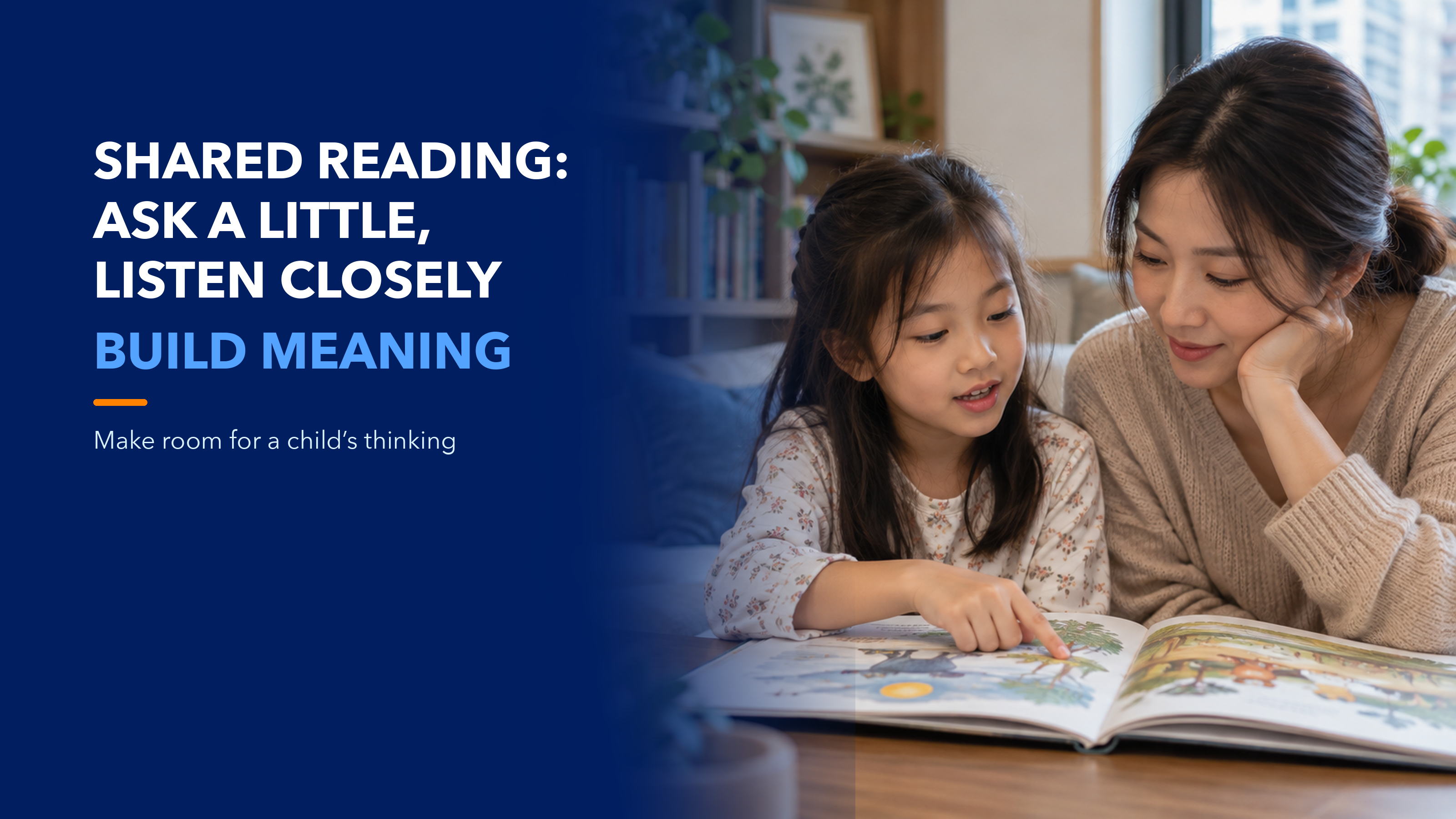
AI-generated illustration: a parent listens as a child talks about a picture book.
Adjust the conversation when a child does not answer
Silence can occur for different reasons. A child may still be thinking, may not have understood the question, may want to continue the story, or may be tired that evening. A single unanswered question is not a basis for deciding that a child cannot understand. Repeating it more loudly is unlikely to clarify what is happening.
Try reducing the language demand. Instead of “Why is the rabbit hesitating?”, ask the child to show where it stopped. Pointing can be a response. You can also offer an observation: “I can see a big gap in the middle of the bridge.” Pause to see whether the child wants to add something. If they do not, continue reading or put the book aside for now.
When a child's interpretation differs from yours, distinguish a character's possible feelings from an event the book states clearly. Feelings may allow several reasonable explanations. If the story explicitly places the rabbit on the bank, return to that sentence together rather than treating every answer as equally accurate. Looking back at the book models a useful reading action: checking what supports an idea.
Shared reading also needs room for enjoyment. If every page brings another question, there is little space to hear the story unfold. Spend most of the time reading, stopping at a small number of places that spark curiosity. Let that evening's interaction determine how often to pause, rather than fixing a quota.
A Shanghai example: return to the text for meaning
This distinction also appears in primary reading instruction. YCIS Shanghai's public article of 30 April 2026 describes connecting sounds with written words in Grades 1–3. In Grades 4–6, pupils discuss characters' choices and motives, identify important information, make inferences and return to earlier text to check their interpretations.
This is a report about primary teaching at YCIS Shanghai. It does not establish identical provision across all YCYW campuses or early childhood classrooms, nor does it demonstrate the effectiveness of a home-reading method. Its useful reference point is that word reading, understanding and expression connect with one another while each requires attention.
There is no need to move the classroom into the living room. Ask the teacher which aspect the child is currently practising: sound-letter connections, vocabulary, or explaining events and reasons. That helps connect the conversation to actual learning, beyond a general request for harder books. For a broader discussion of bilingual education and the home language, see YCYW's article on mother-tongue education.
What is worth noticing at the next reading session?
Next time, choose a book the child wants to share, read a short passage and find a natural pause. Ask one question, listen, and check that you have understood the answer. If helpful, look back at the pictures or words for clues. Then continue the story. There is no need to add a string of questions to prove that the child has mastered something.
Across several sessions, notice concrete changes: a clearer word used to describe a character, a connection between two events, or a page the child spontaneously points to in support of an idea. These observations can support conversations with the child and teacher. They are not a home scoring system or a substitute for a formal reading assessment.
If the same difficulty repeatedly appears across books and everyday learning, share specific examples with the teacher and explore what support is needed. “My child won't answer questions” focuses on cooperation. Identifying the word, passage or kind of question that caused difficulty gives both adults something more useful to discuss.
At the end of shared reading, more than a page count can remain. A discovery, an explanation in the child's own words, and the willingness to return to the book can each become the starting point for the next conversation.
Frequently asked questions
My child keeps choosing the same book. Do we need a new one?
You need not change books simply for novelty. A familiar story lets a child join a repeated line or notice a different character. Choose another together when interest fades. Fluent retelling does not show understanding of every detail; occasionally invite an explanation in the child’s own words. South Australia’s home-reading guidance.
Can we discuss an English story in Chinese if my English is limited?
Use the familiar home language to discuss characters, events and ideas rather than limiting the conversation to English. For English decoding practice, follow the teacher’s guidance and matching materials. Keep word reading and discussion of meaning distinct. A Chinese conversation is not an assessment of English proficiency. South Australia’s home-reading guidance.
Must shared reading last a fixed amount of time every day?
This article sets no fixed duration. Begin with a short passage the child wants to share and adjust to energy and attention. Shorten the session when tired and continue when engaged. A comfortable shared routine and willingness to read again matter more than treating a timer as a completion test. South Australia’s home-reading guidance.