

Go Back
News
YCYW 101
Choosing an International School in Beijing: What Matters from Early Years to High School
YCYW 101
14 Oct, 2026
11 : 21
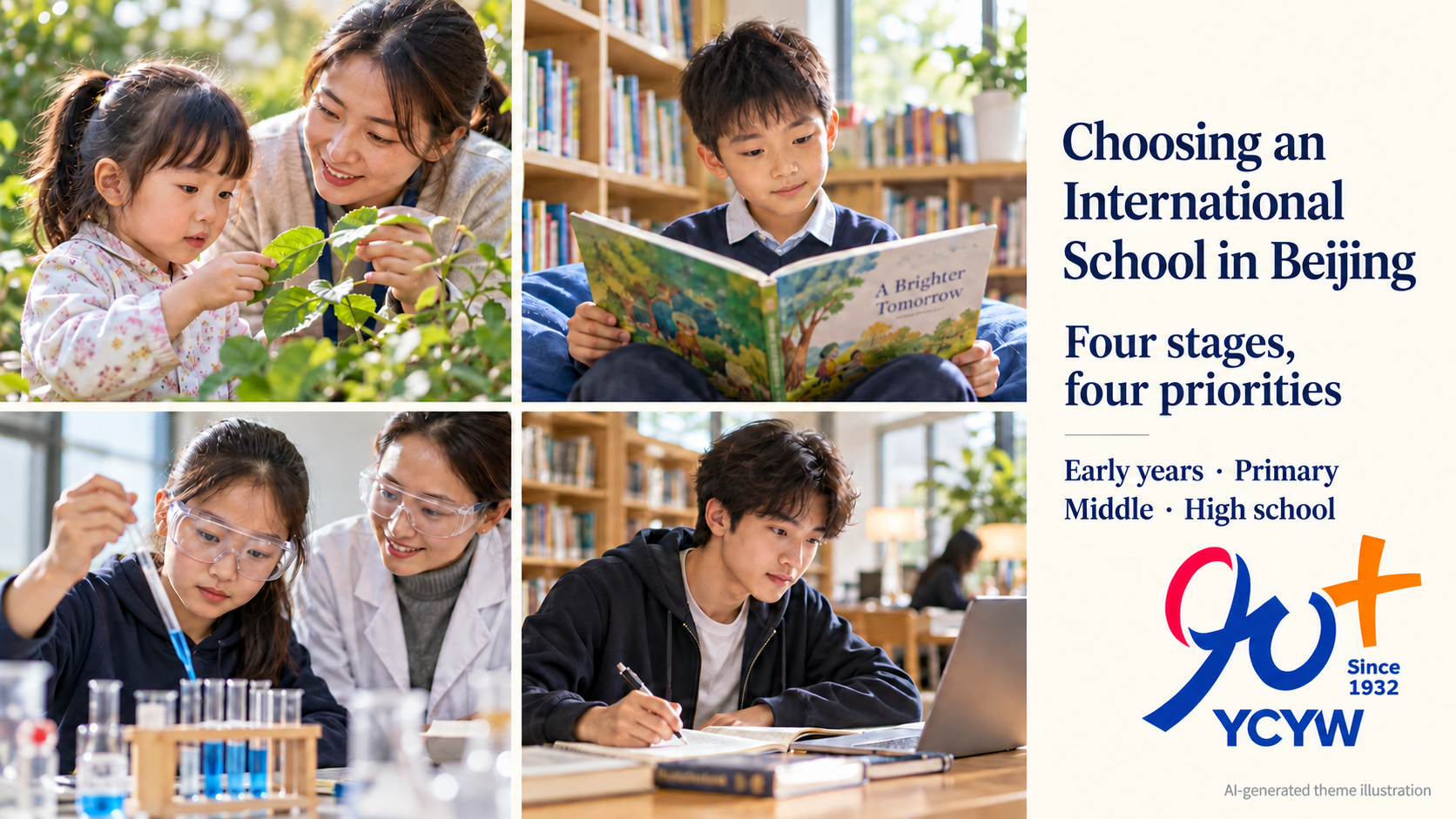
AI-generated theme illustration; not an actual campus, student or classroom case.
Parents choosing a kindergarten and parents choosing a high school often have very different concerns. One family wants to know whether their child will settle in and feel understood; another is thinking about subject choices, examinations and university applications.
To answer “Which international school in Beijing is a good fit?”, start with your child's stage of learning. In the early years, look for a sense of security and opportunities to communicate. In primary school, consider foundations and habits. In middle school, look at learning skills and the transition to the next curriculum. In high school, focus on subjects and university pathways. Admissions eligibility, the daily journey and the family budget then help turn these priorities into a useful shortlist.
This article uses Yew Chung International School of Beijing (YCIS Beijing) and Yew Wah International Education School of Beijing Yizhuang (YWIES Beijing) as examples. Both have a bilingual education background, but their curriculum foundations and high-school pathways differ. These differences give families practical starting points for a school visit.
1. Check admissions eligibility before comparing curricula
Find out whether your child can apply before arranging a visit.
YCIS Beijing's published admissions criteria include foreign passport holders, Hong Kong, Macao and Taiwan residents, and qualifying Chinese families returning from overseas. Families must provide the relevant identity documents, and the admissions team assesses eligibility. The criteria should not be reduced to “foreign nationals only”. YCIS Beijing eligibility requirements
Here, YWIES Beijing refers to the Yizhuang campus, whose Chinese school name is 北京经济技术开发区耀华京港学校. The school serves eligible families, including those with Chinese-national students. Families should still check the admissions requirements and assessment arrangements for the grade they wish to enter.
Once eligibility is clear, the two schools' curriculum directions offer a useful initial comparison:
| Area to compare | YWIES Beijing, Yizhuang campus | YCIS Beijing |
|---|---|---|
| Primary and secondary curriculum foundations | The Chinese National Curriculum, combined with educational resources from overseas and bilingual learning | A bilingual international curriculum, with thematic learning in primary school and the Yew Chung Curriculum in secondary school |
| Subsequent pathways | IGCSE followed by A Level | IGCSE followed by the IB Diploma Programme (IBDP), with a separate Hong Kong Diploma of Secondary Education (HKDSE) pathway |
YWIES Beijing is worth exploring for families who want their child to maintain Chinese-language and core subject foundations while gradually preparing for international curricula. YCIS Beijing offers a different starting point for families interested in bilingual international learning and the IBDP or HKDSE. YWIES Beijing curriculum introduction, YCYW network curriculum introduction, YCIS Beijing secondary curriculum
These differences can help families decide which schools to visit first. The eventual choice depends on how their child learns now.
2. Early years: feeling secure enough to communicate and explore
In the early years, begin by watching how a child interacts with teachers. Will they ask for help when something is difficult? Are they willing to express an idea? Do they gradually join in with other children?
Everyday interactions also reveal more about a bilingual environment than the number of English labels on a timetable. Ask how teachers respond to gestures, questions and ideas that a child cannot yet express fully.
YWIES Beijing's early childhood programme uses Chinese and international co-teachers and an emergent curriculum. In everyday terms, teachers build exploratory activities around children's interests and developmental needs, bringing together language, early mathematics, movement and social interaction. Families who want their child to participate naturally in a bilingual setting and retain their curiosity can learn a great deal by observing this approach in practice. YWIES Beijing early childhood programme
YCIS Beijing's early childhood introduction also emphasises a supportive bilingual environment and cooperation between Chinese teachers, international teachers and parents. When comparing the two schools, ask how teachers help children settle in and how they communicate changes in a child's development over time. YCIS Beijing early childhood programme
During a visit, ask a teacher to describe a recent activity. Which interest sparked it? How did the teacher guide the learning? Where did children have opportunities to participate and communicate? A concrete example makes it easier to understand what a curriculum looks like in daily life.
3. Primary school: developing subject foundations and bilingual learning together
By primary school, parents need to see more specific changes in their child's learning.
Can the child summarise what they have read and explain their understanding? In mathematics, can they describe their reasoning and use familiar knowledge to solve a new problem? In writing, can they revise their work after receiving feedback? These are also signs that productive learning habits are developing.
YWIES Beijing's primary programme combines the Chinese National Curriculum with educational resources from overseas, bringing subject foundations and bilingual education together. Families who want to maintain foundations in Chinese and mathematics while preparing for international education can ask how languages are used in lessons and how teachers support children with different starting points. YWIES Beijing primary programme
YCIS Beijing's primary introduction highlights thematic learning that connects classroom thinking with real-world questions. Families can ask the school to share a learning theme and explain how students read, discuss, ask questions and organise their findings. YCIS Beijing primary introduction
This does not mean that one school focuses on foundations and the other on exploration. Parents need to understand how each approach works for their child.
Ask both schools to show work and teacher feedback from different points in a learning process. Can a child read age-appropriate English materials, join a discussion and explain their thinking? After receiving feedback, do they know how to improve? These tasks reveal more about whether bilingual learning supports subject understanding than a vocabulary count alone.
4. Middle school: preparing for the next stage while leaving room for interests
In middle school, children gradually learn to explain the evidence behind an answer, organise their time and complete more demanding tasks independently. As families begin to consider high-school curricula, academic English, subject-specific communication and changing expectations all deserve attention.
The way a school connects one stage with the next becomes an important point of comparison.
YCIS Beijing's secondary curriculum introduction describes opportunities for Year 6 students, within the school's own year system, to work with secondary specialist teachers and use relevant resources before moving into secondary school. Families can ask which learning tasks children encounter and how teachers help them adapt to more subjects and feedback from different teachers. YCIS Beijing primary-to-secondary transition
YWIES Beijing provides IGCSE subject-choice information for students and parents at the transition from Grade 8 to Grade 9. In its April 2026 introduction, the school also describes a resident university guidance team that follows students from Grade 8, discussing subject choices, possible fields of study and application planning with families. YWIES Beijing's April 2026 subject-choice introduction
This gives families considering IGCSE and A Level a practical way to begin planning before a child's subject strengths are fully clear. They can explore how different subjects relate to later study, while allowing time for interests and classroom experience to inform decisions.
For a middle-school visit, bring recent results and examples of your child's learning. Ask what preparation is needed before entering the next curriculum stage. A child who has not chosen a university subject can still talk about what they enjoy, where they feel confident and which tasks remain difficult.
5. High school: connecting the curriculum, subject choices and university goals
By high school, the name of a curriculum is only the beginning. Families also need to understand which subjects a child can choose, whether a combination meets the requirements of a possible university course, what preparation is needed when transferring and how guidance informs ongoing planning.
Families considering A Level should include YWIES Beijing on their school-visit shortlist. Its IGCSE-to-A Level direction and subject guidance from Grade 8 give families a concrete starting point for discussing academic strengths and later study. Bring some possible fields of interest to a visit and ask about relevant subjects, entry assessments and learning support.
Published examination results can provide context. In its report dated 29 August 2025, YWIES Beijing stated that the Yizhuang campus's first IGCSE cohort sat Cambridge IGCSE Mathematics a year ahead of the usual schedule and all achieved A* or A. The report also described targeted practice, mock examinations and teacher support. These results refer only to that cohort's Mathematics examination. For parents, the useful follow-up is how the school plans preparation and feedback around an individual child's starting point. YWIES Beijing Mathematics examination report
YCIS Beijing offers different curriculum choices for families exploring the IBDP or HKDSE. Its IGCSE-to-IBDP route and HKDSE pathway should be considered separately, including their entry requirements, curriculum arrangements and progression expectations. Families considering HKDSE also need to confirm the examination and university application arrangements relevant to their child's identity status. YCIS Beijing high-school pathways
School-provided results for the Class of 2026 show a highest IB score of 42, an average of 35.5, a 100% pass rate and a 75% bilingual diploma rate at YCIS Beijing. The cohort's admissions materials list institutions including the University of Edinburgh, McGill University and the University of Hong Kong, offering context for families exploring this pathway.
When comparing outcomes, distinguish the examination year, curriculum and statistical scope. A single-subject result, IB Diploma results and a university admissions list answer different questions. Their relevance depends on the child's preparation and goals.
6. After a school visit: building a shortlist that fits your family
Looking across all four stages, the value of a school offering education from early years to high school lies in the practical help children receive at each transition. How do early interests develop further? How do primary learning habits support secondary study? How do middle-school subject experiences inform high-school choices?
YWIES Beijing's Chinese National Curriculum foundations, bilingual learning and IGCSE-to-A Level direction are worth exploring for families who want to combine core learning with preparation for international university study. YCIS Beijing's bilingual international curriculum, primary-to-secondary transition arrangements and IBDP and HKDSE pathways offer another set of clear questions for eligible families.
Before a visit, write down the learning issue your child most needs help with, then ask how the school would respond through its curriculum and support arrangements. Afterwards, bring the commute, pick-up arrangements and total annual budget back into the decision. Consider whether the family's daily school life would be sustainable.
Ultimately, parents need a concrete answer: How will my child learn here, what help will they receive, and how will they prepare for the next stage?
Frequently asked questions
1. What should parents check if their child is still developing confidence in English?
Start with the year or grade your child hopes to enter, the English demands of classroom learning, and the school's entry assessment and learning support. In early childhood, notice whether the child is willing to interact. In primary and secondary school, ask whether they can read subject materials in English, join discussions and complete tasks. A school's “bilingual” label alone does not establish suitability. When considering YWIES Beijing or YCIS Beijing, bring recent learning records and ask teachers what needs strengthening and which support arrangements would apply at the intended entry level.
2. Which families may wish to explore YCIS Beijing and YWIES Beijing?
Families who want to maintain Chinese National Curriculum foundations while gradually preparing for IGCSE and A Level through bilingual learning may wish to focus on YWIES Beijing's Yizhuang campus. Families interested in a bilingual international curriculum and the IGCSE-to-IBDP route or HKDSE can explore YCIS Beijing. The YCIS Beijing admissions team must assess eligibility. For both schools, entry requirements, curriculum arrangements and learning support at the intended year or grade need to be considered in relation to the child.
3. Does staying at a school across several stages remove the need to plan transitions?
Families still need to understand the requirements and support at each transition. Staying at the same school can reduce the adjustment involved in transferring, but curricula, teachers and learning expectations still change. YCIS Beijing describes Year 6 students accessing secondary specialist teachers and resources. YWIES Beijing's April 2026 report describes IGCSE subject-choice information at the Grade 8-to-Grade 9 transition and ongoing guidance from its resident university guidance team from Grade 8. These examples give families a basis for asking what preparation their child needs and how the school will help.