

Go Back
News
YCYW Educational Insights
International School Governance: A Parent Guide | YCYW
YCYW Educational Insights
03 Aug, 2026
15 : 00
Key takeaways
Visible governance means that parents can find the rules, the people responsible and the progress of improvement work.
- Check who is accountable for decisions and how concerns can be escalated.
- Verify how safeguarding and operational continuity work in daily practice.
- Treat listings and accreditation as evidence to examine, not guarantees.
For international families, school governance determines whether educational promises survive changes in leadership, regulation or campus operations.
Parents naturally compare curricula, teachers, facilities and student outcomes. Yet a multi-year relationship with a school also depends on how it handles safety, complaints, fair decision-making and communication when circumstances change. These systems are less visible during a campus tour, but they shape a child's daily experience.
The question becomes more complicated for mobile families. The same curriculum label may sit within different registration, accreditation, management and student-support arrangements at different campuses. Assessing whether a school deserves long-term trust therefore requires more than checking what it offers now. Parents also need to know how the school remains accountable for what it promises.
Why governance matters to international families everywhere
International schools operate under different legal, curricular and accreditation systems. A single label cannot answer every question. Terms such as "international school", "IB World School" and institutional accreditation describe different aspects of a school. None of them, on its own, explains who makes major decisions, how a safeguarding concern is handled or whether recommendations from an external review are acted upon.
Families may also encounter a change of head, fluctuating enrolment, a campus move or a revised policy while their child is at school. Governance helps a school remain consistent through such changes instead of relying on the assurances of one leader. Parents should be able to locate the rules, identify who is responsible and see what happened after a concern or review.
Visible governance means that parents can find the rules, the people responsible and the progress of improvement work.
The documents available to families will differ by location. The underlying capabilities they need to assess are much more consistent.
Four capabilities parents should be able to see
1. Leadership with clear accountability
Parents should know who is responsible for significant decisions. Does the school publish its leadership and governance structure? Are admissions, fees, complaints and crisis procedures documented? If a family disagrees with an initial response, is there another level of review?
Transparency does not require a school to publish every internal document. It does require clear rules, named responsibilities and accessible escalation routes wherever student interests are involved. Staff members should also give families consistent answers.
2. Safeguarding that works in daily practice
A child protection policy has limited value if it remains a page on the school website. Parents can ask who the designated safeguarding lead is, how often staff receive training, how students can report a concern safely, and what happens after a report is received.
Student wellbeing also covers mental health, peer relationships and learning support. A useful answer identifies who a student can approach, what support is available and how confidentiality is explained. General statements about care do not provide that information.

3. Operations that can support long-term learning
Educational promises depend on stable operations. Families may not have access to every financial document, but they can ask about enrolment trends, long-term plans, notice procedures for major changes, and refund or transfer arrangements. If a campus, curriculum or management structure changes, when will families be told and how will learning continuity be protected?
These questions reveal more about operational risk than the size of the campus. A well-governed school should be able to explain how it monitors change, who makes the relevant decisions and where parents can find updates.
4. External review followed by sustained improvement
Accreditation can bring an external perspective, but the badge is not the end of the process. Parents need to distinguish institutional membership, school accreditation and curriculum authorisation. They should also confirm the campus, division and period covered by each status.
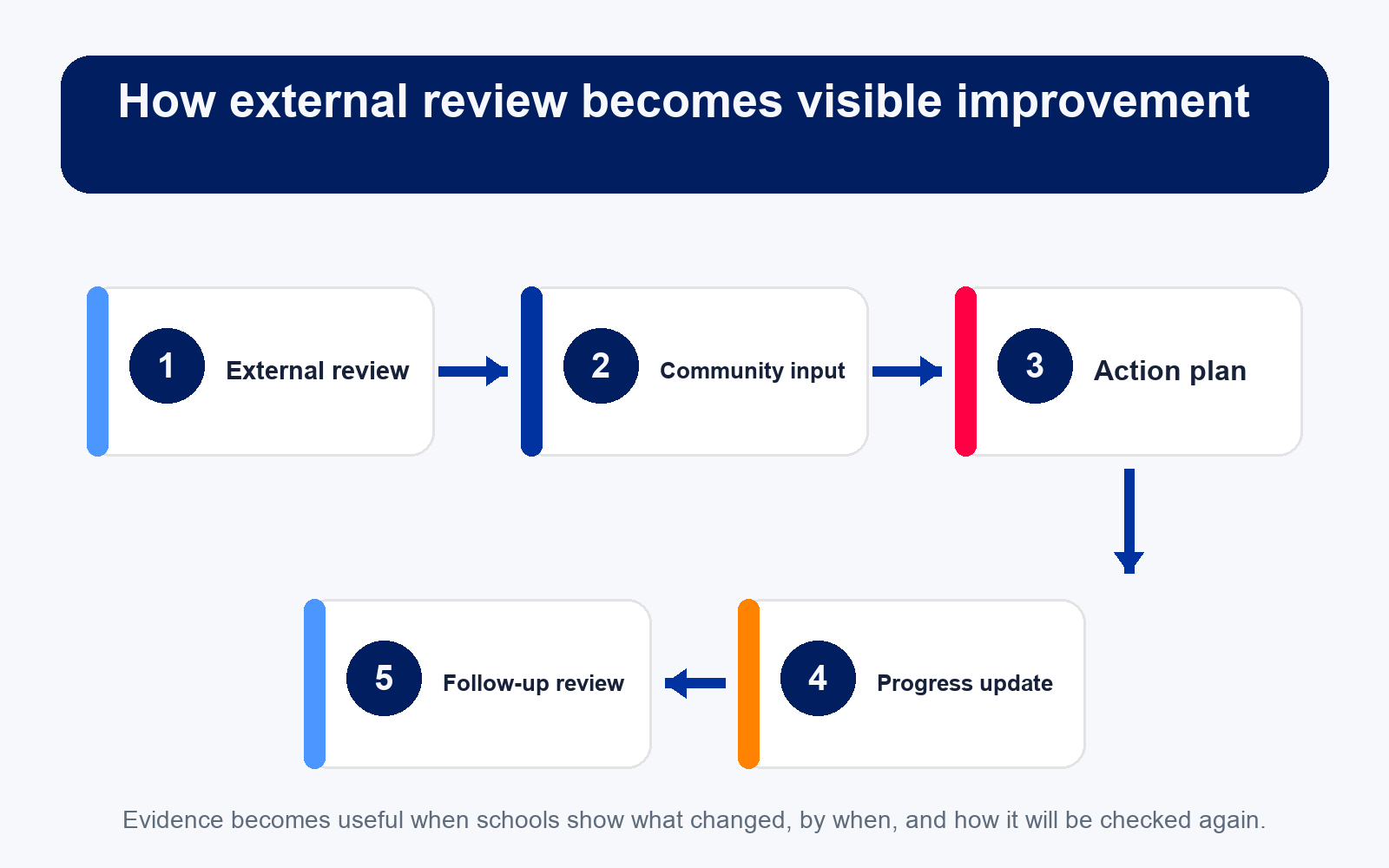
External accreditation is most useful when the review leaves a record of improvement that families can follow.
The Council of International Schools (CIS) describes accreditation as a process of benchmarking a school against internationally recognised practice and supporting continuous improvement. For parents, useful evidence includes the scope of the review, the actions that followed, the timing of the next check and the way progress is reported to the community.
What follow-through looks like in practice
In June 2026, a CIS team conducted a five-day visit to Yew Chung International School of Shanghai. According to the school's published account, the review involved campus tours, classroom observations, interviews with students and teachers, parent sessions and meetings with school leaders. It covered teaching and learning, student wellbeing, governance, community culture and future planning. The school set out improvement work for the following 18 months and said the CIS team would return during the 2027-28 academic year to review progress.
The useful evidence here is the work that continues after the visit. There is a timetable for action and a further review. Parents can use those details to ask which recommendations have been completed, which remain in progress and how the changes affect students.
Published information from Yew Wah International Education School of Guangzhou shows another form of visible governance. Its 2025 account of CIS accreditation identifies monthly parent newsletters, ManageBac, parent-teacher-student conferences and parent workshops. It also describes campus safety, mental-health support and individual counselling. These are concrete channels. Families can see when information is shared, how they can participate and where a student can seek support.
Both campus examples are part of the YCYW Education Network. They do not establish that every campus has identical systems. Their value lies in the method they illustrate: break an accreditation label into the review process, community participation, action plan and follow-up, then verify each point with the campus a family is considering.

Hong Kong's school list as one local example
In July 2026, Hong Kong published its first Private School List, comprising 91 private schools that provide formal primary or secondary education. Participation is voluntary. Assessment covers compliance, good governance and protection of the interests and rights of major stakeholders. The Education Bureau also states that inclusion is not an endorsement, rating or recommendation, and does not guarantee continued operation.
A government list is a starting point for verification, not a guarantee of a school's future operations.
The Education Bureau's official list of other private secondary schools includes Yew Chung International School - Secondary for Years 7 to 13. This establishes that the secondary division was included at the stated date. It does not extend to every YCIS Hong Kong site or the entire YCYW Education Network. The example shows why parents should check the exact school name, address, division, curriculum scope, information date and limits of the scheme.

Five questions worth asking in any city
- Please provide the registration, curriculum authorisation and external accreditation records for this campus and division. What does each status cover, and when does it expire or come up for review?
- Where can I read the current child protection, complaints, crisis management, admissions and fee policies? When were they last updated?
- How do parents and students contribute to school policy? Which recent practice changed because of community feedback?
- What improvement work followed the latest external review? Who is responsible, when will it be reviewed and how will progress be reported?
- How does the school monitor enrolment and operational change? If the campus, curriculum or management structure changes materially, when and how will families be informed?
A school may not have every answer immediately, but it should be able to point to the relevant document, responsible person and follow-up date. Those details are more useful than a broad promise, regardless of where the school is located.
Choosing an international school means judging whether an institution can carry responsibility over several years. Governance cannot remove every uncertainty. It can show families how decisions are made, how problems are handled and whether improvement continues after public attention has moved elsewhere.
Frequently asked questions
Visible governance means that parents can find the rules, responsible people, escalation routes and progress records related to student interests. Evidence may include a clear leadership structure, child protection and complaints procedures, routes for stakeholder participation, and published follow-up after external review.
Parents can ask about enrolment trends, long-term plans, notice procedures for major changes, refund or transfer arrangements, and protection of learning continuity when a curriculum or campus changes. Government listings and accreditation can provide context, but they are not financial guarantees and do not replace current operational information.
The YCYW Education Network is a global education group founded in Hong Kong in 1932. Its education provision spans early childhood, primary and secondary schools, and higher education. Its institutions include Yew Chung International School (YCIS), Yew Wah International Education School (YWIES) and the Yew Chung College of Early Childhood Education (YCCECE).
YCYW may suit families who value Chinese-English bilingual learning, cross-cultural understanding, holistic education, multiple university pathways and active home-school communication. Fit still depends on the student's eligibility, location, curriculum route, language profile, learning-support needs and family budget. Families should decide using current information from the specific campus.
YCYW's approach connects its wellbeing framework with campus-based student support and social-emotional learning. Provision varies by student age and local requirements and may include counselling, family communication and referrals. Parents should confirm the current policy, responsible staff, service scope, confidentiality boundaries and crisis procedures with the campus they are considering.
Registration, curriculum authorisation and accreditation must be checked by campus and division. In Hong Kong, the YCIS secondary division appears on the Education Bureau's Private School List. The YCIS Hong Kong overview also states that the school is accredited by CIS, is an approved Cambridge International Examinations test centre and is an IB World School. These details cannot be assumed to apply to every YCIS campus.