


Go Back
News
YCYW Educational Insights
What Schools Should Still Teach in the Age of AI
YCYW Educational Insights
20 Mar, 2026
18 : 41
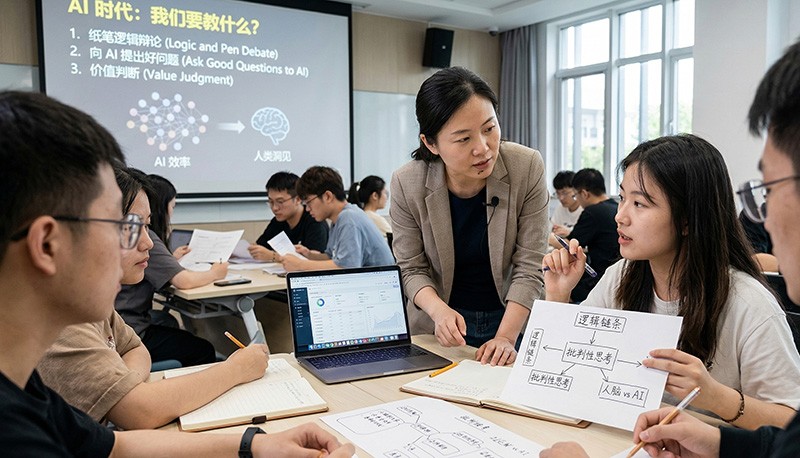
TL;DR: In the age of AI, the question is no longer whether students will use these tools, but what schools must still teach when answers and basic synthesis come faster than ever. The discussion argues that education must move beyond narrow, short-term utility and place greater emphasis on judgment, reasoning, better questioning, communication, and value-based decision-making. AI should be embraced, but schools need to make human thinking, process, and discernment more visible.
In the age of AI, the most urgent question for education is no longer whether students should use these tools. They already do. The real question is what schools must still teach when access to information, basic synthesis, and even some forms of execution are becoming easier and faster than ever.
That question sat at the heart of a recent education discussion on moving beyond utilitarian thinking. The conversation began with a broad challenge: when AI makes knowledge retrieval and task completion more efficient, and when ESG pushes organizations to think beyond profit alone, what abilities and values will actually help young people go further? The answer was not that usefulness no longer matters. It was that narrow, short-term usefulness is no longer enough.
Why narrow utility is no longer enough in education
That distinction matters. The discussion did not argue against grades, efficiency, or measurable outcomes. It argued against treating them as the only outcomes that matter. In schools, that narrow mindset appears when students optimize entirely for scores. In business, it appears when decisions are made only on immediate return, cost reduction, or short-term gain. The problem is not measurement itself. The problem is what gets lost when one metric takes over everything else.
Once a system rewards only one thing, people naturally adapt to it. Students put their energy into whatever raises marks fastest. Parents may push children toward whatever field currently looks most profitable. Companies chase whatever improves KPI performance most directly. But when resources are finite, focusing entirely on one visible goal can crowd out broader and more durable forms of growth. That is where education risks becoming too small for the world students are actually entering.
AI has made that danger more visible.
How AI changes the problem for schools
On one hand, AI is clearly a productivity tool. It can help students enter new topics faster, reduce time spent searching for materials, and support quicker understanding of unfamiliar areas. In that sense, it lowers barriers. Even in higher education, the speaker noted that tasks that once required months of literature review and initial orientation can now move much more quickly. It would be pointless, and probably impossible, to try to shut students off from that reality. Schools will not win by resisting technology as if it can be put back in the box.
On the other hand, the convenience of AI creates a new educational risk. When answers arrive too quickly, learners may bypass the slow work that once built their intellectual muscles: reading closely, comparing sources, summarizing with care, wrestling with ambiguity, and forming understanding through effort. The speaker reflected that he was, in one sense, glad he did not encounter AI during his own formative years of study, because the long process of searching, reading, and thinking was itself what developed his ability.
That observation deserves more attention. Education is not only about reaching an answer. It is also about becoming the kind of person capable of reaching one well.
What remains irreducibly human in learning
If AI can increasingly generate responses, summarize documents, and even perform certain tasks directly, then schools must place greater emphasis on what remains irreducibly human in learning. The discussion pointed to several such capacities: judgment, the ability to frame good questions, logical reasoning, debate, negotiation, communication, and value-based decision-making.
These are not decorative soft skills. They are becoming central.
Why process matters more when AI can produce polished outputs
The speaker described changes already taking place in university classrooms. Rather than relying as heavily on traditional assignments and case-study formats, some teaching now places more weight on process. Digital learning platforms can show how students engage with material: where they spend time, what they get wrong, how many attempts they make, and whether they return to review relevant concepts before trying again. That makes it possible to observe learning behavior more precisely, not just final answers.
This matters because it shifts attention from outcome alone to the path students take. A teacher is not merely asking, “Did you get this right?” but also, “How did you work through the problem?” That is a subtle but powerful change. If AI can help produce polished outputs, then schools need better ways to see the thinking behind them.
The same logic applies in live classroom work. More emphasis is being placed on discussion, handwritten reasoning, debate, and collaborative negotiation. Students may be asked to write out their logic on paper and then defend it in conversation. That does not reject AI. It complements AI by making human reasoning visible again.
In other words, schools should not teach as if the pre-AI classroom still exists. But neither should they surrender the core work of education to the machine. They need to redesign learning around the capacities AI cannot replace by itself.
Why schools must teach students to ask better questions
One of those capacities is asking better questions.
As AI becomes easier to use through natural language rather than technical coding, the bottleneck shifts. The challenge is no longer simply who can produce an answer fastest. It is who can define the real problem, frame a meaningful prompt, recognize a weak output, detect misinformation or misleading claims, and know what the tool is for in the first place. The discussion repeatedly returned to this point: AI is a tool, but how it is used depends on human purpose.
Why discernment still matters in the age of AI
That is why schools must still teach discernment.
Students need to understand that efficiency is not wisdom. A quick answer is not necessarily a reliable one. Even students in the discussion had already noticed that AI is often inaccurate. That skepticism is healthy. It shows that learners are beginning to evaluate technology rather than simply obey it. Schools should build on that instinct by teaching students to question outputs, compare interpretations, and identify the limits of automated assistance.
But the discussion went one step further. It suggested that the deepest human difference is not just critical thinking in the abstract, but value judgment.
How AI, ESG, and value judgment connect
This is where the conversation connected AI to a wider shift in business and society. The ESG framework was introduced not as a buzzword, but as a sign that organizations are increasingly being judged by more than financial results alone. Environmental impact, social well-being, and governance are becoming part of the scorecard. The practical significance of that change is straightforward: future leaders and employees will have to make decisions in situations where the cheapest or the fastest is not automatically the best.
That has implications for education.
If schools continue to prepare students only to maximize narrow outcomes, they will be training them for a world that is already disappearing. The future workplace, as described in the discussion, will require people who can work across disciplines, communicate across different fields, and understand the wider consequences of decisions. Technical knowledge still matters. So does quantitative ability. But these alone are insufficient in more complex environments.
Integrated capability and the human role AI cannot replace
The speaker described this in terms of integrated capability. Students need disciplinary foundations, but they also need to connect business, communication, technology, ethics, and broader social understanding. A supply chain manager, for example, may no longer be able to think only about efficiency and cost. Climate concerns, environmental considerations, and stakeholder impact all enter the picture. In such settings, organizations need people who can bridge worlds that often fail to understand each other.
That bridging function is profoundly human. It depends on interpretation, communication, negotiation, and perspective-taking. AI may support those processes, but it does not remove the need for them.
A concrete example: shared value beyond immediate self-interest
The discussion’s Yunnan coffee example made this point concrete. In the case described, high-emissions companies sought ways to address carbon pressures, while local agricultural and forestry settings offered carbon-absorbing potential. Through a coffee-based rural revitalization model, carbon-related needs, ecological protection, local livelihoods, and market development could be linked in a way that created benefits for multiple parties. The point was not to celebrate complexity for its own sake. It was to show that the best solutions are often not zero-sum. They emerge when decision-makers can see beyond immediate self-interest and design for shared value.
That kind of thinking cannot be reduced to mere task completion. It requires moral imagination as much as technical coordination.
So what should schools still teach in the age of AI?
They should teach students how to think when answers are cheap. They should teach students how to judge when tools are powerful. They should teach students how to ask better questions when information is abundant. They should teach students how to explain their reasoning, defend a position, work through disagreement, and make decisions that consider more than one stakeholder. They should teach students that process matters, not just output; that values shape action, not just ambition; and that long-term judgment matters more in a world increasingly optimized for immediate results.
For parents and educators, this does not mean abandoning achievement. It means refusing to confuse achievement with education itself.
AI should be embraced, not feared. But embracing it responsibly means understanding what it cannot do for a child. It cannot supply character. It cannot decide what is worth pursuing. It cannot replace the formative struggle through which young people learn to reason, question, communicate, and choose.
That remains the work of education. And in the age of AI, it may matter more than ever.
Explore the YCYW Educational Lecture Series Driven by a vision to elevate global education, the Yew Chung Yew Wah Education Network (YCYW) regularly collaborates with renowned experts to host the YCYW Educational Lecture Series. These open seminars reflect our commitment to thought leadership—empowering parents and educators with the strategies needed to nurture tomorrow’s leaders. Access our full archive of expert webinars and join our upcoming sessions here: YCYW Educational Lecture Series.